Ceuta Migrant Chaos: EU Leaders Scramble as Spain Faces Unprecedented Border Crisis and Mounting Deaths
An unprecedented surge of over 60,000 migrants into Spain's Ceuta enclave sparked a major EU crisis, leading Italy to call for Spain's suspension from the Schengen area. While some European nations supported stricter border measures, Spain blasted the lack of solidarity, prompting an emergency meeting of EU interior ministers to discuss a coordinated response amidst complex diplomatic tensions.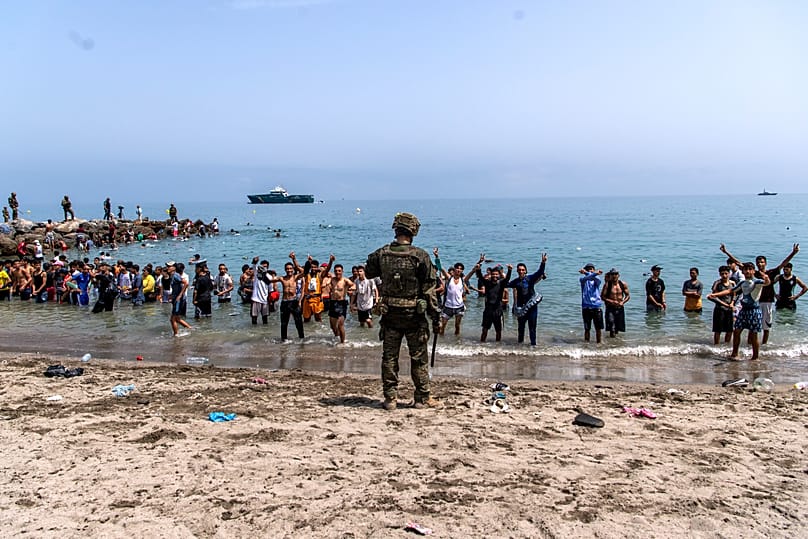
The Spanish enclave of Ceuta in North Africa experienced an unprecedented crisis when more than 60,000 migrants arrived irregularly from Morocco in a single day, marking the largest surge of irregular arrivals ever recorded on EU territory. This event, which tragically resulted in at least 72 deaths according to Spanish officials (though Morocco reported 11 deaths concentrated on the journey to the territory), immediately ignited vivid concerns among European governments and sparked a significant diplomatic row.
Italy was at the forefront of the controversy, with Prime Minister Giorgia Meloni calling for Spain's suspension from the EU's visa-free Schengen travel zone, describing the images from Ceuta as "shocking" and demanding "extraordinary measures." Italy subsequently reintroduced air and maritime border controls with Spain for a month. This stance was explicitly backed by Denmark and Finland, whose leaders, Prime Minister Mette Frederiksen and Interior Minister Mari Rantanen respectively, argued that countries failing to protect external borders should not remain in Schengen. Hard-right political figures across Europe, including Italian Foreign Minister Antonio Tajani and Germany's EPP leader Manfred Weber, echoed these calls, attributing the influx to Spain's decision to grant citizenship to over 500,000 irregular immigrants and an alleged "instrumentalisation of illegal migration." Alice Weidel of the far-right Alternative for Germany, and France’s Jordan Bardella, also called for stricter border security and an urgent debate on EU migration policies.
Spain, in turn, blasted Italy's "demagoguery" and summoned its ambassador to Madrid in protest. Spanish Prime Minister Pedro Sánchez lamented a lack of European solidarity, describing some responses as "rather asymmetric" and an "attack" on Spain. He argued that Spain maintains "one of the least porous external borders of the European Union," citing Frontex data, and that European solidarity should not be a one-way street, recalling Spain's support to other EU countries facing migration challenges. Spanish left-wing politicians, such as MEPs Juan Fernando López Aguilar and Cecilia Strada, condemned the attacks as "opportunistic" and "right-wing propaganda," urging European solidarity in the face of a humanitarian emergency.
Other EU countries adopted a more tempered approach. France reinforced its border controls with Spain but President Emmanuel Macron clarified that Ceuta has a particular status and does not benefit from free movement to the rest of the Schengen Area. Germany’s Chancellor Friedrich Merz called for the "without delay" implementation of the EU Return Regulation and supported Spain's intention to prevent illegal migrants from reaching the European mainland, without explicitly calling for Spain's Schengen suspension. Portugal reaffirmed the importance of strict border control for the Schengen system, and the Netherlands implicated Morocco in the crisis, expecting it to take necessary steps.
The European Commission, led by Ursula von der Leyen, described the scenes in Ceuta as "unacceptable" and emphasized securing external borders. However, it rejected Italy's call for Spain's suspension from Schengen, clarifying that the crisis concerned the enclave of Ceuta, an African territory with special border arrangements, and that no illegal movement to mainland Spain or the rest of the EU had been detected. The Commission noted that additional checks are already required for entry into mainland Europe from Ceuta.
The incident led to an urgent call for a video conference of EU interior ministers. A letter initiated by Italy and Denmark and signed by leaders from 22 EU nations called for an "extraordinary videoconference of the Ministers of the Interior" to form a "common assessment of the situation" and agree on a "coordinated European response." Ireland, holding the EU's rotating presidency, convened this meeting. The signatories warned against allowing "uncontrolled mass crossings" or the "instrumentalisation of migration," which they argued could encourage further attempts and undermine confidence in common migration policy, potentially necessitating temporary internal border controls. Notably, France, Portugal, and Luxembourg did not sign this letter.
The crisis was attributed to several factors. Spain's previous decision to grant legal status to 500,000 unauthorized migrants was cited by some right-wing figures as a "pull factor." Rumors of an open border, amplified on social media, and a Spanish Supreme Court ruling on rapid returns of sea migrants, were also mentioned. Morocco's alleged easing of border controls to exert diplomatic pressure on Spain, reminiscent of a 2021 incident, was also a significant contextual element, though Rabat denied instrumentalizing migration. Spain, however, viewed the mass crossing as an "attack" on its territorial integrity.
In the aftermath, Spanish officials reported that almost all of the 60,000 migrants had returned to Morocco within 48 hours, largely due to the effective work of Spanish and Moroccan law enforcement. The situation in Ceuta largely returned to normal, though some migrant minors remained. On the ground, the crisis also sparked local unrest, with hundreds of Ceuta residents protesting for tighter border controls. This protest was met with a counter-demonstration by residents defending coexistence, leading to tense exchanges and a heavy police presence. The EU interior ministers' meeting was set to discuss options including the reintroduction of internal border controls across Europe and an enhanced role for Frontex, the EU's border agency, in emergency situations, highlighting the ongoing debate over border security and migration policy within the Union.