Africa May Hold the Hidden Origin of the World’s Most Famous “Magic Mushroom”
A newly identified African mushroom species is offering a deeper global understanding of psychedelic fungi, pointing to deeper evolutionary roots than previously believed.
For years, the global story of the well-known psychedelic mushroom Psilocybe cubensishas largely pointed to the Americas.
It is one of the most widespread species, commonly found in tropical regions and often linked to human activity.
But that narrative is now being questioned.
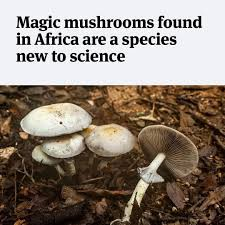
A newly identified species, Psilocybe ochraceocentrata, discovered in southern Africa, is forcing scientists to rethink where this famous group of fungi may have originally come from and how it spread across the world.
Why This Discovery Matters
At first glance, this might seem like just another scientific classification, but it goes deeper than that.
For years, mushrooms found in parts of Zimbabwe and South Africa were assumed to be Psilocybe cubensis. Only through detailed genetic testing did researchers realise they were dealing with a completely different species.
This matters because misidentification hides real biodiversity. When species are grouped incorrectly, scientists lose the chance to fully understand how they evolved, where they came from, and what makes them unique.
In this case, recognising Psilocybe ochraceocentrata opens a new path to studying the origins of psychedelic fungi, one that includes Africa.
A Much Older Origin Than Expected
One of the most important findings from the research is timing.
Scientists estimate that Psilocybe cubensis and Psilocybe ochraceocentrata likely share a common ancestor dating back about 1.5 million years.
This challenges earlier ideas, including a theory by Mexican ethnomycologist Gastón Guzmán, which suggested that these mushrooms spread globally during the colonial era through cattle movement.
While that theory may still explain part of the story, the new timeline shows that these fungi existed and began diversifying long before human trade routes existed.
How Nature May Have Spread These Mushrooms

If humans were not responsible for the earliest spread, then nature likely played a major role.
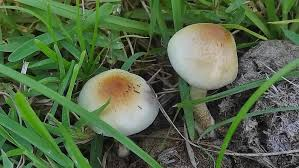
These mushrooms grow on animal dung, meaning they are closely tied to grazing animals. Millions of years ago, large herds moved across continents, and fungi could have travelled with them.
Other natural factors may have helped too:
Wind carrying microscopic spores across long distances
Insects like dung beetles moving spores between locations
Environmental changes that pushed species into new regions
In simple terms, these mushrooms may have spread globally without human help, at least in the beginning.
Africa’s Hidden Biodiversity Gap
This discovery also highlights a larger issue: Africa remains underexplored when it comes to fungal biodiversity.
Globally, over 160 species of this group are known. In Africa, fewer than ten have been formally documented.
That gap is not because Africa lacks biodiversity—it’s because it has not been studied enough.
Researchers also used biodiversity platforms like iNaturalist to study distribution patterns, helping them map where these fungi may have existed over time.
The case of Psilocybe ochraceocentrata proves this clearly. It existed for years, even decades, but was repeatedly mistaken for another species.
This raises an important question: how many more species are still unidentified?
What This Means for Science and Medicine
Beyond classification, this research has broader implications.
Species like Psilocybe cubensis produce compounds that are currently being studied for potential mental health applications. Understanding their evolutionary history may help scientists identify new species with similar or useful properties.
It also improves ecological knowledge. Fungi play a crucial role in breaking down organic matter and supporting ecosystems.
Better understanding of these species could help:
Improve biodiversity conservation
Support ecological research
Guide future medical studies
A Story That Is Still Unfolding
This research does not give a final answer about where “magic mushrooms” truly began.
Instead, it reshapes the conversation.
Rather than a simple origin in one region, the evidence points to a long, complex history involving natural movement, environmental change, and possibly later human influence.
What is becoming increasingly clear is that Africa is not just a passive backdrop in this story.
It may be one of the earliest and most important chapters in the global history of these fungi.