Accra Drowns By Design: City's Flooding Crisis Exposed, Demanding Urgent Action
Accra's persistent flooding is a man-made crisis, stemming from rapid urbanization, poor land use planning, and chronic maintenance failures rather than just heavy rainfall. Decades of unaddressed governance issues have transformed natural hazards into recurring catastrophes, with lessons from other cities offering clear paths to systemic prevention. Political will, particularly within the current "legacy term" administration, presents a critical opportunity to implement long-overdue institutional reforms and shift towards a city that remembers and learns from its past to secure a flood-resilient future.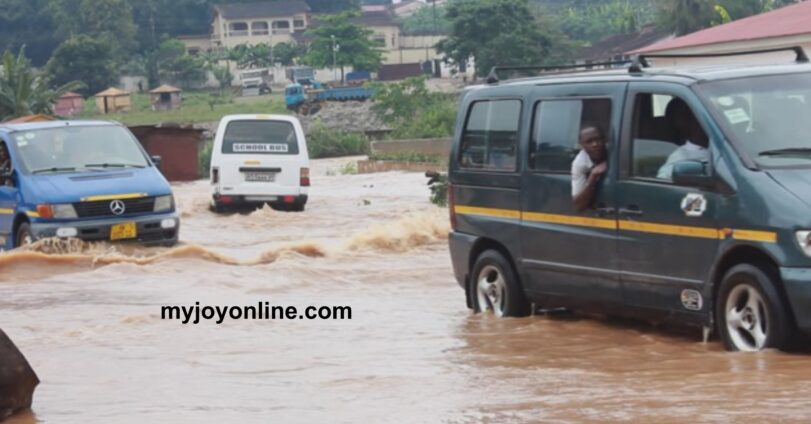
Ghana’s capital, Accra, faces a recurring crisis every rainy season as its streets and communities go underwater, a phenomenon often attributed to heavy rainfall. However, three decades of accumulated evidence reveal a more uncomfortable truth: Accra’s perennial flooding is predominantly a man-made catastrophe, a consequence of systemic governance failures rather than merely natural hazards. The city's coastal savanna location means its annual rainfall of approximately 800 mm is less than that of cities like Amsterdam or Singapore, which absorb far greater volumes without routinely suffering catastrophic loss of life. As disaster researchers argued in Nature in 1976, "taking the naturalness out of natural disasters" highlights that while hazards are natural, catastrophes are made, a point Accra proves every June.
The choreography of an Accra flood is all too familiar: a serious downpour leads to the Kaneshie First Light interchange becoming a brown lake, traders at Kwame Nkrumah Circle hauling goods onto rooftops, and the Odaw channel, the city's primary stormwater drain, bursting its banks into areas like Alajo, Adabraka, and Avenor. The National Disaster Management Organisation (NADMO) issues casualty figures, a minister arrives in gumboots, an excavator is photographed dredging a drain, and promises are made, only to be forgotten until the next season.
This pattern of disaster and unfulfilled promises spans three decades. A downpour on July 4, 1995, paralysed the capital and killed at least 17 people, leading to a committee and a report. Serious floods returned in 2001, 2002, and throughout the late 2000s. In October 2011, at least 14 people died, and tens of thousands were displaced; then-President Prof. John Evans Atta Mills vowed to demolish structures on waterways, but few were removed. The most devastating event occurred on June 3, 2015, when torrential rain met blocked drains, causing floodwater to spread across Kwame Nkrumah Circle. A fire ignited at a GOIL filling station where commuters sheltered, killing over 150 people in a catastrophe driven equally by flood, fire, and failed urban management. The government declared national mourning, promised to dredge the Odaw and clear waterways, and initiated demolitions in Old Fadama, but momentum quickly dissolved amidst court injunctions, protests, and an election year. The decade since has followed this script, with floods in 2018, 2020, 2022, and virtually every year, including 2024 and 2025, when spillage from the Weija dam also overwhelmed downstream communities. New initiatives like President Nana Addo Danquah Akuffo Addo's 2017 pledge to make Accra "the cleanest city in Africa," the creation of a sanitation ministry, the World Bank's $200m Greater Accra Resilient and Integrated Development programme in 2019, and the establishment of a Hydrological Authority in 2022, have yet to break the cycle. Thirty years of flooding is not a sequence of misfortunes; it is one failure, repeating.
The anatomy of Accra's man-made floods is rooted in rapid, uncontrolled urban expansion. Greater Accra's population surged from approximately 1.4 million in 1984 to 5.4 million in 2021, with the built-up area expanding even faster. Savanna, farmland, and marsh that once absorbed rainfall have been sealed beneath concrete and asphalt. This transformation means that storms, which the landscape once naturally absorbed, now result in almost complete and faster runoff into channels never enlarged to accommodate it. The Odaw River and its tributaries, including the Onyasia, Nima, and Kaneshie drains, have followed their courses for centuries, with floodplains inherently part of the river system. Yet, Accra has permitted, or failed to prevent, construction directly on watercourses, wetlands, and floodplains.
Ghana possesses robust regulations, such as a 2011 national buffer-zone policy prescribing setbacks along waterways and the 2016 Land Use and Spatial Planning Act alongside 1996 building regulations for orderly permitting. However, planning officials concede that most city structures lack approved permits. The core issue is not an absence of law, but an absence of consequence, as enforcement fails due to political and administrative pressures. District assemblies are underfunded, inspectors are few, and permits can be negotiated. Demolition orders for illegal structures are often met with injunctions, calls from powerful individuals, or simply lapse during election cycles. Ing. Benedict Atta Poku, a petrochemical engineer, highlights that while drainage infrastructure is designed to specified standards and handed over to government institutions, the greatest challenge lies in its long-term maintenance and utilization. He notes that even properly designed systems become ineffective when drains are blocked with refuse, silt, and debris, reducing water flow capacity. The problem, he argues, is not with the engineers but with the post-completion upkeep and management, stating, "The maintenance of the infrastructure is where the issue is. The utilisation of the infrastructure is where the issue is. That's got nothing to do with engineers."
Maintenance failures are compounded by the city's waste problem. Desilting major drains is treated as an emergency contract awarded only when rains gather, rather than a routine budget line. Much of the network consists of unlined channels that quickly erode and silt. Moreover, drains double as the city's default waste-disposal system; Accra generates roughly 3,000 tonnes of solid waste daily, and incomplete collection means sachet plastics, mattresses, and even furniture are dumped into gutters, choking culverts during the first storm. As the text states, "No drain, however well engineered, functions when it is full of furniture." The city has also destroyed its natural insurance, with the Sakumo lagoon and the Densu delta, both Ramsar wetlands, steadily encroached upon by housing estates, leading to a significant loss of wetland cover in three decades. Wetlands are natural sponges, whereas tile and tarmac are not.
The Odaw River now serves as a grey-black conveyor of sewage, industrial effluent, and plastic, its surface so densely carpeted with waste that it appears solid in places. It empties into the Korle Lagoon, described by researchers as among the most polluted water bodies globally. Successive dredging and restoration projects since the late 1990s, costing tens of millions, have been overwhelmed by the continuous influx of silt and refuse, largely due to Ghana producing an estimated 1.1 million tonnes of plastic waste annually, with only about 5% recycled.
The belief that floods are due to drains being too small or shallow is a misconception. The underlying issue is that Accra has paved over the very ground that historically absorbed rainfall. Natural soils, wetlands, and open spaces have been replaced by concrete, tiled compounds, asphalt roads, and rooftops, causing the city to repel water rather than absorb it. This results in an extremely high "effective imperviousness," where rainwater hits hard surfaces and enters the drainage network at a fast pace and all at once, leading to flash flooding. This overwhelms drains not with the amount of rain, but because too much water reaches them too quickly. Hydrological studies confirm that even small increases in impervious areas can double or triple stormwater peak flow, a reality exacerbated by Accra's dense, low-porosity urban form and built-over floodplains. The narrowing of the Odaw Basin due to encroachment further exacerbates this, effectively engineering the entire city to flash flood as soon as rain hits concrete, long before it reaches a drain. Accra doesn't primarily need bigger drains; it needs to slow stormwater at its source.
Accra's flooding is, at its analytical core, a failure of urban governance. Nkrumah et al. (2014) established that while rainfall intensity has increased with climate variability, the primary driver of flood damage is drainage infrastructure inadequacy and land use change. Fokuo (2025) identified communities along the Odaw River, Kaneshie, Kwame Nkrumah Circle, Alajo, and Adabraka as high-risk areas, with low-income informal settlements bearing the brunt. This governance failure manifests in three main areas: land use planning, drainage infrastructure governance, and institutional coordination. Despite a comprehensive spatial planning framework (Land Use and Spatial Planning Act, 2016), its implementation is partial and undermined by political interference, resource constraints, and fragmented authority. Accra's formal drainage infrastructure is chronically under-maintained, underfunded, and architecturally insufficient, as noted by Nkrumah et al. (2014) regarding the Odaw drain. Furthermore, flood risk governance is spread across a complex, poorly coordinated institutional landscape—including the Accra Metropolitan Assembly, NADMO, and the Ghana Hydrological Authority—without clear accountability, as documented by Owusu and Afutu-Kotey (2010).
The persistence of the crisis is not due to a knowledge deficit, but a "courage deficit" or an "incentive deficit." Genuine remedies, such as demolishing illegal structures or prosecuting officials, are politically expensive, leading to court battles, compensation claims, and lost votes. It has proven easier to perform highly visible acts like dredging for cameras. There's an equity problem, with Ghana's housing deficit pushing the poor onto undesirable, flood-prone land. Effective governance requires enforcement paired with notice, resettlement, and compensation, which demands both financial investment and political nerve. The political economy of urban infrastructure in Ghana favors new, visible construction projects over sustained investment in less visible maintenance and recurrent expenditure, as Resnick (2014) identifies the electoral cycle as a primary obstacle to long-horizon infrastructure investment across African cities.
Other cities demonstrate that this is not destiny. Singapore, with nearly three times Accra’s rainfall, effectively manages floods by rigorously policing drainage reserves, requiring developers to detain stormwater on-site, and transforming drains into assets. Seoul demolished a motorway to resurrect the Cheonggyecheon stream as a flood channel and public space. Munich renaturalised the Isar, widening its floodplain. Zurich has "daylighted" buried brooks, with strict hazard maps. Copenhagen responded to a 2011 cloudburst with a 300-project Cloudburst Management Plan, redesigning streets as channels and parks as reservoirs. The Netherlands funds maintenance through elected water boards that levy their own taxes. These cities respond by rebuilding systems and treating rivers as public assets, demonstrating that consistent enforcement and maintenance, though less glamorous, cost a fraction of disaster relief and reconstruction.
The solutions for Accra are well-documented in official reports. First, information and enforcement: publish legally binding flood-risk maps, digitize and audit the permit system, fund inspectors, and create fast-track courts for planning and sanitation offenses. A single conviction of an official who signed an unlawful approval would be more impactful than ten committees. Second, clearance and restoration: remove structures from primary waterways with due process and resettlement support; restore the Odaw-Korle corridor as a linear park; protect Ramsar wetlands; and convert the 2011 buffer-zone policy into enforceable law. Third, infrastructure and waste: complete World Bank-financed drainage works, fund their upkeep through a ring-fenced annual maintenance levy, require new developments to retain stormwater on-site, extend waste collection to all neighborhoods, impose producer responsibility on the plastics industry, and enforce dumping penalties alongside public education. Finally, accountability: an annual flood-mitigation report to Parliament detailing works, spending, and responsible officials. Hydrologically, Accra must fix the mechanism, not just the symptoms, by decoupling stormwater from drains, requiring buildings to infiltrate runoff, reducing impervious areas, and slowing stormwater at its source. This means ending direct downspout-to-drain piping, directing roof water onto soil, installing infiltration strips, bioswales, rain gardens, detention tanks, and permeable surfaces. Parliament must update building codes to require infiltration features, limit hardscaping, and manage stormwater on-site for new developments. The government should lead by example through depaving public spaces, restoring green corridors, and building green infrastructure.
The concept of an "Urban Continuity Intelligence Layer" suggests a path forward. Instead of merely collecting data, Accra could continuously preserve, connect, and learn from its own experience, understanding how past decisions lead to current floods and how today's choices can prevent future ones. Flooding is accumulated history becoming visible, and continuity is an economic asset, allowing cities to become intelligent by remembering. Technology without continuity, as the input suggests, is simply faster forgetting; continuity transforms memory into judgment. This extends beyond flood management to other societal challenges, arguing that civilizations decline not from lack of technology, but from failing to learn across generations.
President John Mahama’s return to office in January 2025 has been framed as a "legacy term," offering a crucial opportunity for durable institutional reform, unconstrained by immediate re-election incentives. His commitment to a legacy that "cannot be easily undone" aligns perfectly with the need for long-horizon infrastructure governance, such as drainage maintenance and land use enforcement, which are often overlooked for more visible projects. A "resetting agenda" for Ghana is incomplete without a credible, funded, and institutionally serious response to Accra’s perennial flooding. The courage to make these politically difficult choices will determine whether Accra’s residents can finally experience a rainy season without losing their homes to a preventable governance failure. While climate change will make West African downpours sharper, it strengthens the case that governance is decisive. Accra’s next flood is predictable in location, timing, and impact. Ghana possesses the laws, plans, and studies; it lacks execution and consequence. The choice to transition from a city arranged to be ruined by water to one designed to receive it has been deferred for thirty years. The water, unlike politicians, always keeps its appointments.
In immediate response to recent threats, the Ministry of the Interior issued an emergency weather alert on Sunday evening, warning Greater Accra residents to remain vigilant ahead of forecast rainfall for Monday, July 6, with potential flooding in low-lying areas. Concurrently, Accra Mayor Michael Kpakpo Allotey recently presented medical supplies to the Accra Metropolitan Assembly (AMA) Health Directorate, including blood pressure monitors, glucometers, and weighing scales, to support healthcare delivery, public health surveillance, and disease prevention in flood-affected communities, highlighting efforts to strengthen post-flood response beyond waste removal to comprehensive health interventions for vulnerable groups.