10 Startup Myths That Are Hurting Young Entrepreneurs
Everyone talks about hustle, funding, and overnight success. Few talk about runway, unit economics, and burnout. These startup myths are quietly draining young entrepreneurs—and the reality is far less glamorous than social media suggests.

Scroll through any business page and the script is predictable. A 22-year-old drops out, builds an app in six months, raises millions, buys a car, and posts a thread about “mindset.”
It seems clean, fast, cinematic, but however, real entrepreneurship is none of those things.
Behind every visible success story is a pile of constraints: regulation, cash flow stress, supplier disputes, taxes, customer churn, and market timing. Yet startup culture often edits that part out.
The result is a generation of ambitious founders building businesses on half-truths.
Startup culture oversimplifies complexity. And that simplification is costing people money, time, and mental stability.
Here are the myths doing the most damage.
1. “You Need to Quit Your Job to Be Serious”
The dramatic resignation story has become a rite of passage. But data shows a different reality.
Many successful founders started while employed. Sara Blakely built Spanx while working full-time. Mailchimp was run as a side project for years before becoming a billion-dollar company.
Closer home, several African founders built profitable businesses alongside consulting or corporate roles before scaling.
Early-stage businesses are unstable. Revenue is unpredictable. Expenses are fixed. Quitting prematurely increases pressure and shortens your runway.
A salary is not a distraction. It can be oxygen, and can be a boost.
Romanticizing risk without acknowledging runway is irresponsible advice.
2. “Passion Is Enough”
Passion helps you endure. It does not guarantee demand.
Thousands of startups fail every year not because founders lacked passion, but because they built products nobody needed. CB Insights has consistently reported that one of the top reasons startups fail is lack of market demand.
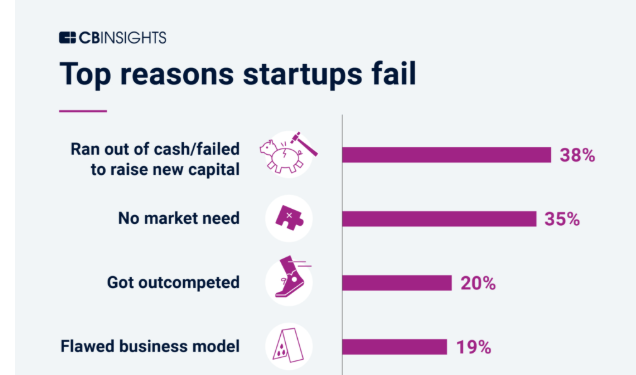
You can love an idea deeply and still misjudge the market.
Customer validation, pricing strategy, distribution channels, and unit economics matter more than emotional attachment. Passion may start the engine. It does not replace fuel.
3. “Raise Funding as Fast as Possible”
Funding announcements trend. Profit rarely does.
Venture capital is not free money. It comes with expectations of rapid growth, equity dilution, and pressure to scale even when systems are fragile.
In 2022 and 2023, global tech layoffs showed what happens when growth is pursued without sustainable revenue.


Companies that raised aggressively during funding booms struggled when investor sentiment shifted.
Bootstrapping is slower. It is also more controlled.
Not every business is meant to be venture-backed. Some are meant to be profitable.
4. “If You Build It Well, Customers Will Come”
This myth has buried countless good products.
Distribution is often harder than development. Marketing is not optional decoration. It is infrastructure.
Instagram did not just rely on filters. It relied on network effects. Paystack did not just build payments technology. It invested heavily in developer trust and partnerships. Distribution strategy often determines survival more than product elegance.
A brilliant product without visibility is invisible brilliance.
5. “Failure Is Always a Badge of Honor”
Failure can teach. It can also bankrupt.
Startup culture celebrates failure as a stepping stone. But failure has financial, emotional, and reputational costs. In environments without strong bankruptcy protections or safety nets, failure can close doors for years.
Learning from small experiments is wise, but glorifying collapse is not.
6. “You Must Scale Quickly or You’re Not Ambitious”
Speed is impressive, while sustainability is rare.
Scaling too early can break operations and hiring too fast without systems leads to chaos. Deciding to expanding into new markets without understanding regulation or local culture leads to losses.
There is a reason many enduring companies grew steadily rather than explosively. Controlled growth builds durable foundations.
Ambition is not measured in velocity alone.
7. “Hustle Culture Equals Productivity”
Sleep deprivation is not strategy.
Startup founders are often praised for working extreme hours. But research on cognitive performance consistently shows that chronic exhaustion reduces decision quality, creativity, and emotional regulation.
Burnout does not build resilience, it erodes it.

8. “You Need a Revolutionary Idea”
Some of the most successful companies did not invent new categories. They improved existing systems.
Google refined search, Facebook refined social networking, and Flutterwave improved digital payments infrastructure in African markets that already had financial systems.
Execution, timing, and adaptability matter more than novelty alone.
A slightly better solution delivered consistently can outperform a radical idea poorly managed.
9. “Solo Founders Are Stronger”
The lone genius narrative is appealing. It is also misleading.
Many high-growth startups are founded by teams. Complementary skills reduce blind spots.
One person rarely excels simultaneously at product, finance, operations, legal compliance, hiring, and marketing.
Isolation increases risk, while collaboration distributes it.
10. “Success Is Immediate If You’re Good”
Media timelines compress reality.
What looks like overnight success often follows years of iteration. Airbnb struggled for funding before becoming dominant.
Stripe refined its product quietly before global expansion. Many African startups operated in obscurity before gaining traction.
Visibility is not the same as velocity.
Success stories are often edited for drama. The unglamorous middle is where most businesses live.
A Healthier View of Building
A more grounded perspective accepts complexity:
• Start small and validate.
• Protect your runway.
• Build distribution early.
• Focus on unit economics.
• Choose funding strategically.
• Treat resilience as operational discipline, not emotional hype.
The goal is not to reject ambition. It is to align ambition with reality.
Startup culture often rewards spectacle. Sustainable businesses reward structure.
The entrepreneurs who survive long term are not always the loudest. They are the most disciplined.
If the myths fade, what remains is harder to romanticize but far more powerful: patient execution, strategic thinking, and a willingness to navigate complexity without shortcuts.