Zambia's Electoral Body Gears Up for 2026 Polls Amidst Presidential Mandate for Fair Elections
President Hakainde Hichilema has called for free, fair, and peaceful general elections in 2026, emphasizing democratic stability and transparency. Concurrently, the Electoral Commission of Zambia clarified that an increase in polling stations is due to more registered voters, not new centres, assuring voters of familiar locations and an improved process.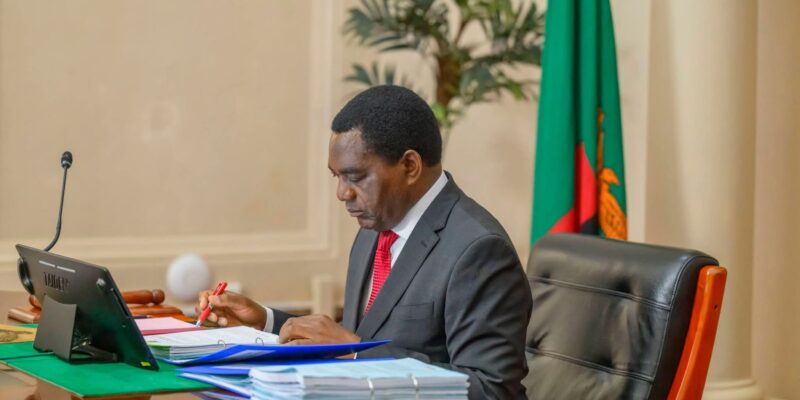
President Hakainde Hichilema has strongly urged the Electoral Commission of Zambia (ECZ) to guarantee that the forthcoming general elections on August 13, 2026, are conducted in a free, fair, and peaceful manner. This call was made during the swearing-in ceremony of Major Vincent Mukanda as the new ECZ Vice Chairperson and Zevyanji Sinkala as Commissioner at State House. President Hichilema underscored the critical importance of credible elections for upholding Zambia’s democratic stability, stating that electoral processes must be free from fear or intimidation to allow democracy to truly flourish through transparency and peace.
The President emphasized the ECZ's crucial role in safeguarding the will of the people and ensuring every citizen's unhindered participation in the electoral process. Furthermore, he appealed to political leaders across the nation to actively foster unity and maintain law and order, cautioning against political competition that could lead to national division. He reiterated that violence poses a significant threat to national development, highlighting peace and education as indispensable pillars for achieving economic growth and stability. President Hichilema also noted that the government’s successful efforts in restoring public confidence in state institutions have positively impacted investor sentiment, leading to substantial investment inflows, particularly within the mining sector. He extended his congratulations to Major Mukanda and Commissioner Sinkala, encouraging them to execute their new responsibilities with unwavering integrity, professionalism, and a steadfast commitment to fairness. In response, Major Vincent Mukanda affirmed the Commission's dedication to delivering credible elections, pledging that the 2026 polls would be free, fair, and peaceful, strictly adhering to Zambian law.
Meanwhile, the Electoral Commission of Zambia has addressed and clarified public concerns regarding a perceived increase in the number of polling stations for the 2026 General Election. ECZ Chief Electoral Officer, Brown Kasaro, issued a statement from Lusaka explaining that this increase is not a result of the creation of new voting centres or any delimitation exercise. Instead, it is directly linked to the significant rise in the number of certified registered voters, which now stands at 8,786,300. Kasaro elaborated that the certification of the Register of Voters directly dictates the number of polling stations required, based on the allocation of registered voters to each voting centre.
Kasaro further clarified the distinction between "voting centres" and "polling stations," noting that voting takes place at established voting centres, which can contain one or more polling stations (effectively, voting rooms). He provided the University of Zambia Sports Hall as an illustrative example: while it constitutes a single voting centre, it may house several distinct voting rooms to accommodate the large number of voters registered at that location. This distinction means that polling stations are not necessarily separate physical locations; a single voting centre can efficiently host multiple polling stations within its confines. Kasaro reminded the public that in 2021, the ECZ announced 12,152 polling stations, but these did not represent 12,152 separate physical locations, as the actual count of voting centres remained around 9,000.
Similarly, for the upcoming 2026 General Election, the increase from 12,152 to 13,529 polling stations does not signify the creation of new voting centres through delimitation. Kasaro explicitly stated that the number of voting centres has remained constant at approximately 9,000. The increment is solely in the number of polling stations (voting rooms) situated within these existing voting centres, designed to effectively manage the expanded voter population. This strategic approach, he explained, ensures that voters can continue utilizing familiar voting centres while simultaneously enhancing the overall voting process. The ECZ's clarification came in response to inquiries raised by the Christian Churches Monitoring Group (CCMG), whose Programmes Manager, Peter Mwanangombe, had highlighted a discrepancy between the polling station figures on the ECZ website (13,529) and the 2025 Polling District Listing (12,200).