Trump's $100,000 H-1B Visa Fee Sparks Outcry and Legal Battle
A federal lawsuit has been filed to challenge President Trump's new $100,000 fee on H-1B visa applications, with plaintiffs arguing it causes chaos and harms U.S. innovation and critical workforce sectors. While Trump cites concerns over exploitation, proponents emphasize the vital role of H-1B immigrants in driving economic growth and technological advancement.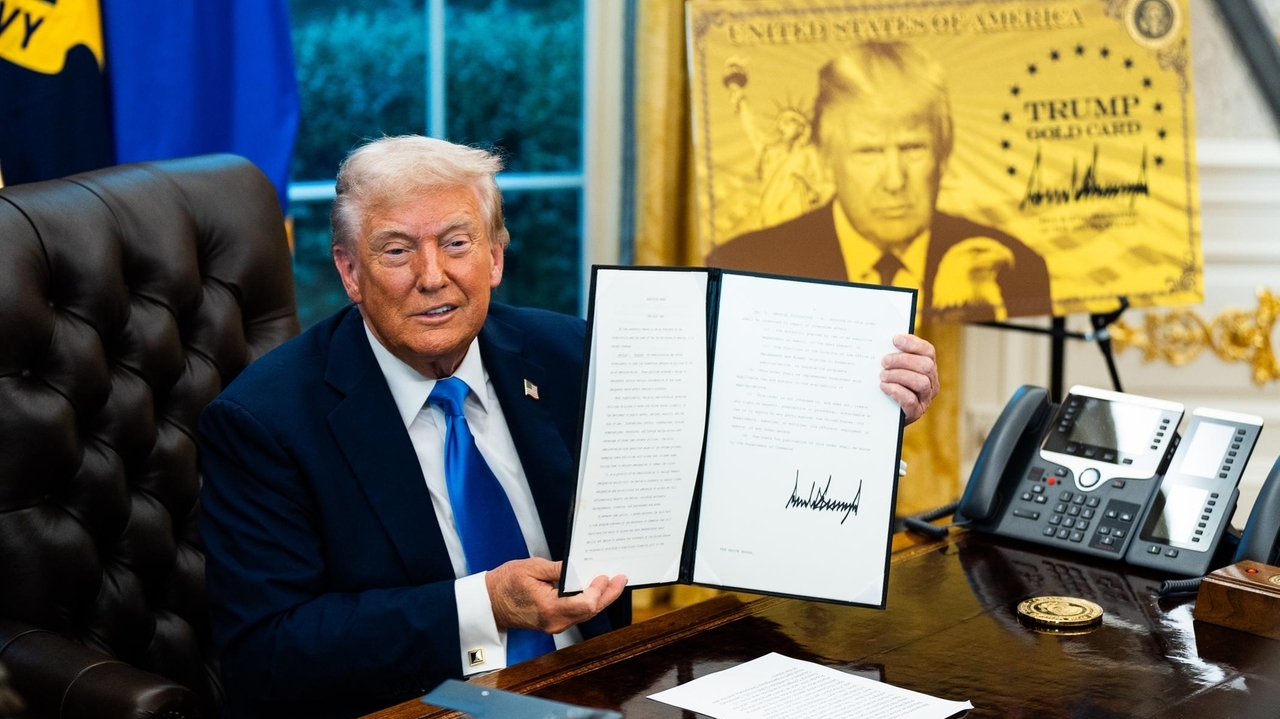
A significant legal challenge has been mounted against the new $100,000 fee imposed on H-1B visa applications, a measure signed into proclamation by President Donald Trump on September 19. This new requirement, which was slated to take effect rapidly, caused widespread alarm among employers and workers, prompting immediate actions such as instructing workers to return to the U.S.
A federal lawsuit was filed in U.S. District Court in San Francisco by a coalition comprising health care providers, religious groups, university professors, and other organizations. The plaintiffs argue that the new fee has plunged employers, workers, and federal agencies into disarray. They contend that the H-1B visa program is indispensable for hiring critical personnel like healthcare workers and educators, and that it significantly fuels innovation and economic expansion within the United States by enabling employers to fill highly specialized roles. The Democracy Forward Foundation and Justice Action Center warned that without immediate relief, hospitals risk losing medical staff, churches could lose pastors, classrooms teachers, and various industries face the loss of key innovators. The lawsuit seeks an immediate injunction to block the order and restore predictability, labeling the fee as “Trump’s latest anti-immigration power grab.”
President Trump's rationale for the increased fee was his belief that the H-1B visa program had been “deliberately exploited to replace, rather than supplement, American workers with lower-paid, lower-skilled labor.” Critics of the program also argue that it serves as a conduit for overseas workers who are often willing to accept salaries as low as $60,000 annually, which is considerably less than the typical $100,000-plus salaries commanded by U.S. technology workers. Historically, H-1B visas have been distributed via a lottery system, with major tech companies like Amazon, Tata Consultancy, Microsoft, Apple, and Google being among the top recipients, and California leading in the number of H-1B workers.
However, many argue that the H-1B program is vital for the U.S. economy, particularly in attracting highly skilled talent. Created by Congress, it aims to fill jobs that tech companies find challenging to staff. According to the lawsuit, about one-third of H-1B workers are essential professionals such as nurses, teachers, physicians, scholars, priests, and pastors. Academics specializing in innovation, like Hemant Bhargava of UC Davis and D. Daniel Sokol of USC, emphasize that the new fee threatens the availability of human capital, potentially harming U.S. growth and innovation at a crucial time when global competition in AI and digital transformation is intensifying.
These experts, themselves immigrants, highlight the substantial value created by STEM immigrants, who are responsible for 23% of innovation output in the U.S. and play a significant role in entrepreneurial ventures and startup innovation. They describe H-1B immigration as a beneficial natural selection process, bringing highly skilled individuals who are eager to work hard, generate new products and services, and optimize existing solutions. They argue that many of the best students are immigrants seeking to remain in the U.S. to create opportunities not possible elsewhere.
Opponents of the $100,000 fee assert that it will deter the brightest minds from contributing life-saving research to the U.S. Todd Wolfson, president of the American Association of University Professors, voiced concern over this. Mike Miller of the United Automobile, Aerospace and Agricultural Implement Workers of America stated that Trump’s plan prioritizes wealth over scientific acumen. Skye Perryman, president and CEO of Democracy Forward, deems the “exorbitant fee” both illegal and an invitation to corruption, stressing that Congress, not executive order, holds the power to levy new taxes or rewrite such programs.
While acknowledging an immigration challenge in the U.S., particularly the skewed distribution of benefits across innovative clusters, professors Bhargava and Sokol argue that reducing H-1B numbers by increasing costs is counterproductive. Instead, they propose increasing the total number of new H-1B visas annually from approximately 85,000 to 350,000. These additional visas, they suggest, should be apportioned across states, including college towns like Lawrence, Kansas, and Gainesville, Florida, and cities such as Pittsburgh and Salt Lake City, to strategically fill economic and technological gaps. They envision a system akin to the medical resident-matching process to ensure optimal placement, leading to improved local innovation, job creation, and economic spillover effects.
This approach is deemed essential for national security, especially given the global surge in industrial policy and AI investments by countries like China. Failure to attract more immigrants, they warn, risks losing top talent to nations like Canada, Australia, and the UK. Despite immigration being a contentious political issue, its historical correlation with productivity and transformation in the U.S. remains clear. H-1B visa holders, in particular, are seen as crucial for creating opportunities for U.S.-born citizens and ensuring the vitality of American innovation, security, and democratic values. Increasing visa costs, therefore, would diminish U.S. prosperity and innovation precisely when they are most needed.