NATO Summit Ignites Global Debate: Trump Arrives, Ukraine Demands, Europe Reshapes Defense
Leaders at the NATO summit in Ankara, including Ursula von der Leyen and Mark Rutte, urged Europe to bolster its defense capabilities and reduce reliance on the US amidst growing transatlantic tensions. US President Donald Trump criticized allies for their response to the Iran conflict, prompting European nations to showcase increased defense spending and a commitment to a "stronger Europe within a stronger NATO." This shift, known as the "Europeanisation of NATO," aims to address geopolitical threats and ensure the alliance's future resilience.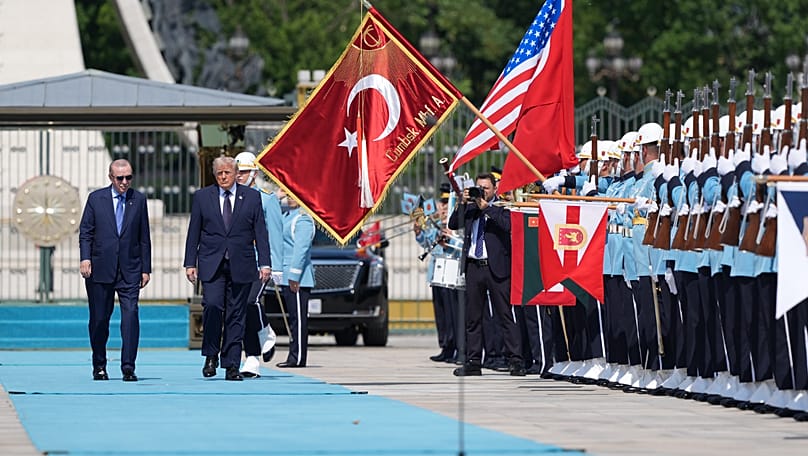
The recent NATO summit in Ankara, Turkey, served as a pivotal platform for leaders to advocate for a more robust European contribution to security, aiming to diminish the alliance's long-standing reliance on the United States. European Commission President Ursula von der Leyen and NATO Secretary General Mark Rutte unequivocally stated the critical need for a "much stronger Europe within a stronger NATO." They underscored the importance of enhanced interoperability between the European Union and NATO, envisioning a clear division of labor where NATO would oversee command structures, capabilities, and standards, while the EU would be responsible for industry, investment, and regulation. This strategic shift, often termed the "Europeanisation of NATO," is propelled by a series of escalating transatlantic tensions.
These tensions have been exacerbated by the White House's unilateral decision to strike Iran and a gradual reduction of US military assets stationed in Europe. US President Donald Trump, upon his arrival in Ankara, articulated his "very disappointed" with European allies' response to his war with Iran. He expressed frustration that allies were not "there for us," questioning the reciprocal nature of the transatlantic relationship. Trump's persistent criticisms, including remarks on Truth Social, placed considerable pressure on European leaders to demonstrate their unwavering commitment to collective defense and to placate his concerns.
In response to these pressures and a rapidly evolving geopolitical landscape, European nations are actively accelerating their defense investments. The Ankara summit showcased significant progress, with new arms contracts worth billions announced at a glitzy defense industry forum preceding the main gathering. Secretary General Rutte highlighted that "Allies and industry from both sides of the Atlantic will reveal new major projects and sign contracts worth literally billions of dollars," encompassing crucial developments in drones, refuelling, and surveillance aircraft designed to enhance Europe's self-defense capabilities. Ursula von der Leyen further detailed the European Commission's financial strategies to bolster homegrown defense, including a €150 billion SAFE loan programme and a provisional €135 billion allocation in the next EU budget. She stressed the imperative for a "massive surge in defence investment" that would yield a tangible return in terms of European jobs, research, and development.
While some nations, such as Poland, the Baltics, and the Nordics, have significantly increased their military spending towards the new 5% of GDP target, others, including Spain, Belgium, Luxembourg, and the Czech Republic, still face challenges in meeting this benchmark. European leaders are keenly focused on preventing further discord with President Trump, relying on his diplomatic ties with Turkish President Recep Tayyip Erdoğan and Rutte's "unstinting charm offensive." As a tangible demonstration of their commitment regarding Iran, European allies, spearheaded by France and Britain, have proposed a potential naval mission for the Strait of Hormuz, positioning vessels closer to the region while awaiting clarity on the fragile US deal with Iran.
The urgent need for a stronger European defense is also reinforced by Russia's aggressive military posture. Mark Rutte issued a stark warning that "Russia has the whole of its economy now on a war footing" and is forging alliances with North Korea, Iran, and China. He emphasized that Europe, Canada, and the US must respond commensurately to defend themselves against this clear and present threat. This period, according to Rutte, represents a "real shift in mindset," which he termed "NATO 3.0: A stronger Europe in a stronger NATO." European leaders are increasingly coming to terms with the reality of the US inexorably reducing its engagement, with Washington expecting its allies to assume greater leadership in the conventional defense of the continent. The Ankara summit thus served as a critical forum to address these profound challenges and to collaboratively chart a renewed course for the transatlantic alliance.