Trump Pledges Utility Bill Protection Amidst AI Data Center Boom
President Donald Trump has unveiled a voluntary pledge with governors and utility companies to protect U.S. consumers from rising electricity costs linked to the expanding AI data center industry. This initiative comes amid growing public concern over energy affordability and resource competition, sparking bipartisan opposition and prompting legislative efforts to ensure data centers bear their share of grid upgrade costs.The U.S. President Donald Trump has initiated a voluntary pledge involving governors and electricity companies, aiming to shield U.S. consumers from potential hikes in utility bills caused by the expansion of artificial intelligence (AI) data centers.
This move underscores the growing controversy surrounding the AI build-out, particularly as voters grapple with affordability issues and express concerns about competition for electricity, water, and land with tech companies.
The initial commitment, announced in March with leading AI and tech companies, has done little to assuage public fears.
The skepticism remains about whether consumers will experience genuine savings, given the already escalating electricity demand.
However, Trump, remains resolute, promising that electricity prices will drop due to a surplus of power, asserting that utility bills for American families will "actually come down" with excess power fed back into the grid.
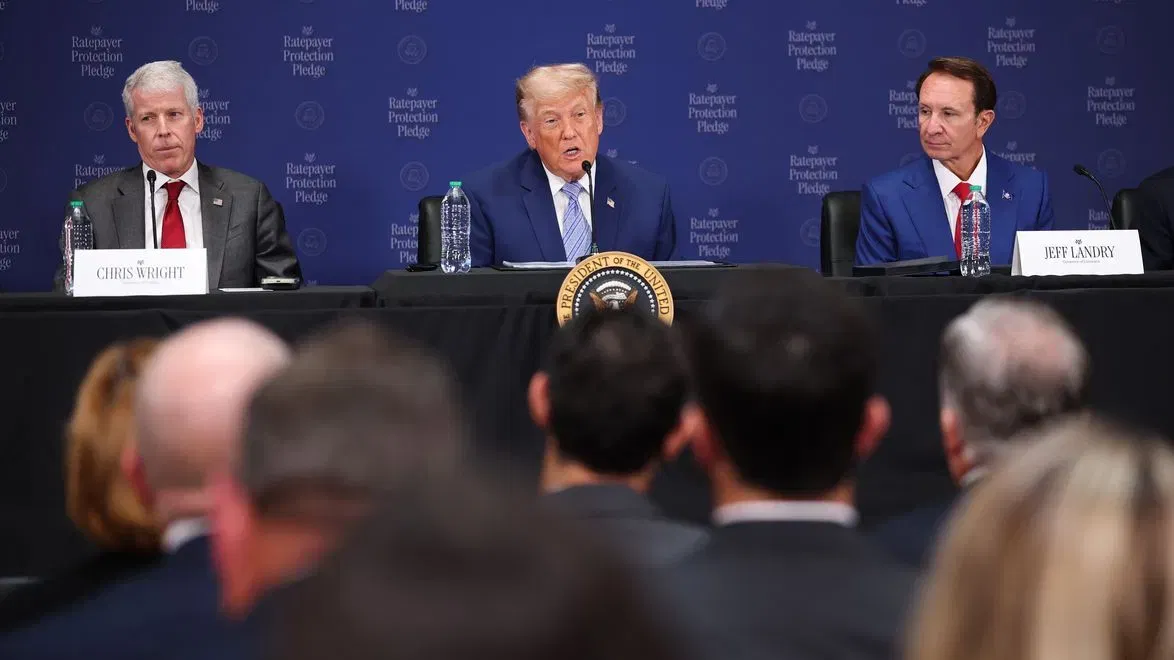
The White House states that nearly 200 additional stakeholders, including utilities and data center developers, have now committed to the pledge, which is projected to cover 80% of all power delivered to U.S. households and businesses.
Despite the administration's assurances, the rapid evolution of AI and the proliferation of data centers are rewriting the broader social contract, posing complex challenges for governance.
While data center construction has been a significant driver of U.S. economic growth, a slowdown could risk the U.S.'s technological edge against nations like China and introduce national security vulnerabilities.
Concurrently, AI's increasing capability to automate tasks such as driving, spreadsheet analysis, and software writing threatens millions of jobs, leading to mounting public resistance as wealth concentrates among a select group of tech tycoons.
Concerns about data centers extend across party lines, encompassing environmental impacts, the use of AI in schools, and the potential for these facilities to inflate living costs and reduce livability in communities.
A recent analysis by ICF, a consulting firm, suggests that increased electricity demand could cause monthly utility bills to surge by 15% to 40% by 2030.
The data center companies counter these arguments by highlighting their contribution to local economies through tax revenues for school districts and reduced property tax burdens for homeowners.
This bipartisan opposition has manifested in various state-level actions. In Texas, frustration with Governor Greg Abbott, a signatory to Trump's pledge, has been leveraged by Democratic gubernatorial nominee Gina Hinojosa, who criticized data centers as being owned by "richest men in the world" with "no rules."

Similarly, New York Governor Kathy Hochul,a Democrat, issued an order banning large server warehouse construction for a year.
In Florida, Republican Governor Ron DeSantis signed a law designed to prevent utilities from passing data center energy costs onto residential and small-business customers.
Numerous state legislatures and utility commissions across the country are also moving to mandate that data centers bear the full cost of their electricity, including expenses for new power plants or transmission system upgrades.
Paradoxically, some tech companies that have signed Trump's Ratepayer Protection Pledge are simultaneously opposing state-level legislation aimed at safeguarding consumers from electricity price increases, as noted by Matthew Freedman of the Utility Reform Network regarding California.
The CEO of Nvidia, Jensen Huang has even identified a lack of power generation as a weakness for America's AI development.
Major companies like Google, Microsoft, Meta, Oracle, xAI, OpenAI, and Amazon are among those committed to the pledge.

The White House has also voiced concerns about the ability of grid operators to manage this surge, specifically criticizing PJM Interconnection, which oversees electric power in 13 states.
The spokeswoman of White House, Taylor Rogers urged PJM to reform its processes and governance, citing its failure to implement a bipartisan statement of principles.
In response to these challenges, the House Energy and Commerce Committee has approved a bipartisan bill that seeks to formalize aspects of Trump's pledge by requiring data centers to bear the costs of grid upgrades, signifying a legislative effort to address these complex energy and economic issues.