The Bold Statement: Untold Story of Princess Diana's Iconic 'Revenge Dress'
Princess Diana's iconic "revenge dress" made a powerful statement in 1994, allowing her to reclaim her narrative after Prince Charles's public confession of infidelity. This black off-the-shoulder gown, worn to a Vanity Fair gala, became a symbol of independence and defiance, profoundly influencing fashion and public perception. The dress's dramatic impact continues to resonate as a powerful example of fashion's ability to communicate personal strength.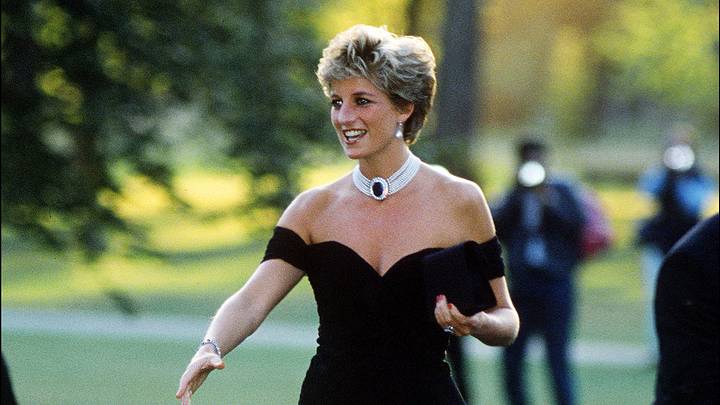
Fashion can be a powerful medium for making a statement, a truth strikingly exemplified by Princess Diana's iconic “revenge dress.” This tight-fitting black gown garnered global attention, allowing Diana to powerfully reclaim her narrative following her husband, Prince Charles, public confession of infidelity during their marriage.
The catalyst for this sartorial moment occurred in 1994, specifically on June 29, just two days prior to Diana’s 33rd birthday. Although separated since 1992, Diana and Charles were not yet formally divorced. On that evening, Diana was scheduled to attend a Vanity Fair gala at the Serpentine Gallery in London. Simultaneously, an ITV documentary featuring Prince Charles was set to air, in which he publicly admitted to remaining faithful to Diana only until their marriage had “irretrievably broken down.” This confession confirmed long-standing rumors of Charles’s affair with Camilla Parker-Bowles, now the Queen of the United Kingdom. Charles described the situation as “a deeply regrettable thing to happen, but it does happen.” Aware of the documentary's airing and the impending public knowledge of Charles’s affair, Diana chose not to retreat but instead to make her own emphatic statement.
Diana stepped out at the gala in a striking black off-the-shoulder dress featuring an asymmetrical hem and a flowing chiffon train. She accessorized with a magnificent pearl necklace, centered by a sapphire-and-diamond brooch, reportedly a wedding gift from the Queen Mother that had been passed down from Queen Mary. Diana had it dramatically placed at the nexus of seven strands of pearls. She also wore the Collingwood Pearl Drop Earrings, often seen on Kate Middleton today, and a diamond-and-sapphire bracelet, rumored to be a gift from the Emir of Qatar. A Salvatore Ferragamo clutch and Manolo Blahnik heels completed the ensemble, but the centerpiece was undeniably the sleek, glamorous, and tight-fitting dress itself.
The dress was designed by Christina Stambolian years prior, after Diana had commissioned her for a “special dress for a special occasion,” asking for something unique, regardless of length. The garment remained unworn in her closet for three years, much to Stambolian's disappointment, until Diana found the “right occasion.” Stambolian later remarked in the book Diana: A Life in Dresses that Diana “looked like a beautiful black bird in it.” The dress marked a significant departure from the more reserved attire typically worn by Diana and other royals. Furthermore, royals traditionally reserved black dresses for funerals, a detail that many interpreted as Diana's unspoken acknowledgment of the demise of her marriage. Interestingly, this dress was not Diana's initial choice; she had planned to wear a Valentino gown, but after the ensemble was leaked to the press, she opted for a different statement.
Diana's decision to wear such a bold piece was not without apprehension. Her butler, Paul Burrell, recounted in his 2003 memoir A Royal Duty that Diana was “wracked with nerves,” simultaneously worried about the documentary and the suitability of her chosen dress. He claimed she asked him, “You don’t think it’s too much?” before ultimately deciding, “Here goes then, Paul.” Burrell further recalled in the documentary Secrets of the Royal Dressmakers that Diana initially felt she “can't face the world knowing what Charles has just said,” adding, “Anyway, I haven’t got anything to wear.”
Ultimately, Diana’s choice proved triumphant, solidifying her place in the hearts of the British public and worldwide, thanks to its powerful symbolism. Royal commentator Richard Fitzwilliams stated that “the revenge dress was a triumph for Diana,” allowing her to communicate her feelings dramatically and instantly garnering public sympathy. Fitzwilliams noted that Charles, in contrast, suffered a “public relations catastrophe” as the only memorable aspect of his interview was his admission of adultery. The press swiftly dubbed it the “revenge dress,” seeing it as Diana’s silent, yet profound, response to Charles’s infidelity and asserting her as the creator of her own narrative rather than a mere bystander.
The concept of “revenge dressing” has since become a phenomenon, applied to celebrities and individuals alike who choose to dress impeccably after a breakup. Many influential figures in fashion have cited the revenge dress as a major inspiration. Rihanna, for example, named Diana's revenge dress as a fashion influence in a 2017 Vogue interview, declaring, “Every time a man cheats on you or treats you badly, you need a revenge dress. Every woman knows that.” She added, “Whether her choice of this knockdown dress was conscious or not, I am touched by the idea that even Princess Diana could suffer like any ordinary woman. This Diana Bad B*tch moment blew me away.” For many, the revenge dress resonated personally with Diana's betrayal and her evident refusal to be defined by it. Fashion historian Darnell-Jamal Lisby explained to Time that the image resonates due to deep feelings for Diana's pain, making her victory, however small, seem significant. Lisby further elaborated, “She was showing the pain she was going through, but also that she was trying to find herself. By the time she was separating from Charles, she was a grown woman in the real world. The identity of the dress was very much, ‘I’m an independent individual and I’m out in these streets and I’m feeling myself.’”
The revenge dress was not the sole instance of Diana making a fashion impact. Her legacy includes numerous outfits that remain stylish today, from sheath dresses and tailored suits to blazers and her classic exercise attire. From the delicate floral gown she wore while dozing at the Victoria and Albert Museum after only three months of marriage, to the blue one-piece swimsuit she famously sported on Dodi Fayed’s yacht in 1997, fashion was an intrinsic part of Diana’s enduring legacy, with the revenge dress arguably standing as her most famous look.