The 1896 Adwa War: How Ethiopia Defied Colonialism
Ethiopia with the exception of Liberia which was used as a settler place for freed slaves remains the only African Country to have not been Colonialism. Achieving this, however, did not come easy but the Ethiopians stood united choosing death over slavery.
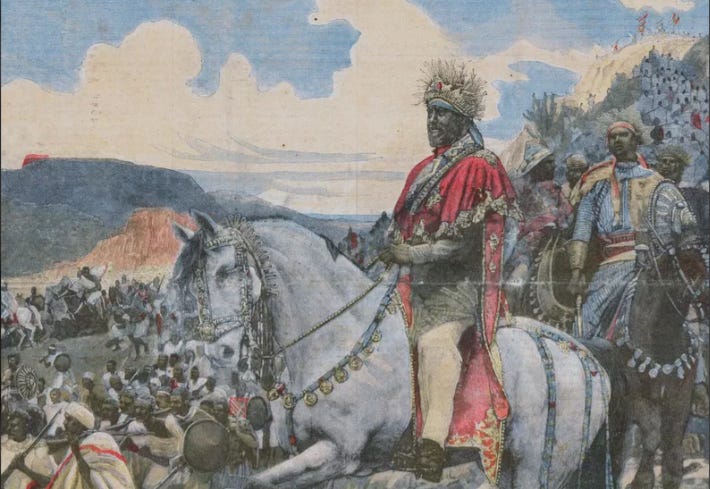
The Battle of Adwa (1896) remains one of the most defining confrontations in African history — a resounding victory that established Ethiopia as a force to be reckoned with and forced other European powers to acknowledge their independence.
To date, this decisive victory of the Italians by the Ethiopians under Emperor Menelik II, stands as a powerful reminder of Ethiopia's resistance to colonial domination, reinforcing the unity, strategy and resilience of a nation determined to safeguard it's independence.
BACKGROUND OF THE CONFLICT
Before the arrival of the Italians, the Ethiopian empire stood as one of Africa's oldest civilizations — a nation deeply rooted in Christianity, cultural heritage and strong monarchial traditions.
In the late 19th century, under Emperor Menelik II, the empire expanded significantly to the south through serious violence and repression that many historians today characterize as genocidal. This Expansionist drive positioned Ethiopia as one of the only few African Empires participating in the Scramble for Africa.
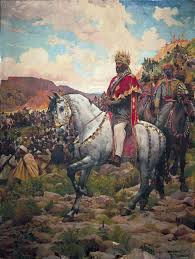
After the 1885 Berlin Conference which marked the beginning of the "Scramble for Africa". European nations — notably the United Kingdom, France, Germany, Italy, Belgium, Spain, and Portugal started carving up the entire continent, brutally enforcing colonialism from one to the other. Italy, eager to prove itself to be among the Imperialist giants, unfortunately, turned it's ambitions towards Ethiopia.
A relative newcomer to the game, Italy began its colonial military exploits in 1885, when, with Britain’s encouragement, it occupied the Red Sea port of Massawa. From there, it advanced to the horn of Africa thus establishing the colony of Eritrea which was formerly controlled by Ethiopia.
The conflict between the Italians and Ethiopians started shortly after the signing of the 1889 Treaty of Wuchale. However, the treaty had different interpretations to both sides and the Italians decision to apply force to enforce it's own interpretation set the stage for the first Italo-Ethopian war which climaxed at the historic Battle of Adwa
Apparently, the Italian version of Article 17 essentially sought to reduce Ethiopia to a protectorate of Italy, a stark contrast to the Amharic version that granted Emperor Menelik a fair exchange — recognising the Italian claim of Eritrea in exchange for a loan of arms and money.

When Menelik discovered this deception, he denounced the treaty and began mobiliizing his forces, determined to defeat Ethiopia's Sovereignty.
MOBILIZATION AND PREPARATIONS
Menelik who claimed to have descended from King Solomon and Queen Sheba knew he had to prepare to defend his territory. The Ethiopians started off by collecting modern weapons from abroad and in addition to this launched a public relations campaign aimed at getting the Europeans to join their cause.
Swiss-born engineer Alfred Ilg, for example, who served as Menelik’s de facto chief of staff, helped modernize the country’s infrastructure and, during trips to Europe, reportedly promoted Ethiopia as “Africa’s Switzerland" — a symbol of stability, independence, and Christian civilization amid the colonial chaos.
Menelik, who during his rise to power had mutilated rival Ethiopians, branded slaves with the sign of the cross, destroyed mosques, and encouraged pillaging knew he had to unite everyone together as they had one common enemy at that time — the Italians.
When he called for a mass mobilization in September 1895, he was able to raise around 80,000 to 120,000 troops, with men pouring in from almost all of Ethiopia’s regions and ethnic groups as opposed to the estimated 29,700 men on the Italian side.
Meanwhile, the Italians had advanced really close, reaching within 250m miles of Addis Ababa, the newly founded European Capital.
THE BATTLE OF ADWA
According to historian Chris Prouty: "They [the Italians] had inadequate maps, old-model guns, poor communication equipment and inferior footgear for the rocky ground. (The newer Carcano Model 91 rifles were not issued because Baratieri, under constraints to be economical, wanted to use up the old cartridges). Morale was low as the veterans were homesick and the newcomers were too inexperienced to have any esprit de corps. There was a shortage of mules and saddles".
The first major clashes of the Italo-Ethopian War began in late 1895, as Italian forces under General Oreste Baratieri advanced deeper into Ethiopian territory. Their campaign initially had some success, with minor victories in Akele Guzai and Coatit, but Menelik's strategy soon began to unfold with precision.
In December 1895 and January 1896, the Ethiopian army annihilated a vanguard Italian column at Amba Alage and then besieged an Italian fort at Mekele, forcing its surrender in large part by implementing Taytu’s strategy of cutting off the water supply. The Ethiopians next slipped past the main, entrenched Italian force and moved on to the Adwa area.
Throughout this war, Menelik spread false rumours downplaying the size and cohesiveness of his troops. Historian Raymond Jonas later described it in his 2012 podcast as "one of the 19th century’s greatest campaigns".
The Italian commanding officer, Oreste Baratieri, considering the resources he had left and also inaccurate maps proposed retreating to Eritrea. But on February 25, 1896 he received a telegram from Italian Prime Minister Francesco Crispi essentially goading him into action. His subordinate generals likewise pushed for a decisive engagement, prompting Baratieri, who had earlier vowed to bring Menelik back to Italy in a cage, to advance three brigades.
At dawn on March 1, 1896 the Italians unaware that Menelik had planned to break camp the next day advanced towards Adwa. Menelik, during his morning prayers was alerted by his scouts and quickly mobilized his forces. The Ethiopian army organised into several wings under commanders such as Negus Temple Haymanot, Ras Makonnen, Ras Mengesha and Ras Mikael who took strategic positions on the surrounding hills, waiting to ambush the Italians moving through the valley.
When the fight eventually broke out, the Italians and their African auxiliaries quickly found themselves disorganized, highly outnumbered, and exposed in inhospitable terrain.
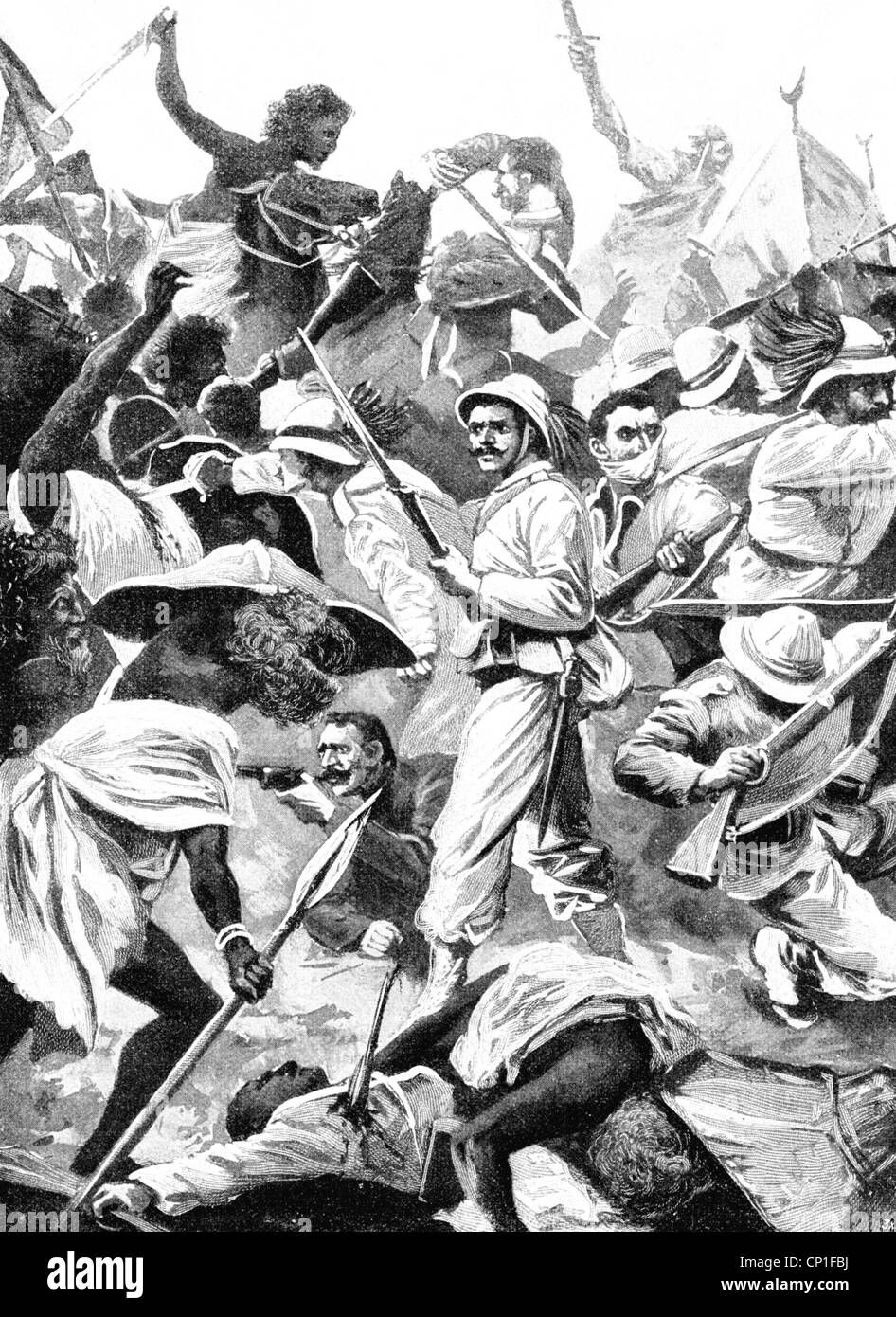
And by the end of day, the Italians were in full retreat. General Elena's reserves which were supposed to facilitate the retreat were quickly overwhelmed by pursuing Ethiopian Cavalry led by Empress Shew and Wollo. They chased them as far as nine miles, before giving up the chase and then lit fires on the highest hilltops — a signal for local peasants to attack the Italian stragglers.
THE AFTERMATH
The aftermath of Battle of Adwa, marked a decisive turning point in Africa and colonial history. The Italians had suffered severe casualties, with an estimated 6000 deaths although only a little more than half were Italians with the rest been askari forces (African troops hired and trained by the Europeans).
An additional 3000-4000 Italian soldiers were taken prisoners back to Addis Ababa prompting Jonas to describe it as a “racial turning of the tables that put whites at the mercy of blacks in significant numbers for the first time.”
However, Emperor Menelik, treated them well and eventually released many, whereas, in contrast, the Africans fighting alongside the Italians had their right hands and left feet amputated.
In the aftermath of the battle, Crispi’s government collapsed and Baratieri was put on trial, and was later acquitted.
As a direct result of the battle and in a bid to foster peace, the Italians signed the treaty of Addis Ababa, officially recognising Ethiopia as an Independent State.
Ultimately, the battle of Adwa represented more than just a victory — it became a symbol of hope to many African countries proving that European supremacy was a sham and any African Country with strategy, unity and determination could defeat a colonial power.