SHE100: Lindiwe Mazibuko—The Woman Born to Use Her Voice
She was South Africa's first black woman to lead a parliamentary opposition, at thirty-one. She faced insults, racial attacks, and institutional resistance, and never flinched. Yet, Lindiwe Mazibuko is not done with South Africa.

Lindiwe Mazibuko's story is, at the very basis for understanding, is a story about voice—how you find it, how you use it, how systems try to silence it, and what happens when a woman refuses to be quiet.
This is the story of a girl who began her public life as a soprano and ended up on the floor of South Africa's National Assembly as Leader of the Opposition.
It is the story of a woman who left parliament voluntarily, went back to school at Harvard, and then returned not to reclaim a seat, but to build something more durable than a political career: a pipeline for the next generation of Africa's ethical leaders.
That single sentence contains multitudes of resistance, of precedent, of the particular kind of loneliness that comes with being first in a room that was not designed with you in mind.
But it is only one sentence in a much longer story, and the chapters that followed it are, arguably, the more interesting ones.
The Soprano Who Found a Different Stage
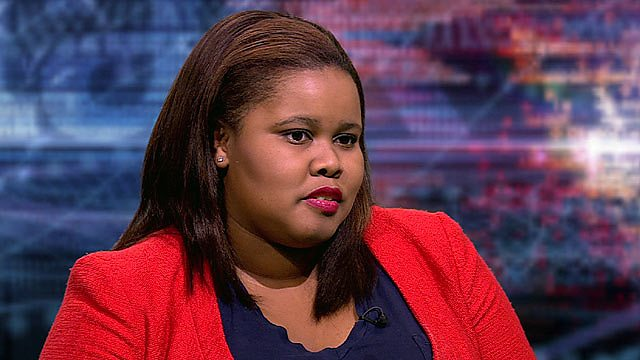
Lindiwe Desire Mazibuko was born on April 9, 1980, in Manzini, Swaziland, to South African parents of Zulu heritage.
Her father was a banker and her mother was a nurse. Her grandfather had lived in Swaziland as an Anglican bishop.
When Lindiwe was six, the family returned to South Africa, settling in Umlazi, a township outside Durban in what is now KwaZulu-Natal.
To avoid the apartheid-era Bantu Education system, a system designed to limit rather than liberate, her parents enrolled her in Carmel College, an independent Jewish primary school in Durban.
It was a deliberate act of parental defiance against a government that had decided what kind of education a Black child deserved.
She later matriculated at St Mary's DSG in Kloof in 1997, and her soprano voice earned her an invitation to the Royal Scottish Academy of Music and Drama in Glasgow.
She then went on to enrol for a Bachelor of Music at the University of KwaZulu-Natal before shifting direction entirely, pursuing a BA in French, Classics, Media and Writing at the University of Cape Town in 2006, followed by a BA Honours in Political Communication in 2007.
The pivot from music to political communication was not a betrayal of her first instinct. It seems to be an expansion of it, she was still using her voice. She had simply chosen a larger auditorium and a different intent.
She joined the Democratic Alliance as a researcher, then rose to become the party's National Media Liaison Officer.
In 2009, she was elected to the National Assembly, representing the DA in the KwaZulu-Natal constituency.
She served as national spokesperson, Shadow Deputy Minister of Communications, and Shadow Minister of Rural Development and Land Reform before the moment that would define her public identity.
On October 27, 2011, after a fierce contest within the DA parliamentary caucus, she was voted in as the party's parliamentary leader, becoming, at thirty-one, the first black woman to lead a parliamentary opposition in South Africa's history.
The Weight of Being First
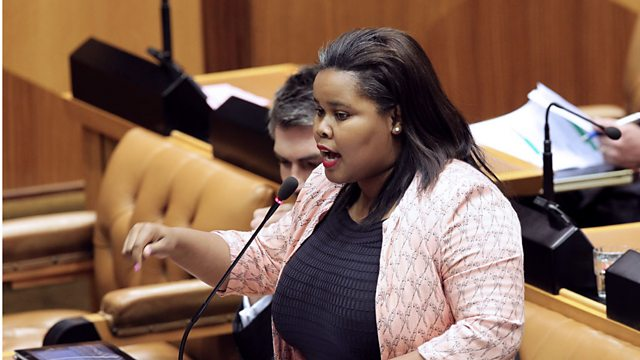
The three years Lindiwe Mazibuko spent as Leader of the Opposition were not quiet ones.

On the floor of the National Assembly, she was sharp, prepared, and relentless in her interrogation of the ruling ANC's record, holding the government accountable on issues as varied as youth unemployment, clean governance, and constitutionalism.
She brought a rigour and an eloquence to parliamentary debate that earned her recognition across party lines, even as it earned her enemies within her own.
But the attacks came not just from across the aisle. Her racial identity became a weapon in the hands of critics who questioned whether a Black woman who attended a Jewish primary school could claim to represent the struggles of ordinary South Africans.
Amidst all of this, she did not flinch, neither did she retreat. She responded with the composure of someone who had already decided that no insult would be given the power to redefine her.
In May 2014, she resigned from the National Assembly. The decision was misread by many as defeat, well it wasn't.
After her resignation she went to Harvard, to the Kennedy School of Government, where she earned a Master in Public Administration, becoming a John F. Kennedy Fellow and an Edward S. Mason Fellow.
She was a woman who believed in growth and had chosen to invest in herself, to deepen the foundation from which she would build the next chapter. It was, in retrospect, one of the most strategic decisions of her career.
In 2012, at the height of her parliamentary career, she was named South Africa's Most Influential Woman.
It was a recognition of what the country had seen on its screens and in its chamber, a young Black woman from a Durban township, standing at a microphone in the National Assembly, holding one of Africa's oldest liberation movements to account.
This she did not with anger or disdain but with evidence, with argument, and with a voice that had been trained, literally, to fill rooms.
After Parliament, the Real Work Began
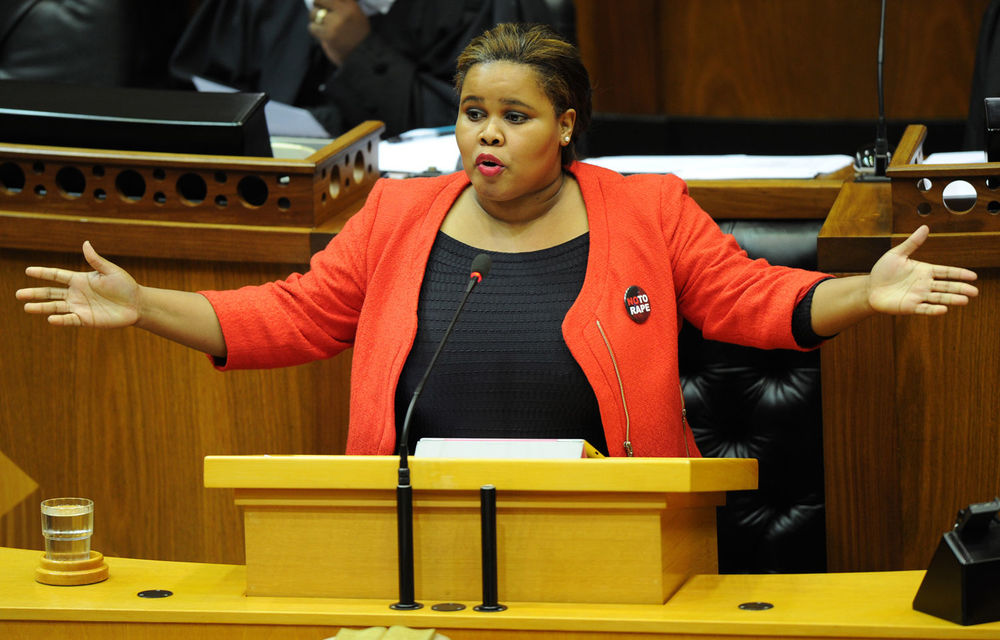
Harvard gave Lindiwe more than a degree, it gave her a framework for the question she had been asking since parliament: how do you build a continent of ethical leaders when the systems for producing them are broken?
Her answer became Futurelect—a non-partisan, non-profit organisation she co-founded and leads as CEO, dedicated to training the next generation of political and public sector leaders in Africa.
Every year, up to thirty promising leaders graduate from its intensive, interdisciplinary programme, learning the skills of persuasion, negotiation, and ethical governance, and joining a growing network of Africa's future decision-makers.
In September 2023, she launched Futurelect's civic education programme with the ambition of reaching over a million young South Africans.
In March 2024, in collaboration with M&C Saatchi Abel, the organisation launched the Futurelect Civic Education App, a voter education tool designed to bring young, first-time voters into active democratic participation.
The app was not a campaign tool for any party. It was a citizenship tool for a generation.
Beyond Futurelect, she is a World Economic Forum Young Global Leader, a Fisher Family Fellow at Harvard Kennedy School's Belfer Center for Science and International Affairs, a trustee of the Nelson Mandela Children's Fund and the Institute for Security Studies, and a board member of Africa No Filter and Women Political Leaders.
She writes a weekly column in The Sunday Times, South Africa's leading national newspaper, where she continues to do what she has always done: hold power accountable, in clear, careful, unsparing prose.
She has said she is also in the process of launching a programme specifically designed to support African women who want to enter politics, understanding, from personal experience, that the journey is harder for women than the job descriptions suggest, and that preparation is the most powerful form of protection.