Rwanda Cracks Down: Nation Doubles Down on Crypto Ban Amid Bybit's Franc Integration
Rwanda's central bank has reiterated its ban on cryptocurrency activities involving the national currency following Bybit's P2P support for the Rwandan franc, citing financial risks and lack of legal protection. This action underscores Rwanda's long-standing restrictive crypto stance, aimed at protecting financial stability and currency confidence, even as the nation explores its own e-franc digital currency and a new VASP licensing framework.
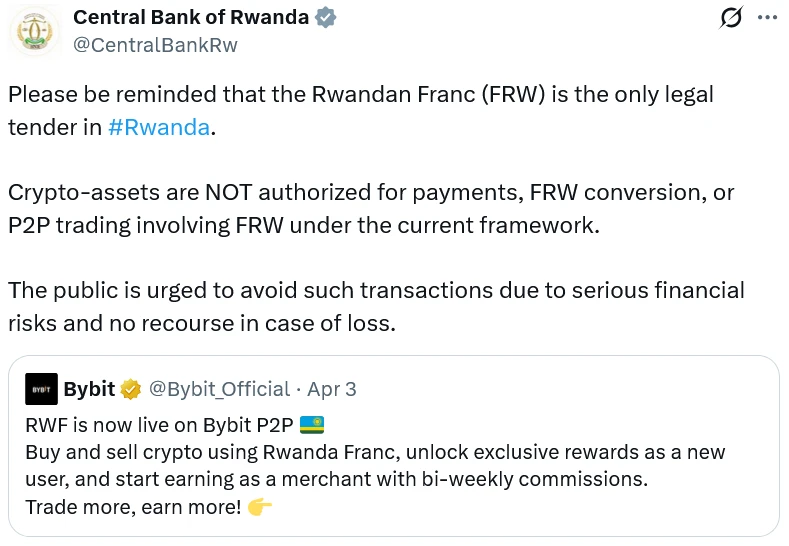
The National Bank of Rwanda (NBR) has warned the public that crypto payments and trades using the local currency remain illegal in the country after Bybit added support for the Rwandan franc for its peer-to-peer platform on Friday.
“Crypto-assets are NOT authorized for payments, FRW conversion, or P2P trading involving FRW under the current framework,” the central bank posted to X on Sunday, urging citizens to avoid crypto due to “serious financial risks and no recourse in case of loss.”
The central bank’s comments were in response to an X post from Bybit on Friday, stating that the Rwandan franc (FRW) can be used to buy and sell crypto through its Bybit P2P service.
In a separate X post, the NBR noted that the FRW “remains the only legal tender in Rwanda” and that “NBR-licensed financial institutions are prohibited from converting FRW into crypto-assets or vice versa.”
Cointelegraph reached out to Bybit for comment but did not receive an immediate response.
Rwanda has been trying to strengthen the FRW’s presence in the country with a central bank digital currency, the e-franc rwandais, which is currently in the proof-of-concept stage and may progress to a pilot phase.
Since 2018, Rwanda has strictly limited the use of cryptocurrencies to protect its economy and keep trust in its currency.
Recently, officials warned that foreign crypto platforms might create ways for people to trade the Rwandan franc outside government control.
At the same time, Rwanda is working on its own digital currency called the e-franc. It is still being tested, but it aims to improve payments while allowing the government to stay in full control of the country’s money.
Rwanda is not banning cryptocurrency completely, it is trying to control it better.
In March, the Rwanda Capital Market Authority introduced a plan to set clear rules for crypto businesses.
The plan would allow these businesses to operate, but under strict conditions, and the cryptocurrencies will not be used as official money, and some activities like mining, mixer services, and certain tokens will be banned.
In simple terms, Rwanda wants to support crypto growth while keeping it safe and well-regulated.
Rwanda is taking a careful approach to cryptocurrency because many growing economies, wants to support new technology while still protecting its financial system.
Instead of fully accepting digital currencies, the country has put limits in place to avoid risks like money leaving the country, unstable prices, and loss of economic control.
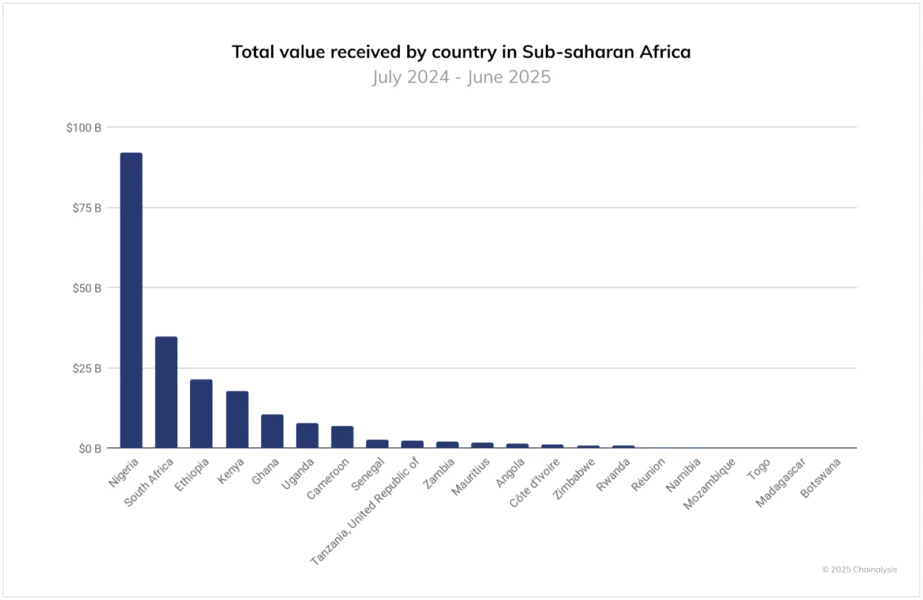
Data from Chainalysis shows that crypto use in Rwanda is still low in 2024 and 2025, especially compared to Nigeria and South Africa.
Because of this, Rwanda has faced fewer financial risks so far. However, the government is still keeping a close watch as crypto continues to grow worldwide.