Podcasts and the Rise of Ragebait Intellectualism: When Controversy Becomes Content Strategy
Ragebait intellectualism has taken over podcast culture and the Nigerian podcast boom is no exception. Outrage is the product, and your anger is the revenue.

I have never really understood the hype around podcasts. It is one of the products of the 2020s creator economy that never sat entirely well with me. So imagine my reaction when my friend sent me a link with the urgent text, listen to this, rain hammering the roof on a supposedly hot Lagos Sunday afternoon, that kind of weather that makes you want to dance in the rain.
Unwilling to commit to something I knew nothing about, I went in search of clips. The first sentence from one of the guests in one of the clips circulating was enough to make me close the tab and never go back.
One of the guests, a man, floated the idea in rebuttal that men could collectively decide to return women to what he called their position "centuries ago." Baby factories, he said.
What unsettled me was not the statement itself. I have lived long enough on Nigerian social media to know that this kind of rhetoric has always existed in someone's group chat.
What unsettled me was the setting and it trended.
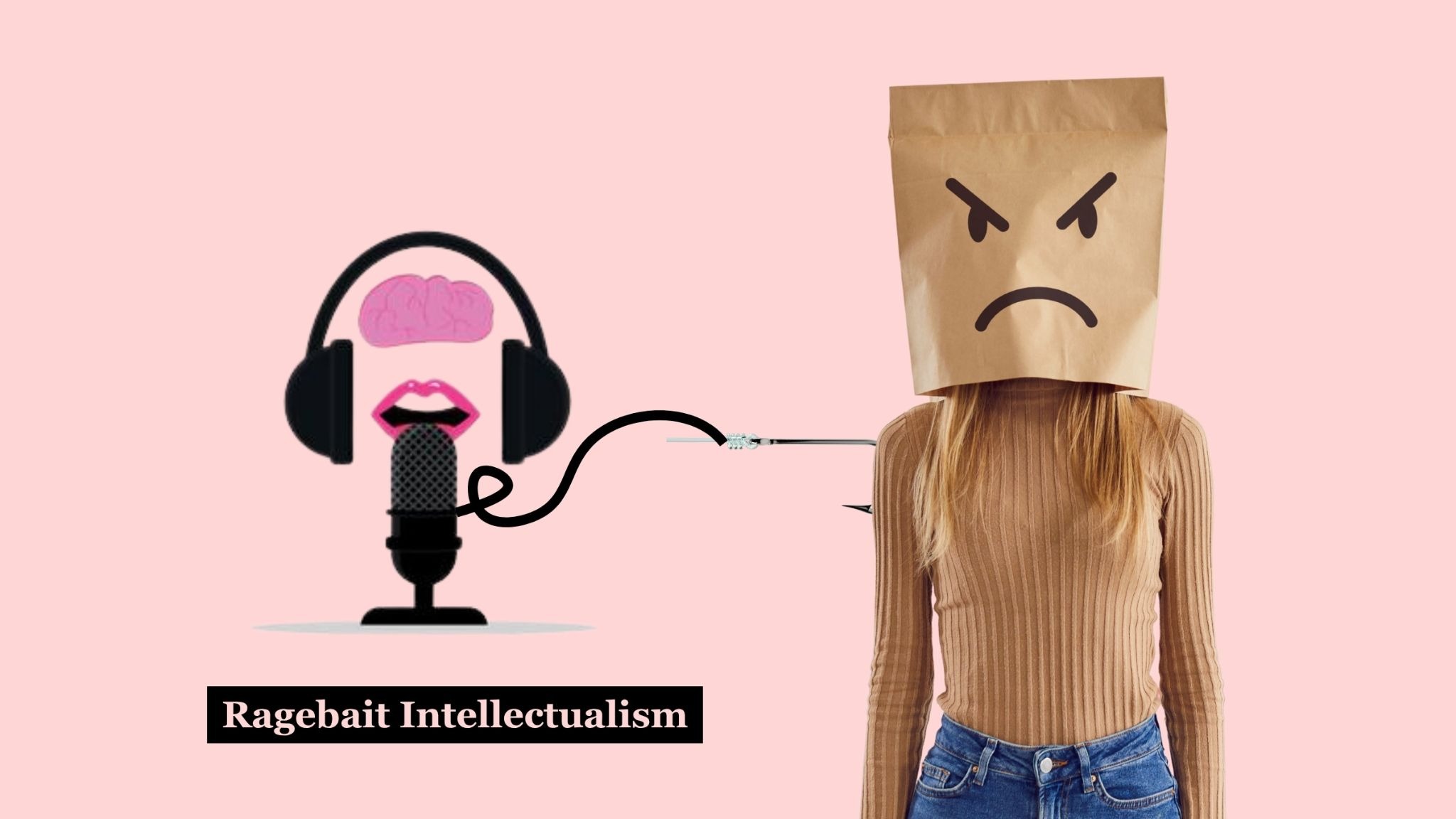
What Is Ragebait Intellectualism and Why Is It Taking Over Podcast Culture?
Ragebait is not new, but its marriage to the podcast format has produced something particularly insidious. Oxford University Press named "rage bait" its Word of the Year for 2025, noting that its usage had tripled ina single year.
This is a reflection of how fundamentally online culture and digital behaviour have shifted. What we are watching in real time is the professionalization of provocation.
Ragebait intellectualism is its podcast offspring. This is when controversial statements are dressed in the language of discourse, delivered by people positioned as thinkers, commentators or truth-tellers.
The guest does not say something hateful — they say something "uncomfortable." The host does not endorse it — they "allow the conversation to breathe." The audience does not just react, it engages. And engagement, in 2026, is a dug oil well.
These are intentional structures put in place. Platforms reward engagement and outrage produces comments and views, so creators engineer content to provoke strong reactions.
A podcast that makes you furious keeps you watching. You comment, share the clip captioned "Can you believe this?" Your outrage becomes free advertising and, sadly, the algorithm cannot distinguish between a share made in admiration and one made in disgust.

The Psychology Behind Why Audiences Cannot Look Away
There is a reason you keep seeing these clips even when you have decided to ignore them. Research shows that moralized language increases engagement and that people often use outrage to signal loyalty to their group and disgust toward an out-group.
Mental health professionals have described the pattern as a cycle. Outrage sparks engagement, algorithms amplify it and users end up mentally exhausted but increasingly unable to disengage.
This is a loop that has been studied by experts and podcast creators who know exactly how to trigger it.
Social Insight
Navigate the Rhythms of African Communities
Bold Conversations. Real Impact. True Narratives.
A 2024 study published in Science found that misinformation spreads most effectively when combined with moral outrage.
When a podcast guest makes a factually absurd claim — that men have some collective power to "decide" to reduce women to reproductive functions — and frames it as a bold take rather than what it actually is (misogynistic fantasy), the outrage that follows spreads the clip far beyond its original audience.
The correction never trends. The original statement always does.
The Nigerian Podcast Economy and the Incentive to Shock
To understand why this keeps happening, follow the money. The global podcast advertising market grew from $840 million in 2020 to $2.43 billion in 2024, nearly tripling in four years.

Even in markets like Nigeria, where podcast infrastructure is still developing and monetization pathways remain uncertain, there is still somewhat of an incentive structure in place and it typically comes from views, subscribers, brand partnerships and the social capital that comes from being the show everyone is talking about.
Nigerian podcasts have become the new town square — whether it is relationship drama, gender debates, or blunt life advice, these shows now spark more heat online than reality television.
Some hosts have built entire brands on being the place where the unsayable gets said. The controversy is the major product.

What Ragebait Podcasting Does to Public Discourse
Research dating back to 2012 established that eliciting outrage serves as a powerful tool in both media and political manipulation. What we are seeing in podcast culture is the mainstreaming of that tool under the cover of "open conversation."
The format lends itself to this deception — two hours of talk creates the illusion of depth. A single inflammatory statement dropped forty-five minutes in becomes the clip, the headline and the thing everyone knows without having listened to a word of context.
I want to be precise here, because I am not making a blanket indictment of the medium. I rarely sit through podcast episodes — I guard my time and attention fiercely, and most podcast shows do not earn either.
However, I have sat through several episodes of Femi Lazarus' Declassified podcast, and I will keep doing so. That is because what that show does is the opposite of what I have been describing.
It sparks honest, grounded conversations about Africa — the kind Africans actually need to be having about identity, wealth, governance, history and where we are going. It is proof that the intention is the problem and not necessarily the format.
There is already a growing consensus in Nigerian media spaces that the podcast boom has produced a decline in meaningful conversation and that the proliferation of shows has not deepened discourse so much as it has cheapened it. The most-watched clips are rarely the most thoughtful ones.
The difference between a difficult conversation and a manufactured one is not always loud. Sometimes it is subtle: a host who invites a controversial guest because the tension will produce insight, versus one who invites them because the tension will produce views.
Social Insight
Navigate the Rhythms of African Communities
Bold Conversations. Real Impact. True Narratives.
We know what the latter is and we know how often we come across it on social media.
The audience that keeps showing up, furious and faithful, is not bearing witness to truth-telling. They are at the consumer end of the business model.