Long Island Tornado Unleashes Devastation, Prompts Cleanup and Future Storm Concerns
A rare tornado, formed from a waterspout, struck Atlantic Beach on Long Island, causing significant damage at the Sun & Surf Beach Club and minor injuries. Experts explain the unusual meteorological conditions that led to this event, highlighting the general rarity of tornadoes in the region and dismissing significant long-term increases due to climate change.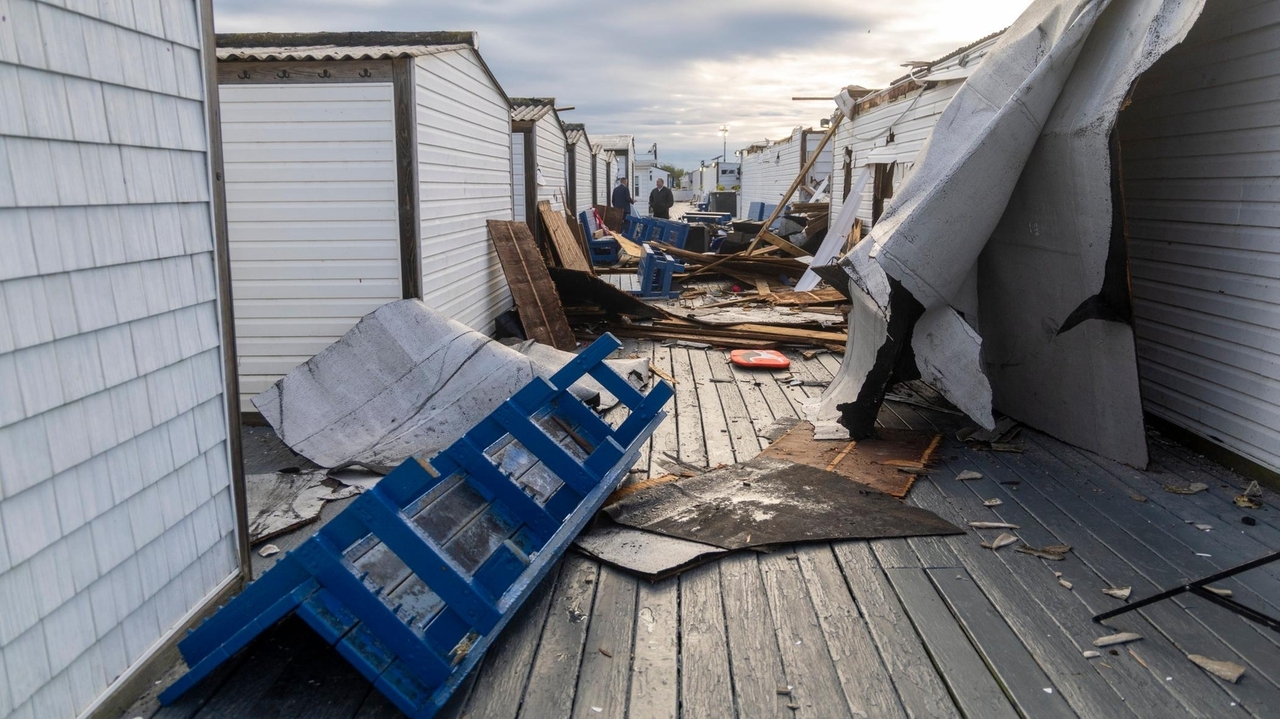
Long Island experienced a rare meteorological event on Thursday evening when a tornado, originating as a waterspout over the ocean, made landfall in Atlantic Beach. This small but powerful twister caused significant damage within minutes, particularly at the Sun & Surf Beach Club, where it tossed wood, plaster, beach chairs, toys, and personal belongings from approximately 50 cabanas. One individual at the club sustained minor injuries. National Weather Service officials confirmed the tornado brought winds between 60 and 112 mph, classifying it between an EF0 and an EF1 on the Enhanced Fujita Scale, which, despite being considered relatively weak, can still inflict substantial damage.
The impact at the Sun & Surf Beach Club was immediate and chaotic. Chris Nappi, the club's food and beverage manager, recounted the traumatic experience of a family sheltering in a cabana as its roof began to lift. Bill Baumert, the club's president, expressed relief that injuries were minimal given the widespread destruction. The Inwood Fire Department conducted searches for trapped individuals. Following the damage, the club was temporarily closed for cleanup and repairs, with hopes of reopening later in the season, while its sister club, Silver Point Beach Club, which suffered minimal damage, reopened shortly after.
Tornadoes are an uncommon occurrence on Long Island. Nelson Vaz, a warning coordination meteorologist for the National Weather Service, noted that the area typically sees a tornado only once every few years. Thursday's event was the first on Long Island since September 25, 2022, when a weak tornado hit Laurel, and the first in Nassau County since November 13, 2021, when multiple low-level tornadoes were recorded across the Island.
The rarity of tornadoes on Long Island is primarily due to a lack of the specific atmospheric conditions necessary for their formation, unlike regions such as 'Tornado Alley' in the central United States. Jase Bernhardt, an associate professor and director of sustainability studies at Hofstra University, explained that tornadoes require a 'clashing of contrasting air masses,' typically dry air meeting moist air, which is common in the Great Plains. Long Island, however, does not frequently experience very dry air masses, and the surrounding ocean waters tend to moderate the climate, further preventing the necessary 'ingredients' for these cyclones.
The formation of Thursday night's tornado was attributed to a unique set of circumstances. Moist air from the ocean interacted with an unusually strong low-pressure system for the time of year, which brought drier air from the north and west. Additionally, a crucial element known as vertical wind shear was present, meaning a significant difference in wind velocity and direction at various atmospheric heights. Bernhardt highlighted the 'notable air mass contrast' and the 'spin generated by the fact that the wind speed and direction was a little bit different over the water versus over the land' as key factors.
Regarding future predictions, experts like Bernhardt believe that while Tornado Alley has seen a shift eastward in recent years, potentially linked to human-caused climate change, Long Island remains on the extreme fringe of this trend. He suggests that any potential increase in tornadoes on the Island would be slight and take several decades to become a measurable trend, likely remaining unnoticeable to residents. Furthermore, any increase would predominantly involve weak tornadoes with minimal impact. Bernhardt emphasized that while tornadoes are frightening and can cause damage, other climate change impacts, such as flash flooding, pose a more significant concern for Long Island.
The storm system that brought the tornado also delivered substantial rainfall across Long Island, with totals reaching around 5 inches in Suffolk County and 2 to 4 inches elsewhere. Nassau County officials declared a state of emergency due to widespread flooding and downed trees. NewsdayTV meteorologist Geoff Bansen noted the rapid onset of heavy rain, causing significant flooding and leaving many vehicles stranded. Suffolk County Executive Edward P. Romaine reiterated the increasing frequency of extreme weather events, stressing the importance of preparedness and infrastructure hardening, referencing a prior August 2024 storm that brought 10 inches of rain to Suffolk's North Shore. Winds also reached nearly 50 mph near John F. Kennedy International Airport, and hundreds of homes experienced power outages, which PSEG Long Island worked to restore.