Kraken Unleashes CFTC-Regulated Bitcoin Futures for US Traders: A Game Changer
Kraken has launched perpetual futures trading for eligible U.S. clients on Kraken Pro, bringing this popular crypto derivatives product under domestic regulatory oversight. Leveraging its acquisition of CFTC-licensed Bitnomial, Kraken offers traders unified access to perpetuals, spot, margin, and CME-listed futures, enhancing capital efficiency. This move follows recent CFTC signals that opened doors for regulated platforms to offer such products.
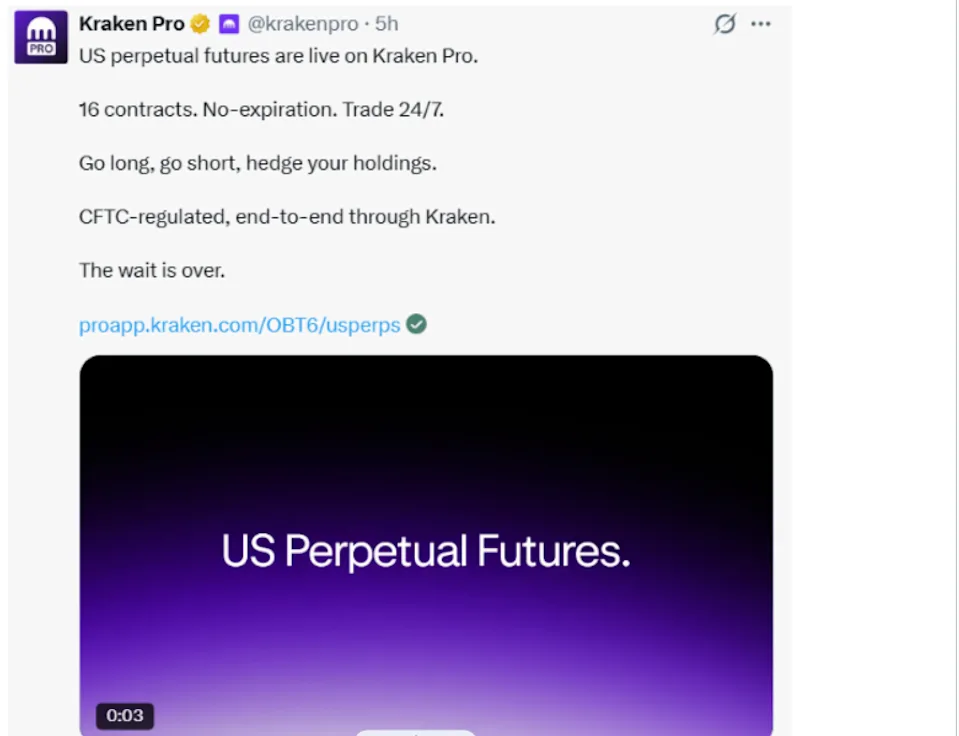
Kraken has officially launched perpetual futures trading for its eligible U.S. clients on Kraken Pro, marking a significant milestone by bringing the most-traded crypto derivatives product under domestic regulatory oversight at scale.
These contracts are listed on Bitnomial, a Commodity Futures Trading Commission (CFTC)-licensed exchange, clearinghouse, and brokerage that Kraken's parent company, Payward, acquired earlier this year.
This launch provides U.S. traders with access to perpetual futures, a product that generated over $60 trillion in global trading volume in 2025, within the CFTC’s regulatory framework, integrated alongside existing spot, margin, and CME-listed futures.
Perpetual futures are a type of derivative contract designed to track the price of an underlying asset without an expiration date.
Unlike traditional futures contracts, positions in perpetuals do not require periodic rollovers and can remain open indefinitely, provided that margin requirements are continuously met.
This structure allows traders to maintain sustained leveraged exposure, whether long or short, to assets they may not physically hold.
To ensure that contract prices remain closely anchored to their respective spot markets, Kraken’s perpetuals implement an 8-hour funding rate mechanism.
At specific times each day (7 p.m., 3 a.m., and 11 a.m. CT), holders of long and short positions exchange funding payments.
If the perpetual price is above the spot price, long position holders pay shorts; conversely, if it is below, short position holders pay longs.
The foundation of this launch is Bitnomial, which possesses the complete suite of U.S. derivatives licenses, encompassing exchange, clearinghouse, and brokerage functions.
Payward finalized its acquisition of Bitnomial in May of the current year, following its purchase of NinjaTrader in May 2025.
These strategic acquisitions furnished Kraken with the necessary regulated infrastructure to offer perpetual futures within a domestic U.S. venue.
A key benefit for traders is that perpetual contracts on Kraken Pro reside within the same futures wallet as existing CME-listed products.
This integration means traders can manage both CME futures and crypto perpetuals using a single pool of collateral, eliminating the need to allocate capital across multiple platforms for separate positions.
TheCo-CEO of Payward and Kraken, Arjun Sethi, emphasized that the operational efficiency this offering provides to serious traders.
He stated, “The most useful thing an exchange business can do for a serious trader is to put everything in one place.
Spot, margin, futures and now perpetuals all live in the same account at Kraken, with perpetuals and futures backed by the same collateral so capital isn’t stranded across half a dozen venues.”
At launch, eligible U.S. clients can trade perpetual bitcoin along with eight other assets. Kraken has indicated its intention to progressively expand both the available contract set and collateral options over time.
These products are offered through NinjaTrader Clearing, LLC, operating as Kraken Derivatives US, which is a CFTC-registered Futures Commission Merchant.

This launch aligns with a signal from the CFTC in May, which created avenues for regulated platforms to offer perpetual futures.
That same month, the agency approved Kalshi’s bitcoin perpetual contracts and provided guidance that also paved the way for Coinbase to connect U.S. customers to global options and perpetual markets.
Following its offering, Kalshi reported over $1 billion in perpetual trading volume within its initial week.