Freedom Tech Under Fire: Bitchat App Defies Indian Cybercrime Crackdown Amid Protests!
Jack Dorsey's censorship-resistant Bitchat messaging app has seen a surge in popularity, particularly during recent student protests in India, following an attempt by the Indian government to have it removed from GitHub. Designed to operate without internet or central servers, Bitchat leverages Bluetooth mesh and Nostr to facilitate communication in regions facing network restrictions. This incident underscores the growing importance of decentralized technologies in moments of political tension.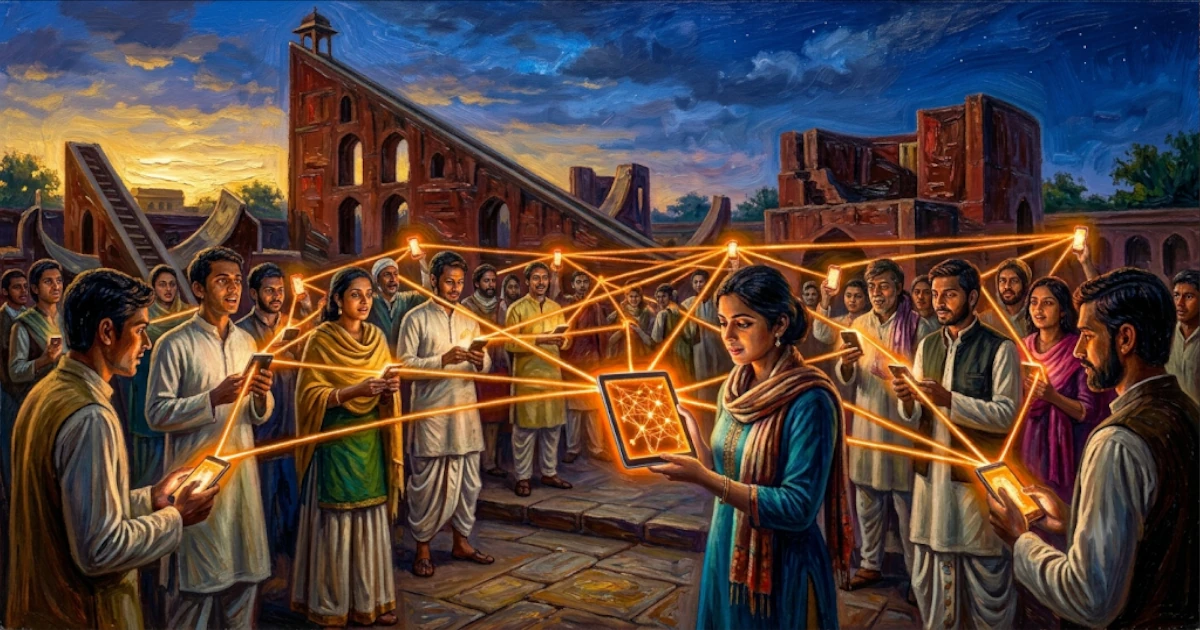
Bitchat, the censorship-resistant, Bluetooth-enabled messaging application developed by Jack Dorsey, has once again garnered significant global attention. The app, designed to function without internet access, phone numbers, user accounts, or central servers, recently became the subject of a formal takedown request from India’s cybercrime authorities. This incident unfolded during a period of widespread student protests in India, highlighting the escalating tension between governmental authoritarian measures and the resilience of decentralized technologies.
First announced by Jack Dorsey in July 2025 as a "weekend project," Bitchat relies on Bluetooth mesh networks for localized communication and the Nostr protocol for broader reach. This peer-to-peer encrypted messaging application allows devices to form local mesh networks, automatically discovering nearby peers and relaying messages across multiple hops. When internet connectivity is available, it seamlessly integrates with Nostr relays. Users can participate in public local channels, send private end-to-end encrypted messages, and access location-based channels. Crucially, Bitchat requires no mandatory registration, offers a panic feature to clear stored data, and is entirely open-source, with its primary repositories hosted under the permissionlesstech organization on GitHub. The application also supports direct installation file sharing between Android devices via Wi-Fi or Nearby Share, enabling new users to join the mesh even without internet access. Key figures involved include Jack Dorsey and open-source developer Calle, known for their work on Cashu ecash, with experimental demonstrations even showing offline Bitcoin-related payments over the same mesh network.
Bitchat's effectiveness in challenging environments was not unprecedented. It first saw significant real-world deployment during periods of government-restricted connectivity. In September 2025, during civil unrest in Nepal, the app recorded nearly 50,000 downloads in a single day. Similar spikes in adoption occurred in January 2026, when Iranian users turned to Bitchat and a localized fork during severe internet restrictions. These earlier instances established a clear pattern: when conventional mobile networks or social platforms become unreliable or restricted, tools that operate independently of these centralized networks experience rapid and widespread adoption.
The most recent surge in Bitchat's prominence stems from events in India in May and July 2026. Following the cancellation of the National Eligibility Entrance Test (NEET-UG) due to a significant leak of exam questions, millions of candidates were affected. This controversy fueled a youth-led satirical movement, the Cockroach Janta Party (CJP), and ignited widespread protests demanding accountability from Education Minister Dharmendra Pradhan and comprehensive reforms to the examination system. As demonstrators gathered in New Delhi, reports emerged of mobile data and internet blackouts in protest areas.
On July 24, 2026, the Indian Cybercrime Coordination Centre (I4C) issued a notice to GitHub, demanding the restriction of access to three Bitchat repositories within three hours. The I4C explicitly cited the application's capability to function during network restrictions and internet shutdowns, arguing that its technical architecture could significantly impede lawful interception, attribution, and investigation by law enforcement agencies. Jack Dorsey promptly shared this notice on X, stating that "the government of India does not like technologies like bitchat and wants it taken down." Market data from Sensor Tower, reported by TechCrunch and other outlets, indicated that India accounted for approximately 85 percent of the app’s global downloads between July 17 and 23, with over 91,000 downloads in India over five days and daily active users peaking at over 330,000.
Despite the official takedown attempt, the GitHub repositories for Bitchat remained accessible. Developers and users quickly circulated mirrors, including on decentralized platforms like Radicle. Furthermore, the application itself continued to function on devices where it was already installed, and its offline file-sharing feature minimized reliance on app stores or GitHub for further distribution, demonstrating remarkable resilience. The protests also saw political ramifications, with Education Minister Dharmendra Pradhan resigning on July 25.
The use of alternative messaging tools during protests has a rich history. During the Arab Spring, centralized platforms like Twitter and Facebook facilitated coordination, but their dependence on internet access and corporate intermediaries made them vulnerable to pressure or blockage. A technological predecessor, FireChat, a mesh-networking application, gained hundreds of thousands of downloads during Hong Kong’s 2014 Umbrella Movement when mobile networks faced congestion or disruption. Bitchat evolves this lineage by integrating mesh networking with the open Nostr protocol, incorporating stronger cryptographic defaults, and maintaining a fully open-source codebase. The swift response to the Indian GitHub notice, involving rapid mirroring and peer-to-peer distribution, illustrates Bitchat's evolution: the tool is no longer solely dependent on a single company or platform for its survival; once distributed, it becomes largely self-replicating.
Bitchat's design fundamentally embodies the principles articulated in Eric Hughes' 1993 "A Cypherpunk’s Manifesto," which posits that "Privacy is necessary for an open society in the electronic age" and that individuals must build code to resist surveillance and control. Bitchat functions without requiring user information, basing identities purely on cryptography, thereby eliminating the need for users to trust a central operator. Its ability to persist during conventional infrastructure restrictions and its resilience against intermediary takedown requests, such as the one from GitHub, exemplify the practical application of cypherpunk ideals. This marks the third time Bitchat has gone viral in the context of democratic demonstrations, serving as a vital solution against government-driven internet censorship. From FireChat in Hong Kong to Bitchat in Nepal, Iran, and now India, there is a consistent demand for communication that remains functional even when traditional networks fail, a demand Bitchat effectively addresses by empowering individuals with decentralized communication and coordination tools.