Historical Legends (Part 1): Alhassan Dantata, The Great Grandfather of Dangote
Alhassan Dantata, once an almajiri and sold into slavery, overcame immense hardship to become one of West Africa’s wealthiest men through groundnut trading. His legacy birthed the influential Dantata business dynasty in Nigeria, and he would become the great grandfather of Aliko Dangote.
Who are the Dantata Family?
The "Dantata Empire" typically refers to the influential Dantata family from Kano, Nigeria, known for its prominent business figures and significant impact on Nigeria's economic landscape. The family's success is largely attributed to the legacy of Alhassan Dantata, a legendary merchant who laid the foundation for their fortune. His descendants, including Aliko Dangote, Aminu Dantata, and Sayyu Dantata, have further expanded the family's business interests across various sectors.
Alhassan Dantata was considered the patriarch of the family, he was a successful trader who built a vast business empire, particularly in groundnut trading, and was once the wealthiest man in West Africa. The following is an account of pivotal moments in life.

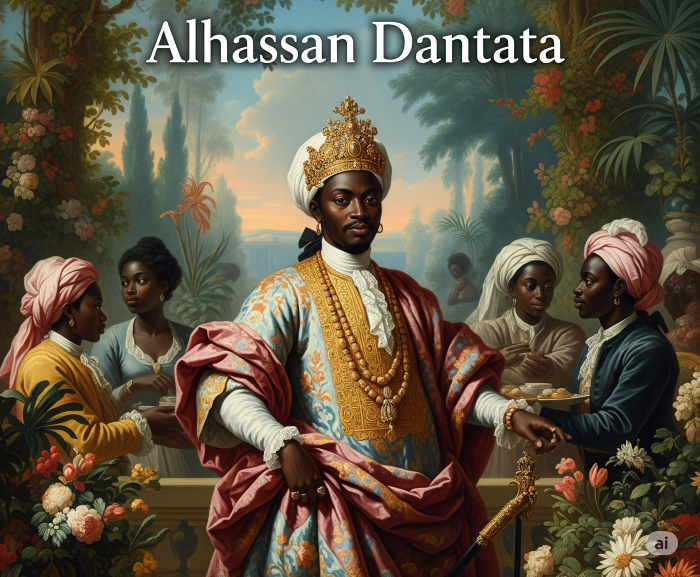
Image: Alhassan Dantata
Born into Promise (1877)
In the ancient Hausa town of Bebeji, nestled within the vast Kano Emirate, a boy was born into a dynasty of wealth and ambition. His name: Alhassan Dantata. His lineage was storied—his father, Abdullahi, was descended from prosperous Katsina merchants; his mother, Fatima Maduga Amarya, was no ordinary woman. A feared caravan leader, she would later carve her fortune in the markets of Accra, Ghana, earning fame as one of the wealthiest Hausa traders on the coast.
Born into the heart of the Agalawa trading clan, Alhassan was destined for greatness. Yet, just beneath the golden veil of prosperity, shadows stirred. The winds of change were blowing through the Sahel, and soon, they would blow his riches away.
Storms of War and Slavery (1893–1895)
In the searing dry season of the early 1890s, as tensions within the Kano Emirate reached a boiling point, the world of the young Alhassan Dantata collapsed with terrifying speed. The Kano Civil War (1893–1895) was more than a dynastic struggle—it was a storm that tore through families, trade guilds, and generations-old merchant legacies. For the Dantatas, who had thrived for decades under the protective canopy of commerce and political patronage, it was an existential threat.
When the dust of battle began to rise, Alhassan’s father, Abdullahi, had already passed away, leaving his sixteen year old son with a substantial inheritance: livestock herds, parcels of valuable land, and a fleet of caravans that had once stretched across the Sahara to Tripoli and Timbuktu. It was an empire in miniature.
History
Rewind the Stories that Made Africa, Africa
A Journey Through Time, Narrated with Insight.
However, war often does not recognize legacy. As rival factions—backed by external influences and fueled by bitter rivalries—clashed violently for control of Kano’s throne, the Dantata estate became a target.
Dantata’s hometown, Bebeji, lay directly in the path of violence. That year, a rebellious faction from Kano launched a surprise attack on the town, and what followed was nothing short of a massacre. Many of the town’s residents were killed on sight. The survivors were seized—among them, Alhassan and his two brothers, Bala and Sidi.
The three were captured. In a time when freedom was fragile and power shifted with the wind, they faced the terrifying possibility of permanent enslavement. However, through determination, negotiation, or perhaps the quiet intervention of allies, the Dantata brothers managed to ransom their own freedom and return to Bebeji.

But the chaos wasn’t over. Barely a decade later, Dantata would again find himself in the shadow of conquest. After a period of fragile stability, a new wave of invaders descended on the region. On February 1, 1903, British forces crossed into Kano territory from Zaria, marking the beginning of their campaign to seize control of the Emirate.
Dantata was in Bebeji when the British troops launched their attack. The town’s chief and many of his soldiers were killed, gunned down in a brutal demonstration of colonial firepower. It was yet another traumatic upheaval for Dantata, who had spent his youth watching empires rise and fall not on maps, but in the dirt roads and shattered walls of his home.
Yet through these crises—war, betrayal, captivity, colonial invasion—Alhassan Dantata endured. The exact details of how he navigated these violent transformations remain murky. Where he was held during his initial captivity, how he negotiated his release, or who intervened on his behalf—all remain buried in time..
What emerged from that silence, however, was unmistakable: a young man who had seen the worst of human ambition and survival, and who would go on to master both.
History
Rewind the Stories that Made Africa, Africa
A Journey Through Time, Narrated with Insight.
Survival and Reinvention
When Dantata resurfaced, he was a different man. Stripped of privilege, he lived as an almajiri, a wandering Islamic student, begging for food by day and memorizing the Qur’an by night. His faith anchored him. His ambition burned quietly.
He started from the bottom—carrying loads in the market, selling scraps, and observing everything. Each transaction, every face, became part of his mental map. His knowledge of trade, languages, and cultures became his new capital. Dantata began to rebuild not only his wealth, but also his network.
Sea Routes and Southern Expansion
He embarked on a bold journey southward, passing through Ibadan and Lagos, and sailed by sea to the Gold Coast (modern-day Ghana). In doing so, he became one of the first northern Nigerian traders to commercially exploit coastal routes.
Utilizing coastal steamers, Dantata began transporting kola nuts to Lagos, where he resold them to Kano-bound traders. This strategic move allowed him to dominate both ends of the supply chain and amass substantial wealth.
By 1906, he expanded his inventory, trading in beads, necklaces, European cloth, and other luxury items. His wealth grew, and he purchased a home in the Koki ward of Kano, planting firm roots in the city that had once witnessed his ruin.
Personal Loss and Family Partnership (1908–1912)
In 1908, tragedy struck. Dantata’s formidable mother, Fatima Maduga Amarya, passed away in Accra. Her death marked the end of an era and caused him to scale back his West African travel, now limiting his operations mostly to Lagos and Kano, though he continued to visit Accra occasionally.
Around this time, he married Hajiya Umma Zaria, a capable and devout woman who became his chief agent for trade with female clients. Due to religious beliefs, Dantata avoided direct business with women, but his wife oversaw a network of female agents across Kano, managing everything from household items to high-value jewelry with professionalism and precision.
Groundnut Gold: The Breakthrough (1912–1918)
By 1912, European interest in groundnut exports reached the northern Nigerian markets. Through the influence of Emir Abbas and his agent Jakada, the British reached out to Kano’s top merchants, including Umaru Sharubutu and Maikano Agogo.
History
Rewind the Stories that Made Africa, Africa
A Journey Through Time, Narrated with Insight.

Image: Emir Abbas
But in 1918, it was Dantata whom the Royal Niger Company (RNC) approached. Unlike others, he moved swiftly. His southern trade experience, command of English, and significant capital reserves set him apart. Where rivals hesitated, Dantata acted—and in doing so, gained a massive commercial advantage.
His early struggles had made him financially disciplined. Every kobo was accounted for, thanks in part to Alhaji Garba Maisikeli, his loyal financial controller of 38 years. Dantata’s careful, frugal nature allowed him to scale rapidly, and soon he dominated the groundnut business in the north.
Crowning Success: The Richest Man in Kano (1922–1929)
By 1922, Alhassan Dantata had become the wealthiest businessman in Kano, overtaking long-established competitors. His discipline, vision, and responsiveness made him not just successful but dominant.
In 1929, when the British Bank of West Africa opened in Kano, Dantata made history. He became the first local trader to open a bank account, arriving with twenty camel-loads of silver coins. It was more than a deposit—it was a public demonstration of his unmatched prosperity.
Empire Builder: The UAC and Beyond (1930s–1940s)
In the following decades, Dantata’s influence soared. After the Royal Niger Company merged to become the United Africa Company (UAC), he was appointed its chief groundnut buyer in northern Nigeria. At his peak, he supplied nearly half of UAC’s regional groundnuts.

In 1932, he applied for a license to export groundnuts independently, but global turmoil and war delayed approval. Undeterred, he continued building. By 1949, he contributed £10,200 in property toward the Kano Citizens Trading Company, helping establish northern Nigeria’s first indigenous textile mill.
History
Rewind the Stories that Made Africa, Africa
A Journey Through Time, Narrated with Insight.
National Reach, Local Roots (1950s)
Between 1953 and 1954, Dantata became a licensed buying agent dealing directly with the commodity board, cutting out middlemen. His business interests by now included cattle, cloth, beads, precious stones, grain, rope, and more.
He was so influential in the kola nut trade that entire “kola trains”—rail shipments from the western forest belt—were filled entirely with his goods. Dantata’s commercial reach extended throughout Nigeria and West Africa, with agents (mostly family members) running offices across major cities.
The Influence of Faith
Despite his vast fortune, Alhassan Dantata was purported to have remained humble and devout. He dressed modestly, ate simply, and frequently shared meals with his workers. He avoided disputes and quietly resolved any misunderstandings with colonial officials or competitors.
His religious life was deeply important to him. In the early 1920s, he became one of the first Northerners to perform the Hajj by mailboat via England. He built a mosque in his home, started a Qur’anic school for his children, and employed a full-time Islamic scholar, Alhaji Abubakar.
A devoted member of the Qadiriyya Sufi order, Dantata paid his zakkat (alms) regularly and forbade interest earnings on his bank deposits, in keeping with Islamic principles.
His wife, Hajiya Umma Zaria, remained a pillar of his success—managing a network of older female agents who knew the needs of their customers intimately. From trinkets to luxury items, her trading empire within Kano ran in perfect sync with her husband’s commercial machinery.
The Final Gathering (1955): A Merchant’s Last Counsel

Image: Alhaji Aminu Dantata (first left), late Hajiya Bara Dantata (standing middle), late Alhaji Ahmadu Dantata (first right) and their mother, late Hajiya Umma Zaria (sitting).

History
Rewind the Stories that Made Africa, Africa
A Journey Through Time, Narrated with Insight.
Image: Late Alhassan Dantata with five of his sons. Aminu is on his right followed by Ahmadu. On the left is Mamuda, then Mudi and Sanusi
By 1955, age and decades of tireless enterprise began to weigh heavily on Alhassan Dantata. When illness struck that year, it was not sudden—but it was grave. The man who had weathered civil war, slavery, colonial conquest, and economic upheaval knew his time was near.
Sensing the end, Dantata summoned his most trusted circle: his children, and his chief financial controller, Garba Maisikeli—the man who had helped him manage every coin for 38 years. In this private meeting, Dantata’s final instructions were not about wealth—they were about legacy.
He urged them to remain united after his passing. His greatest fear was not the loss of money, but the collapse of what he had spent a lifetime building—his family, his business, and his name. He pleaded with them to preserve the firm, Alhassan Dantata and Sons, and ensure that it would not splinter from greed or rivalry.
His advice was deeply personal. He encouraged intra-family marriage to strengthen ties, cautioned against unnecessary conflict with rival merchants in Kano, and emphasized their duty to care for less fortunate relatives, especially the poor among them.
The End of an Era: August 17, 1955
Three days later, on a quiet Wednesday morning—August 17, 1955—Alhassan Dantata passed away peacefully in his sleep.
True to his humble nature, there was no grand procession or monument. He was buried that same day, in accordance with Islamic custom, in his own home in the Sarari ward of Kano.
Sources
Forrest, Tom (1994). The Advance of African Capital: The Growth of Nigerian Private Enterprise. Edinburgh University Press. p. 206.
https://zodml.org/discover-nigeria/people/industry/alhassan-dantata
https://dailytrust.com/last-man-standing-alhaji-aminu-dantata-90/