“Everyone Is Doing Better Than You”: The Psychology of Comparison in the Age of Social Media
“Everyone Is Doing Better Than You” dives into the unseen impact of social media on how we measure ourselves. Why does scrolling make us feel behind, and how can we reclaim perspective?
There is a quiet moment that happens while scrolling. It’s brief, almost invisible. You see someone’s promotion. Someone’s engagement. Someone’s glow-up. And before you fully register what you’ve seen, something inside you shifts. Your day feels smaller. Your progress suddenly feels questionable. Your life, for reasons you can’t clearly explain, feels behind.
No one tells you this is happening. There’s no alert for it. But the feeling is real and it’s becoming one of the most common emotional experiences of the digital age.
Social media did not invent comparison. Humans have always measured themselves against others. What changed is scale, speed, and intimacy. We are no longer comparing ourselves to a handful of people in our immediate environment. We are comparing ourselves to hundreds and sometimes thousands of curated lives, presented daily, endlessly, and without context.
And the psychological consequences are deeper than many people want to admit.
Why Comparison Hits Harder Online

Psychologists describe comparison as a natural cognitive shortcut. It helps people assess progress, social standing, and belonging. But social media turns that instinct into a constant, unavoidable loop.
On platforms built around visibility and engagement, extremes perform better than reality. Success is highlighted. Struggle is edited out. Ordinary moments rarely survive the cut. Over time, this creates a distorted environment where achievement looks universal and delay looks like failure.
Frequentsocial media comparison is linked to increased anxiety, depressive symptoms, and lower self-esteem, particularly among young adults. The issue isn’t just envy, it’s perception collapsing. When everyone appears to be thriving, the mind starts searching for what’s “wrong” with itself.
And comparison online feels more personal than comparison offline. You are not looking at strangers on a billboard. You are looking at people you know, people you went to school with, people whose lives seem close enough to touch but far enough to feel unreachable.
The Illusion of “Falling Behind”
One of the most damaging ideas social media quietly reinforces is the concept of a shared timeline, the belief that life should unfold in a specific order, at a specific pace.
By a certain age, you should have achieved something. By another, you should be settled. If others have arrived and you haven’t, the conclusion feels obvious: you are late.
But this idea collapses under scrutiny. Sociologists and behavioral researchers have repeatedly pointed out that life paths are increasingly non-linear, shaped by economic instability, cultural shifts, and unequal access to opportunity. A study onsocial media and mental health notes that constant exposure to others’ milestones can intensify feelings of inadequacy, even when individuals are objectively doing fine.
Yet logic rarely defeats emotion. The brain doesn’t process statistics while scrolling. It processes symbols like houses, rings, passports, titles and assigns meaning to them. Meaning like: you should be further by now.
There is another layer to this problem that often goes unspoken: comparison isn’t just a side effect of social media. It is structurally useful.
Social Insight
Navigate the Rhythms of African Communities
Bold Conversations. Real Impact. True Narratives.
Platforms are designed to keep attention. Content that triggers emotion, admiration, envy, aspiration, performs better. Posts that suggest success without revealing struggle are more likely to be liked, shared, and promoted. Over time, algorithms learn what keeps people scrolling and amplify it.
This creates an environment where insecurity becomes a renewable resource.
Algorithmic curation can amplify emotional responses by repeatedly exposing users to content that reinforces existing vulnerabilities (Nature Human Behaviour). When comparison feeds engagement, and engagement feeds visibility, the cycle sustains itself.
The result is a digital space where self-worth is constantly negotiated not through reflection, but through reaction.
When Inspiration Quietly Turns Into Self-Doubt
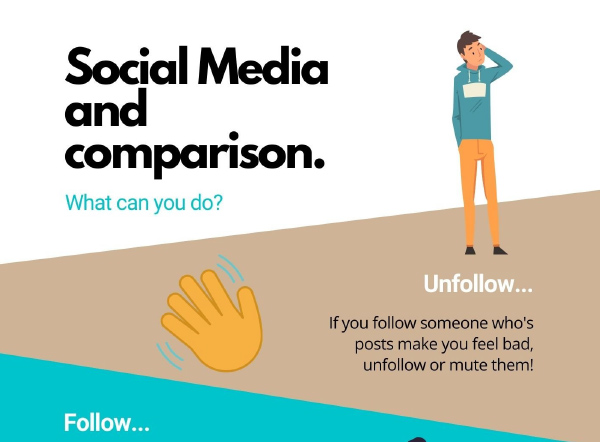

It’s important to say this clearly: not all comparisons are destructive. Seeing others succeed can motivate growth. It can expand your imagination. It can show what’s possible.
The problem begins when inspiration turns into self-erasure.
There is a subtle emotional line between “I want that too” and “I am not enough because I don’t have that yet.” Social media blurs that line daily. Without context, without nuance, without visible struggle, success starts to feel effortless and effort starts to feel like personal failure.
I’ve caught myself doing it. Admiring someone’s progress and then mentally auditing my own life, as if there were a scoreboard somewhere I’d forgotten to check. That reflex doesn’t come from nowhere. It’s learned. Repeated. Reinforced.
Reclaiming Perspective in a Culture of Comparison
The solution is not pretending social media doesn’t affect people. It does. The question is whether users can develop psychological literacy around what they’re consuming.
Understanding that feeds are curated, that timelines are unequal, and that visibility is not truth helps loosen comparison’s grip. So does remembering that most lives look impressive in fragments and complicated in full.
Comparison loses power when people stop treating it as evidence and start seeing it as information without context.
No one is doing life “correctly.” They’re doing it visibly.
And visibility, in the age of social media, is often mistaken for success.
The most unsettling part of comparison culture isn’t envy. It’s how normal it has become to feel inadequate while doing reasonably well.
Social Insight
Navigate the Rhythms of African Communities
Bold Conversations. Real Impact. True Narratives.
Social media doesn’t always tell people they are failing. It simply surrounds them with images that suggest everyone else is winning.
Recognizing that illusion doesn’t require quitting the internet or rejecting ambition. It requires something harder: learning to separate appearance from reality, and progress from performance.
Because the truth, the one rarely reflected on screen is this: most people are figuring it out as they go, just like everyone else.
They’re just doing it with better lighting.