Business Anatomy Series(Part 6): Innoson Vehicle Manufacturing Company
What is Innoson doing differently that has enabled it to stand the test of time? How has it survived where global brands like Peugeot(which left Nigeria in 2004) struggled to sustain manufacturing operations in Nigeria?
What is Innoson doing differently that has enabled it to stand the test of time? How has it survived where global brands like Peugeot(which left Nigeria in 2004) struggled to sustain manufacturing operations in Nigeria?
Innoson Vehicle Manufacturing Co. Ltd. (IVM) is Nigeria’s first indigenous automobile manufacturer, based in Nnewi, Anambra State. Often described as the "Pride of African Roads", the company was established in 2007 and officially launched in 2008 by Chief Innocent Ifediaso Chukwuma

Image Credit: Innoson Motors
Over its first eight years, IVM successfully sold over 10,000 vehicles, affirming its product-market fit in Nigeria and beyond.. From humble beginnings, IVM has expanded significantly and, as of 2025, boasts an annual production capacity of 60,000 vehicles. According to Pro Share, the company currently employs 7,200+ direct and indirect staff, making it one of the largest private-sector employers in Nigeria's manufacturing space.
Beyond Nigeria, IVM has expanded its reach to over 25 African countries, reinforcing its position as a regional player in African transportation.
Founder’s Background and Vision

Image Credit: https://icsi.lbs.edu.ng
The driving force behind Innoson Motors is Chief Innocent Ifediaso Chukwuma, a self-made industrialist born in 1961. His entrepreneurial journey began in the late 1970s, initially working as an apprentice in motorcycle spare parts trading. He went on to establish Gabros International, a football team, with his brother’s support and later founded Innoson Nigeria Limited in 1982, which specialized in motorcycle spare parts and tire production.
By the early 2000s, Chukwuma had expanded into motorcycle assembly and plastic manufacturing. This industrial trajectory culminated in the founding of IVM in 2007.
Chief Chukwuma was motivated by three critical issues. First, he sought to reduce Nigeria’s dependence on imported used cars, which were overwhelming the market. At the time, the auto sector was dominated by “tokunbo” vehicles, with a staggering ratio of 1 new car to 131 used cars.
Second, he wanted to offer affordable new vehicles to Nigerians, taking inspiration from his earlier work in reducing motorcycle costs. Finally, he aimed to boost local industrial capacity, create jobs, and retain capital within the country—all in pursuit of national development.
Business Model and Operational Structure
IVM operates a hybrid model that combines local manufacturing with selective international component sourcing. Approximately 65–70% of vehicle components are produced locally, including body panels, interior fittings, and other structural parts. However, critical powertrain components such as engines and gearboxes are currentlyimported from Japan, China, and Germany due to Nigeria’s underdeveloped component manufacturing ecosystem.
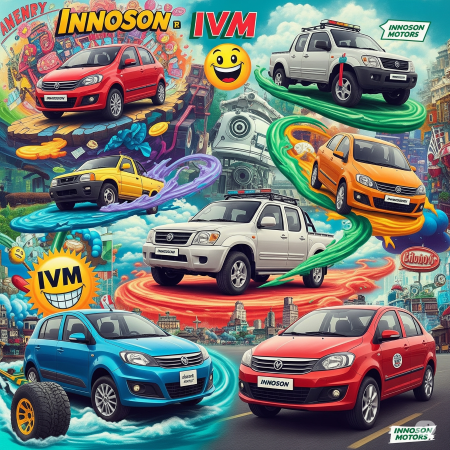
The company offers a broad product range, including cars, SUVs, pickups, buses, vans, tricycles (“keke”), and more recently, electric vehicles (EVs). A major selling point is that all vehicles are customized for African road conditions, with rugged suspensions, durable frames, and high ground clearance.


Image Credit: The Sun Nigeria
Unique Business Model Approach
Innoson’s business model prioritizes institutional buyers. The company focuses heavily on selling to government agencies, and corporate fleet operators. These clients offer large-volume orders, long-term contracts, and consistent cash flow.
It also serves individual buyers, particularly middle-class Nigerians looking for affordable new vehicles that offer a viable alternative to imported used cars.
One of IVM’s unique differentiators is its after-sales refurbishment program, which allows customers to return vehicles to the factory for restoration. This offering increases the lifecycle value of IVM vehicles and strengthens customer loyalty, especially in a continent where vehicle longevity is critical.
Challenges and Industry Constraints
Despite its success, Innoson Motors faces several significant challenges. The prevalence of imported used vehicles (“tokunbo”) continues to undermine the affordability and attractiveness of new cars. Many Nigerians still prefer cheap used imports, largely due to price sensitivity and brand perception. Changing this preference has required continuous marketing, education, and demonstration of product value.
Another major challenge lies in sourcing components. While local content is commendably high, the continued reliance on imported engines and gearboxes means that IVM’s supply chain is exposed to currency volatility, import tariffs, and global shipping disruptions.
The company also battles market perception issues, as some Nigerians still view foreign-made vehicles as inherently superior, despite IVM’s efforts to meet international standards.
Compounding these issues are inconsistent government policies and inadequate industrial infrastructure, which create an unstable environment for manufacturers. Factors such as poor roads, electricity instability, and unclear automotive import/export regulations have added layers of complexity to IVM’s operations.
Achievements and Growth Milestones
It has also achieved critical international certifications, including ISO 9001:2015 and MANCAP, which validate the quality and reliability of its manufacturing processes.
Export-wise, IVM has established a solid footprint across 25+ African countries, including Ghana, Sierra Leone, Mali, and Burkina Faso. This regional expansion highlights the brand's scalability and relevance outside its home market.
On the innovation front, IVM made headlines by introducing one of Nigeria’s first locally made electric vehicles, as well as compressed natural gas (CNG) vehicles, aligning with global shifts toward cleaner, more sustainable transport.
Government and corporate patronage have also played a critical role in the company’s growth. IVM has secured high-volume contracts from several Nigerian state governments, federal agencies, and other African administrations—bolstering both revenue and reputation.
Setbacks and Lessons Learned
IVM has not been immune to setbacks. In its early years, the company faced widespread skepticism about the viability of large-scale auto manufacturing in Nigeria. Additionally, the company continues to grapple with the challenge of producing engines and gearboxes in-house, which remains commercially unfeasible due to low volume and high capital costs.
Legal and financial challenges have also emerged. Notably, IVM was embroiled in a long-standing legal battle with GTBank, a case that attracted national attention. While the company ultimately secured a favorable judgment, the ordeal consumed management bandwidth and underscored the importance of financial governance in business growth.
Socio Economic and Industrial Impact
The broader impact of Innoson Motors on Nigeria and Africa cannot be overstated. The company has created thousands of jobs across its plants, dealerships, and supplier networks. It has also stimulated the development of a local supply chain, fostering the growth of small and medium enterprises (SMEs) in component production.
Strategic Outlook
Looking forward, Innoson Motors has several paths for strategic expansion. Vertical integration through local production of engines and transmissions would reduce dependency on foreign suppliers and increase profitability. Further expansion into Francophone Africa and other underserved regions could unlock new revenue streams.
Collaborations with international EV technology firms or global automakers could accelerate innovation and R&D. Additionally, building a robust aftermarket service and spare parts ecosystem could strengthen brand loyalty and enhance lifetime vehicle value.
Conclusion
Innoson Motors is a transformational force in African industrialization, blending local innovation, social consciousness, and business acumen. From its modest beginnings in spare parts trading to manufacturing electric vehicles and CNG-powered transport, IVM has consistently delivered solutions tailored to African realities. As the company continues to grow and evolve, it represents more than just a business—it embodies the aspirations of a continent striving for self-reliance, innovation, and global relevance.