Africa’s Vanishing Animals
Find out which iconic African animals are facing the threat of extinction.
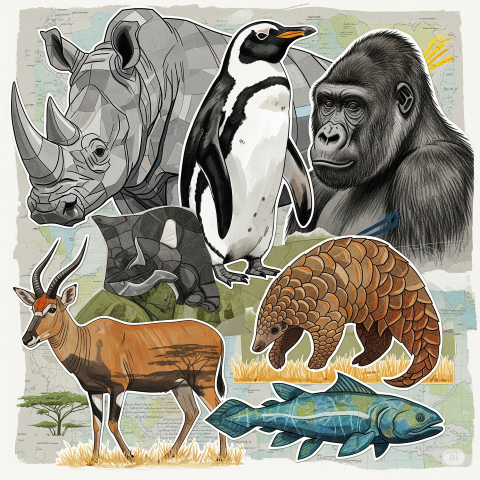
At dawn, across the dry plains of Tsavo and the mist-veiled ridges of Virunga, some of Africa’s most ancient creatures stir—quiet, elusive, and on the brink of extinction.
For centuries, Africa has been celebrated as the cradle of life; its wildlife a theater of abundance. But today, many of its creatures exist as whispers, hanging on not by evolution’s favor, but by bureaucratic threads, conservation miracles, and, sometimes, sheer luck.
The Rhino: Strength Meets Vulnerability

Image Credit: World Wild Life Foundation
Few animals have become as tragic a symbol of Africa’s conservation crisis as the black rhinoceros. Once roaming across vast stretches of East and Southern Africa, this two-ton herbivore has been whittled down to fewer than 5,000 individuals, down from tens of thousands just a few decades ago.
The decline was swift and brutal: a 96% population drop between 1970 and 1990, driven largely by the illegal horn trade. Despite international bans, rhino horn remains a prized commodity in parts of Asia, where it's believed to hold medicinal properties—an unscientific myth with deadly consequences.
Poaching remains a relentless threat, but coordinated anti-poaching efforts and community conservation models in Namibia and Kenya have brought cautious optimism. Yet the black rhino’s plight is far from over. It exists in fenced reserves, protected by armed guards—alive, yes, but no longer wild in the fullest sense.
Primates in Peril: Gorillas and Monkeys on the Edge

Image Credit: World Wildlife Foundation
In the forests along the Nigeria-Cameroon border, the Cross River gorilla—a rare subspecies of the western gorilla,lives in increasingly fragmented terrain. With fewer than 250 mature individuals, it's one of the most endangered primates on Earth. Unlike the more visible mountain gorillas, which benefit from tourism revenue and broad global awareness, the Cross River gorilla remains elusive and largely forgotten.
These gorillas suffer from the same pressures as their habitat: encroachment, logging, hunting. A report by Afrikanza likened their situation to “watching a cathedral being slowly dismantled, brick by brick.” Conservation efforts depend on international funding and the cooperation of local communities, many of whom face economic hardship themselves.
The Hirola: A Lone Lineage in Danger

Image Credit: Shutterstock

In the dry grasslands along the Kenya-Somalia border lives an antelope unlike any other. The hirola, also called Hunter’s hartebeest, is the last surviving member of its genus. If it goes extinct, an entire evolutionary branch disappears with it.
Today, only around 500 hirola remain in the wild. None exist in zoos or breeding centers, making conservation efforts urgent—and precarious. The animal’s decline isn’t due to poaching so much as ecological neglect: overgrazing by livestock, disease outbreaks, and the expansion of human settlement.
The Ethiopian Wolf: A Rare Carnivore Clings to Life

Image Credit: Wikipedia
Africa’s rarest predator doesn’t roam the plains—it pads silently through the Ethiopian highlands, hunting rodents in alpine meadows. The Ethiopian wolf, with its slender muzzle and rust-red coat, resembles a fox, but its lineage is older, more specialized.
With fewer than500 individuals,the species survives in scattered populations. Hybridization with domestic dogs, outbreaks of rabies, and shrinking habitat have steadily eroded their numbers.
Pangolins: Silent Victims of Global Demand

Image Credit: Ifaw
Pangolins may be Africa’s quietest tragedy. These shy, nocturnal insect-eaters are covered in keratin scales—the very feature that has led to their downfall. All four African pangolin species are now critically endangered due to poaching for their scales and meat.
Though pangolin meat is consumed locally in some regions, it is the global black market, driven largely by demand in Asia, that fuels mass trafficking.
According to Earth.org, pangolins are now the most heavily trafficked mammals in the world. In 2025, a Netflix documentary offered a flicker of awareness.
Vanishing Birds: Penguins and Larks

Image Credit: Britannica
Not all of Africa’s endangered animals walk on four legs. The continent’s skies and coastlines also echo with vanishing songs and fading wings.
The African penguin, native to the rocky shores of southern Africa, has lost over 99% of its population in just 100 years. Overfishing, climate change, and oil spills have ravaged its food sources. South African environmental agencies now estimate that the species could disappear from the wild entirely by 2035.
Further inland, the Botha’s lark—a small, ground-nesting bird found in South Africa’s grasslands, now numbers fewer than 350. Intensive farming and habitat fragmentation have decimated its population.
The Coelacanth: Time Traveler in Trouble

Image Credit: Thought Co
In the depths of the Indian Ocean, off the coasts of Tanzania and South Africa, swims a living fossil: the coelacanth. Once thought to have gone extinct with the dinosaurs, the species was rediscovered in 1938 and has fascinated scientists ever since.
But fascination doesn’t guarantee protection. Deep-sea trawling and oil exploration in their habitats now threaten the species.
The coelacanth’s incredibly slow reproductive cycle(females gestate for five years and live up to a century), makes any loss devastatingly hard to recover from. Every death sets back the clock by decades.
What We Stand to Lose
Each of these species represents more than a conservation challenge. They are symbols of wonder, of fragility, of a shared evolutionary history that we are erasing at an accelerating pace. Some are iconic; others anonymous. But all are slipping away, often unnoticed and largely un-mourned. Perhaps the question isn’t whether we can save them. It’s whether we are willing to.