A Schism To Remember: Thomas Sankara VS Blaise Compaoré
How deep was the bond between Thomas Sankara and Blaise Compaoré? What drove a trusted friend to turn into an assassin? And why did Sankara’s ideas make him a target?
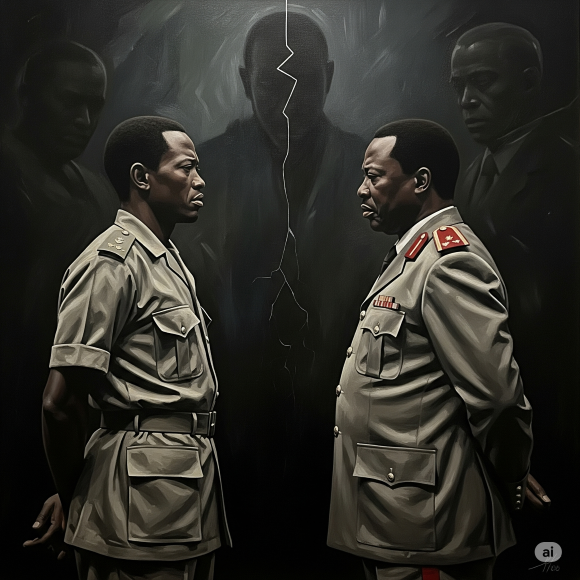
In a modest office in Ouagadougou, on a warm October afternoon in 1987, a man who had spent four years restructuring an entire nation walked into a meeting — and never walked out.
He was unarmed, and surrounded by friends. No bulletproof glass. No security convoy. He believed his revolution made him invincible.
This is the story of Thomas Sankara, the firebrand revolutionary president of Burkina Faso, and his betrayal at the hands of Blaise Compaoré — his comrade, confidant, and killer.
It is a story still whispered in the streets of West Africa, not because it is rare, but because it is too familiar. A bitter dance of politics and the personal.
People Die, Ideas Might Not

Image Above: Sankara(Left-Most Center Figure), Compaoré(Right-Most Center Figure)
When Thomas Sankara seized power in a coup in 1983, Burkina Faso was still known as Upper Volta—a landlocked, impoverished former French colony. Sankara, just 33, was a paratrooper and jazz guitarist. He immediately renamed the country “Burkina Faso,” combining two native languages to mean “the land of upright people.”
From the start, Sankara was unlike any African leader of his time. He cut ministerial salaries, including his own, to a pittance. He banned government officials from flying first class. He sold off the government’s Mercedes fleet and replaced them with cheap Renault 5s.
Heplanted millions of treesto halt desertification and redistributed land from feudal landlords to peasants. He mandated mass vaccination campaigns, built railways and roads with local labor, and established one of the continent’s most progressive policies on women’s rights.
And crucially—rather fatally, he refused foreign aid, particularly from the IMF and France, declaring, “He who feeds you also imposes his will”
By 1987, Burkina Faso was the only African nation with a budget not dependent on Western aid. But Sankara’s refusal to bow to foreign interests made him a target of growing concern. And his domestic policies, though visionary, angered powerful elites and traditional chiefs.
Still, none of them scared him. The only man he should have feared, if he feared anyone at all, was the one closest to him.
History
Rewind the Stories that Made Africa, Africa
A Journey Through Time, Narrated with Insight.
A Friend Today, Is Not A Friend Forever

Image Above(Sankara on the Left, Compaoré to the Right). Credit: Pan African Review
Blaise Compaoré was born on February 3, 1951, in the town of Ziniaré, in what was then Upper Volta. His father, a veteran of the Second World War, instilled in him a sense of stoicism early on. Compaoré began his education at a Catholic school in Fada N’Gourma, before moving on to a lycée in the capital, Ouagadougou.

Tragedy struck during his adolescence, as his mother died suddenly when he was just 15, and his father passed away a few years later.
After being expelled from the lycée, Compaoré turned toward the military, enrolling in basic training. It was during this period that he chose to pursue a career in the armed forces in earnest, eventually continuing his studies at the Yaoundé Military Academy in Cameroon.
There, he crossed paths with future key figures in Upper Volta's political evolution, including Henri Zongo and labor leader Soumane Touré.
After the 1974 Agacher Strip border conflict between Upper Volta and Mali, Compaoré was stationed in the north near Ouahigouya—where fate introduced him to Thomas Sankara. In the wake of this loss, Compaoré found solace and belonging with the family of Thomas Sankara—particularly Sankara’s father, Joseph, who came to regard him as a second son.
He and Thomas, idealistic and ambitious, quickly forged a bond that would shape the destiny of a nation. Compaoré was present during the 1983 coup that brought Sankara to power. He was entrusted with defense, foreign relations, and the president’s personal security. Sankara called him “my best friend.”
But by 1987, cracks had begun to show.
Compaoré was reportedly uncomfortable with Sankara’s growing radicalism and ideological purity. While Sankara refused foreign loans, Compaoré maintained quiet relations with French diplomats. And as Sankara pushed through his revolution at lightning speed, he made enemies not just in Ouagadougou, but in Paris, Abidjan, and Washington.
French intelligence, according tolater reports set to be declassified, began cultivating relationships with figures close to Compaoré. There were whispers of a conspiracy—a movement to “restore order.” But Sankara remained oblivious, or perhaps willfully blinded by the power of friendship.
History
Rewind the Stories that Made Africa, Africa
A Journey Through Time, Narrated with Insight.
Tragedy Strikes

Image Above: Conseil de l’Entente. Credit: Thomas Sankara Website
On the morning of October 15, 1987, Sankara arrived at the Conseil de l’Entente, a government building in Ouagadougou, for a regular meeting with the National Revolutionary Council. He wore a simple military uniform, carried no weapon, and greeted the soldiers outside with his usual warmth.
Minutes later, a group of heavily armed men, many of them from Compaoré’s personal guard, stormed the building. They shot him immediately, followed by twelve others present for the meeting. Sankara is said to have receivedtwelve bullets, mostly in his chest. His body was hastily buried in a shallow grave, unmarked, as Compaoré announced on national radio that “President Sankara died this afternoon in an unfortunate accident.”
The sole survivor, Halouné Traoré, would live to tell another story. There was no accident. There was only betrayal.
The Silence That Followed
After the coup, Compaoré wasted no time reshaping the narrative. He affirmed that the revolution had “gone astray”, opened Burkina Faso’s economy to foreign investment, welcomed IMF loans and reinstated ties with France.
Most crucially, Compaoré reversed Sankara’s nationalization programs, which had transferred key industries and commercial sectors from private hands to state control—hallmarks of Sankara’s Marxist policies. While Sankara’s policies aimed to reduce foreign influence and build economic self-reliance, they also sparked concern, both domestically and abroad, about the potential slide toward authoritarianism under an increasingly centralized state.
For 27 years, Compaoré governed with calculated political finesse, earning him a reputation among some international agencies as a “stabilizing force”.
Underground, Sankara became a symbol of what might have been. His face appeared on t-shirts, murals, and whispered conversations. Students shared bootleg recordings of his speeches, and by the early 2010s, frustration with Compaoré’s regime reached a boiling point.
In 2014, when Compaoré attempted to amend the constitution to extend his term, hundreds of thousands took to the streets. They set fire to the parliament and stormed government buildings.
Compaoré subsequently fled to Ivory Coast, where he remained in exile. Despite this, in 2022, a military court in Burkina Faso convicted him in absentia for the murder of Thomas Sankara.
History
Rewind the Stories that Made Africa, Africa
A Journey Through Time, Narrated with Insight.
Burkina Faso, In The Aftermath

Image Above: Thomas Sankara. Credit: Patrick Aventurier, 17 November 1986.
Today, Sankara’s legacy has turned into a national ethos. In Ouagadougou, a bronze statue of him stands tall, his arm raised toward the sky. Schools once afraid to mention his name now teach his speeches.
They imagine a Burkina Faso not shackled by debt or corruption. They imagine an Africa free to shape its destiny without suspicious interference. They imagine a leader who walked the talk, who refused luxury, and who perhaps could have changed their country for the better.