10+ Crypto Projects Died in the First Three Months of 2026, Here Is What Killed Them
Over 20 crypto projects, from DeFi protocols and NFT marketplaces to Bitcoin miners and blockchain games, have shut down in Q1 2026. Here is the full list, and the deeper forces driving the blockchain industry's most significant shakeout since 2022.
Before a single coin is minted or a token launched, there is always the idea's birth: a shared, tamper-proof ledger that no single authority could control.
Different blockchains are usually the infrastructure, and various cryptocurrencies are built on top of them.
All of this, when looked at together, invited a generation of builders, investors, and dreamers to believe that decentralisation was not just a technical concept but a financial revolution.
And for a while, that belief moved markets. Emerging economies from Nigeria to Indonesia, El Salvador to the UAE, saw in crypto something their traditional financial systems had repeatedly failed to deliver: access, speed, and borderless value transfer.
Venture capital has flooded across the crypto market. Different projects have been launched.
DeFi promised to replace banks, and NFTs promised to replace ownership as we knew it back then. GameFi promised to rewrite how entertainment and income could intersect. Everyone, it seemed, wanted a piece of the blockchain future.
While the future is still being written, Q1 of 2026 has filled its first chapter with obituaries.
Three months into the year, and over 20 crypto projects, DeFi protocols, NFT marketplaces, governance tools, analytics platforms, Bitcoin miners, and blockchain games have announced shutdowns, phased wind-downs, or outright bankruptcy.
This is not the rug-pull chaos of 2022, and most of these are orderly, transparent exits, with teams returning user funds and communicating clearly.
But that almost makes it more unsettling. When the fraudsters leave quietly, it is alarming. When the builders do, it is a reckoning.
The 2026 Blockchain Graveyard, Every Confirmed Exit
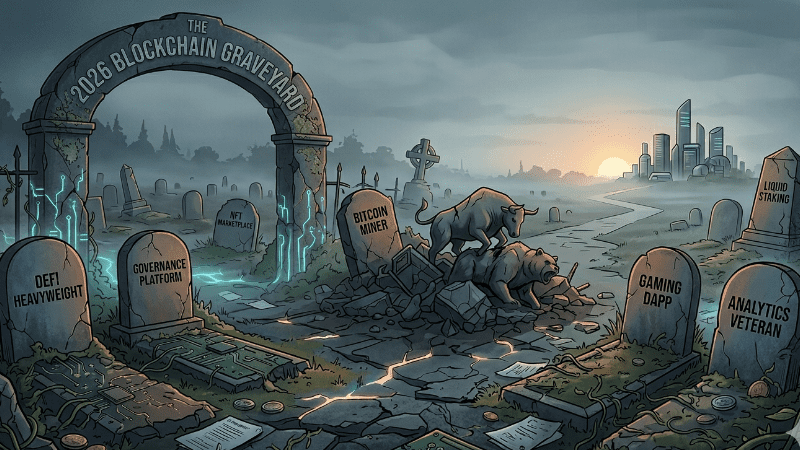
Tally: The governance platform that powered on-chain voting for over 500 DAOs, including Uniswap, Arbitrum, and ENS, quietly ceased all operations in mid-March, citing costs that simply no longer made sense.
Balancer Labs: The original entity behind the Balancer Protocol, wound down in late March following legal exposure from a $116 million past exploit and an inability to sustain corporate overhead, though the decentralised protocol itself continues running.
Angle Protocol: they began a phased shutdown of its EURA and USDA stablecoins, which had peaked at a combined $250 million in total value locked (TVL).
Milky Way: Celestia liquid-staking protocol that once held $250 million TVL, permanently closed on January 15 after liquidity evaporated entirely.
Polynomial Protocol: Polynomial protocol,which processed a peak volume of $4 billion in derivatives, walked away from operations, citing persistent liquidity problems and unsustainable running costs.
Magic Eden: While they dominated cross-chain NFT trading on Solana and Bitcoin, they began winding down its EVM marketplace and Bitcoin API in March, with full closure eyed for early April.
Nifty Gateway: The Gemini-owned NFT marketplace shut down effective February 2026 as trading volumes collapsed.

Entropy: A self-custody startup that raised $25 million, closed in January with its founder returning the remaining capital to investors.
Bit.com: Bit.com will complete a phased shutdown on March 31 as part of a broader business restructuring.
NFN8 Group: In the mining sector, U.S.-based NFN8 Group filed Chapter 11 bankruptcy after a data centre fire destroyed its operations.
GENSO Online: A fantasy RPG built on GameFi rails, announced the full shutdown of its servers and marketplace for April 30, after revealing that server costs were running five times higher than revenue.
Pixiland: Pixel, a strategy game on Ronin indefinitely suspended all Web3 and token plans in mid-January, pivoting entirely to a Web2 model.
Forgotten Runiverse: An Ethereum-based MMORPG, went dark indefinitely in late January, citing financial infeasibility.
Archblock: The crypto firm filed for Chapter 11 in early February with $100 million in liabilities against just $10 million in assets.
Tudou Guarantee: A Telegram-based crypto escrow service focused on Southeast Asia, shut down in January following regulatory action tied to illicit activity.
What Actually Killed Them

The post-2025 liquidity hangover is the most direct explanation. After a bull run that pushed TVL to record heights, capital retreated toward safety, Bitcoin ETFs, blue-chip protocols, and stablecoins.
What is left behind are projects that had chased growth through unsustainable incentive structures, only to watch users disappear the moment APYs normalised.
High fixed costs, legal teams, compliance infrastructure, and cross-chain maintenance became fatal burdens. Add a hack to the equation, and the mathematics turned irreversible.
Narrative collapse accelerated the damage. Restaking, GameFi, and NFTs, the stories that powered the 2024–25 cycle, have lost the market's imagination.
Capital is now rotating toward real-yield products and tokenised real-world assets. Everything else is competing for scraps.
Meanwhile, artificial intelligence has emerged as the dominant destination for both venture funding and engineering talent, pulling resources away from blockchain projects that might otherwise have survived a leaner quarter.
This Is Not the Death of Crypto, It Is Its Growing Pain

There is a silver lining in the wreckage, if you are willing to look for it. The overwhelming majority of these closures have been orderly.
The Team and organisation communicated early. Users withdrew safely, and founders returned capital where they could.
That discipline was absent in some scenarios in the past. Its presence now signals something important: the industry is maturing.
The speculative froth is being cleared away, and what remains is being forced to justify its existence through genuine utility and sustainable revenue, not hype cycles and liquidity mining incentives.
History offers a frame for this moment. The 2018 ICO collapse eventually gave birth to DeFi. The 2022 crash opened the door to institutional adoption.
If the pattern holds, 2026's purge may well clear the runway for a leaner, more resilient generation of crypto infrastructure, one built for revenue from day one rather than endless dilution.
The question, as always, is not whether the technology survives. It is who is still standing when the dust settles.