Zambia's '26 Election Results: Hichilema Leads as Tensions Mount and Constituencies Report
The AU-COMESA EOM has called for calm in Zambia's ongoing electoral process and issued recommendations for the 2026 general election, targeting government, ECZ, political parties, and media. Early results for the August 2026 presidential election show Hakainde Hichilema leading Brian Mundubile, while local elections have also seen declarations and allegations of irregularities have surfaced, coupled with emotional reactions from supporters.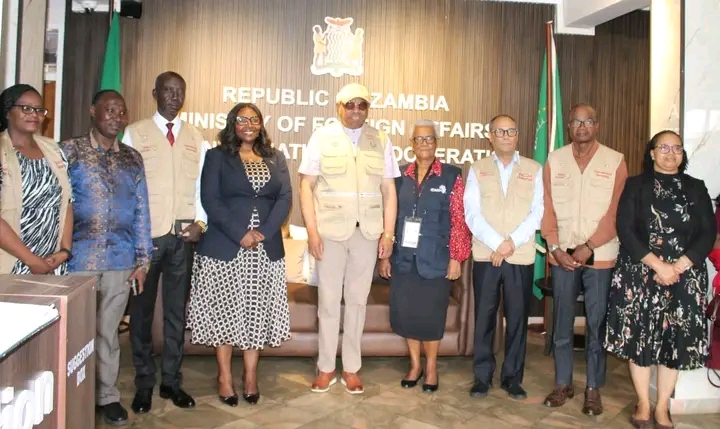
The African Union-COMESA Election Observation Mission (AU-COMESA EOM) has urged all stakeholders involved in the ongoing Zambian electoral process to maintain calm, exercise restraint, and avoid any actions or statements that could escalate tensions. The Mission emphasized allowing the Electoral Commission of Zambia (ECZ) to complete the counting and verification of results, announce the outcomes, and ensure that any electoral disputes are resolved peacefully through established legal and institutional mechanisms. With the electoral process still underway, the AU-COMESA EOM offered preliminary recommendations for various stakeholders ahead of the 2026 general election.
For the Government of Zambia, the Mission recommended ensuring an enabling environment during elections by urgently addressing underlying causes of tension and politically motivated violence that restrict constitutionally guaranteed freedoms and rights. The Legislature was advised to undertake electoral and constitutional reforms through broad-based consultations, ensuring that electoral legislation is enacted well in advance to allow for adequate implementation, stakeholder preparation, and civic and voter education. The AUEOM reiterated its 2016 and 2021 calls for legislation to effect constitutional provisions for political party funding and campaign finance accountability. Additionally, the Legislature should review the application of the Public Order Act and other laws affecting civic and political rights to ensure consistency with the Constitution and Zambia’s regional and international obligations on freedoms of assembly, association, and expression. A clear legal framework governing constituency delimitation, including objective criteria, population quotas, permissible variances, and statutory timelines for public consultation and publication, was also recommended.
The Electoral Commission of Zambia (ECZ) was advised to increase the number of polling stations to accommodate the growing electorate, improving accessibility and reducing congestion. They should also increase the number of polling booths to a minimum of three, in line with the number of registered voters, and consider more efficient voter-verification mechanisms to reduce delays. The use of a single voter verification document was suggested to speed up voter processing at polling stations. The ECZ should conduct a post-election evaluation to assess the conduct of the 2026 general election, determining what worked and what did not, to guide future election cycles. Increasing partnerships with stakeholders to provide targeted voter education, especially to enhance youth participation, and considering the adoption of a Biometric Voter Identification system to reduce slow voting processes were also key recommendations.
Political Parties were urged to strengthen internal party democracy through transparent, competitive, and inclusive candidate selection processes. They should refrain from inflammatory rhetoric, political violence, and intimidation, instead promoting issue-based campaigns that foster peaceful political competition. Electoral-related disputes must be channeled through appropriate legal mechanisms. Civil Society Organisations (CSOs) were encouraged to continue civic and voter education initiatives, particularly targeting women, youth, first-time voters, and persons with disabilities. CSOs should also continue engaging with state institutions and political actors to promote accountability, inclusion, and democratic reforms based on recommendations from domestic observers and international election observation missions. The Media was called upon to adhere to the Electoral Code of Conduct, ensuring balanced, accurate, impartial, and equitable coverage of all political contestants throughout the electoral cycle. Specifically, the Zambia National Broadcasting Corporation (ZNBC) should provide equitable airtime and coverage to all candidates, in accordance with Article 50 of the Constitution and regional and international standards, to ensure a level electoral playing field.
In the August 2026 presidential election, UPND presidential candidate Hakainde Hichilema is currently leading after results from a consolidated 27 out of 226 constituencies were announced by the ECZ. According to the tally, Hichilema has polled 243,509 votes, while National Reconciliation Party for Unity and Prosperity (NRPUP) presidential candidate Brian Mundubile has garnered 161,883 votes. These 27 constituencies represent 11.95 percent of the total, showing a gap of 81,626 votes in Hichilema's favor. Of the declared seats, Hichilema won 14 constituencies and Mundubile won 13, indicating a competitive race across both urban and rural areas. Hichilema's strongest performances were observed in Lusaka Province, where UPND swept all 8 reported constituencies including Lusaka Central, Matero, Munali, and Kanyama. He also secured wins in North Western Province (Kabompo West, Solwezi West) and Central Province (Mkushi North, Kabwe Central). Mundubile posted his biggest numbers from Eastern Province, taking 10 constituencies including Petauke Central, Lundazi, and Mambwe, as well as Muchinga Province (Chinsali, Chama North, Chama South) and Northern Province (Mporokoso). The Copperbelt Province saw a split between the two candidates. The ECZ stated it is working to transparently conclude the tallying and announcement of results from the remaining 199 constituencies without undue delay.
Meanwhile, local election results also saw declarations. Mr. Kasikili was declared duly elected at the Northmead Secondary School totalling centre, with his victory signifying that the people of Roma Constituency would benefit from 40 million Kwacha for development. He thanked residents for their support. Other candidates in the Roma Constituency race included Independent Sean Tembo (6,414 votes), Independent Glead Mwenya (4,209), Francis Mulenga (2,024), Socialist Party’s Chungu Zhane (1,166), and Chansa Robert (536 votes). The UPND also secured three ward seats within Roma Constituency: Silwizya, Kalingalinga, and Mulungushi.
Amidst the ongoing tallying, allegations of a well-coordinated plan by the NRPUP to circulate fake G20 results and prematurely declare themselves winners have emerged from multiple sources. These sources further alleged that some police officers were approached with promises of senior positions and were prepared to cooperate with the NRPUP during the elections. However, the presence of Special Forces from the army reportedly surprised those involved in the alleged scheme. It was also noted that certain senior officers were targeted for promotions, with the sentiment that dealing with the police is easier due to aspirations for promotions, while the military is perceived as more challenging. The tensions surrounding the election outcome were palpable, with Emmanuel Jay Jay Banda reportedly seen shedding tears and pleading for divine intervention after realizing that the odds were not favoring their side. Similarly, another emotional supporter was observed crying and praying to God to grant Brian Mundubile victory, expressing deep worry about the outcome and desperately calling for a favorable result for their preferred candidate.