Ukraine Defiance: Zelenskyy Vows Victory as Europe Grapples with Energy War and Sanction Battles
Recent weeks in late August 2025 have seen Ukraine's Independence Day celebrations and continued international military aid juxtaposed with escalating diplomatic disputes. Attacks on the Druzba oil pipeline have halted supplies to Hungary and Slovakia, intensifying Budapest's anti-Ukraine stance within the EU. Meanwhile, a major debate on post-war security guarantees for Ukraine is unfolding, highlighting divisions among European leaders and prompting legal challenges to EU sanctions.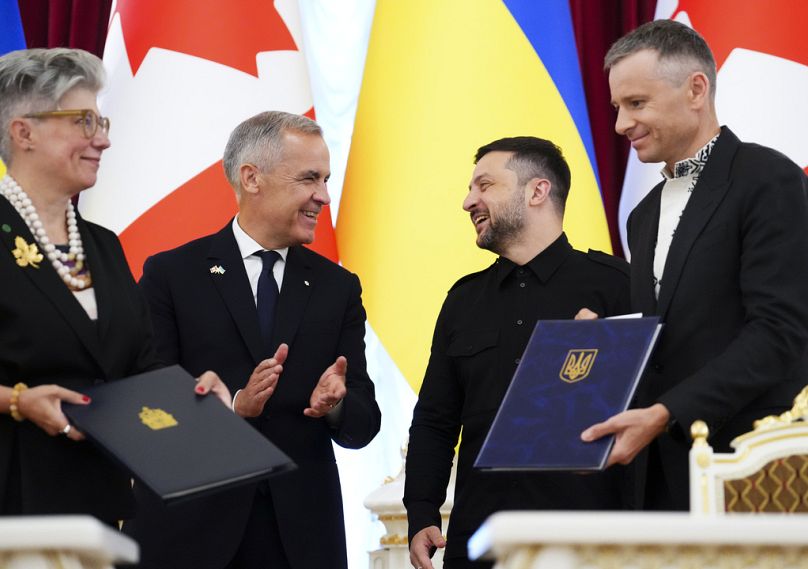
The ongoing conflict in Ukraine continues to fuel a complex web of military actions, diplomatic disputes, and legal challenges across Europe, particularly in late August 2025. Ukraine marked its Independence Day with President Volodymyr Zelenskyy vowing continued resistance against Russian forces, now well into its fourth year. In a defiant speech, Zelenskyy emphasized pushing back the war to Russian territory and increasing pressure on Moscow, asserting that peace is "coming." This commitment to defiance is bolstered by significant international support, as evidenced by Canadian Prime Minister Mark Carney's visit to Kyiv, where a defence agreement was signed, and €1.3 billion in new military assistance was announced, focusing on urgently needed equipment like drones, ammunition, and armored vehicles. This also included plans to expand defence-industrial cooperation and production facilities in both Ukraine and Canada. Meanwhile, humanitarian efforts continued with the 68th prisoner exchange between Ukraine and Russia, which saw the return of military personnel and eight Ukrainian civilians, including two journalists and a former mayor of Kherson, many of whom had endured over three years of captivity.
However, these affirmations of solidarity are set against a backdrop of increasing tensions and diplomatic rifts, particularly concerning energy security. Hungary and Slovakia have voiced strong disapproval of Ukraine's actions, specifically its continuing attacks on the Druzba oil pipeline on Russian territory. The latest incident involved a strike on the Unecha oil pumping station in Russia, marking the third such attack in a week and effectively halting Russian oil deliveries to both Hungary and Slovakia for at least five days. In a joint letter to the European Commission, Hungarian Foreign Minister Péter Szijjártó and Slovakian Foreign Minister Juraj Blanár condemned Ukraine's "completely irresponsible" actions, arguing that they severely threatened the energy security of their nations, despite the hundreds of billions of Euros in support provided by the EU to Ukraine. While Ukraine did not officially acknowledge the strikes, Robert Brovdi, head of Ukraine's Unmanned Systems Forces, posted a video on Telegram showing the aftermath, adding a provocative message in Hungarian. Hungarian minister Szijjártó further stated on his X-account that these attacks primarily harm Hungary and Slovakia, not Russia. Both countries continue to import substantial amounts of Russian oil due to carve-outs from EU sanctions. Former US President Donald Trump also reacted strongly to a complaint from Hungarian Premier Viktor Orbán, expressing his anger and calling Orbán a "great friend." In contrast, Polish Foreign Minister Radoslaw Sikorski criticized Hungary's position, recalling its frequent vetoes in the EU regarding support for Ukraine. The European Commission, while acknowledging receipt of the letter, reiterated that EU security of supply was not in danger, citing Member States' requirements to maintain 90 days of emergency oil stocks, which both Hungary and Slovakia reportedly possess.
These energy-related tensions are part of a broader pattern of Hungarian diplomatic friction within the EU concerning Ukraine. Hungary refused to sign an EU statement condemning a recent major Russian aerial attack on Kyiv that killed 23 people, including children, and damaged diplomatic premises. This refusal aligns with Budapest's consistent rejection of financial or military support for Ukraine and its frequent vetoes of joint EU statements. The remaining 26 EU member states have increasingly bypassed Hungary to issue statements in their own names. Furthermore, Hungary is actively seeking to block Ukraine's EU accession, with a government-organized survey indicating overwhelming public opposition to Ukraine joining the bloc. In response to the pipeline attacks, Hungary banned Ukraine's drone unit commander, Robert Brovdi, from its territory and the entire Schengen Zone, leading to further social media spats between the two nations' foreign ministers.
Beyond these immediate concerns, European nations are also deeply divided on the critical issue of security guarantees for Ukraine in a post-war scenario. Italy's Deputy Prime Minister Matteo Salvini ignited a firestorm with France by urging President Emmanuel Macron to personally go to Ukraine "with his helmet, gun, and bullet-proof vest," and accusing Macron of using the war to boost his alleged low popularity. Salvini firmly opposes the deployment of Italian soldiers in Ukraine, advocating instead for a collective defence mechanism inspired by NATO's Article 5, which would protect Ukraine without formal NATO membership, thus avoiding Russia's "red lines." Conversely, President Macron has taken a leading role, calling for the deployment of a robust security guarantee force with air, sea, and land components, positioned "behind the front line" alongside Ukrainians to deter future Russian aggression, emphasizing European strategic autonomy. Experts like Élie Tenenbaum dismiss Salvini's claims about Macron's motives, suggesting the Ukrainian issue is not primarily a domestic popularity tool. Internally, Italy's coalition government is also divided, with Prime Minister Giorgia Meloni supporting Ukraine and sanctions, while Salvini's Lega, with its historical ties to the Kremlin, frequently opposes European support, balancing public opinion with EU and NATO commitments.
The debate over security guarantees extends to the practicalities of military assistance. The EU's High Representative, Kaja Kallas, confirmed broad support among member states to extend the EU Military Assistance Mission in support of Ukraine (EUMAM Ukraine) to sites within Ukraine following a ceasefire. Since its launch in November 2022, EUMAM Ukraine has trained approximately 80,000 Ukrainian soldiers across various European locations, with 24 EU member states and Norway participating. While there is a consensus on extending the mission, a rift exists regarding the timing: some favor extending only after a ceasefire, while others advocate for updating the mandate immediately so it can take effect upon cessation of hostilities. Latvian and Estonian defence ministers expressed readiness to send instructors but highlighted the immense logistical and security challenges, even after a ceasefire, citing the risk of Russia breaking any truce. Kallas views this training mission as a vital element of the security guarantees the EU could provide, noting that Americans have been clear about Europeans taking the lead on such guarantees. Discussions are ongoing within the "Coalition of the Willing" (around 30 mostly European countries) to map out short- and long-term deterrence strategies. Kyiv ultimately views NATO and EU memberships as the ultimate security guarantees but also calls for continued supplies of military equipment, training, and intelligence. Alongside the training mission, France and the UK are spearheading efforts for a "reassurance force" of European troops in no-contact areas, though some nations are hesitant without US involvement. Trump has indicated US willingness to provide "backstops" like air/missile cover and intelligence sharing, but ruled out ground troops. The EU is also focusing on bolstering Ukraine's defence capabilities and closing its own military capability gaps, identifying nine priority areas for defence investments (including air defence and drones) and proposing a €150 billion loan scheme for joint procurement, with a goal to assign "lead nations" and negotiate contracts by October.
Further complicating the landscape of EU actions is a novel legal challenge against the Council of the European Union. Businessman Alisher Usmanov has initiated what lawyers describe as a first-of-its-kind defamation action in a Hamburg court, challenging the Council's statement of reasons for listing him under EU sanctions in September 2023. Usmanov's lawyer, Joachim Steinhoefel, argues that key assertions relied upon by the Council were unsubstantiated, citing instances where media allegations—such as claims that Usmanov "reportedly fronted for President Putin" or that Putin called him "his favourite oligarch"—were found unlawful or based on retracted information. Steinhoefel contends that the Council failed to meaningfully verify sources, relying on "unverified press cuttings" in contravention of EU case-law requiring multiple, independent, specific, reliable, and consistent sources. The lawsuit also targets the Council's assertion that Usmanov "actively supported the Russian government’s policies of destabilisation of Ukraine" simply by operating a business in Russia and paying taxes. Steinhoefel labels this inference a "perverse inversion of basic rights," arguing it constitutes "coercion by proxy"—instrumentalizing lawful private conduct for foreign policy leverage. As EU courts do not provide a tort-style defamation action against EU institutions, Steinhoefel's attempt to sue the Council in Germany was initially blocked by an appeals court citing immunity, leading to an appeal to the Federal Court of Justice, claiming a violation of the right to judicial redress. The suit seeks to prohibit the Council from further disseminating the contested statements, rather than challenging the sanctions listing itself, highlighting the intricate legal dimensions of EU foreign policy.