Twenty Graduates, ₦1 Billion: Is the NYSC Still Safe to Serve?
Nigeria’s NYSC abduction raises questions about graduate safety, kidnapping, ransom, national service, and whether scrapping the scheme can solve insecurity.

Imagine finishing university, packing your bags, telling your family you are going to serve your country, and then disappearing on the road before you even reach camp.
For the families of prospective corps members travelling from Ibadan to orientation camps in Abia and Akwa Ibom, that became the reality on Independence Day, October 1, when unknown gunmen attacked two buses in Umunoha, Imo State.
Police said 20 passengers were abducted, while 10 others were rescued at the scene; the abducted group included prospective NYSC members. Families later said kidnappers demanded ₦50 million for each victim, putting the initial ransom at ₦1 billion. The demand was reportedly later reduced, but the larger question remains: if young Nigerians cannot safely travel to begin a compulsory national service year, what exactly does “national service” mean?
The NYSC Was Built for Unity, Not This

The National Youth Service Corps was created in 1973, after the Nigerian Civil War, with a stated purpose of rebuilding national ties, encouraging unity and exposing young Nigerians to communities beyond their places of origin. The scheme has therefore always involved a deliberate movement of graduates across state and cultural lines, with corps members serving in schools, hospitals, businesses, public institutions and communities.
But the country in which the scheme operates has changed. The Federal Executive Council approved reforms in June 2026, including risk-sensitive deployment and a redesigned orientation programme, showing that safety is already part of the conversation around the scheme.
Yet the Imo incident raises a more uncomfortable question: how much can a risk-sensitive system protect people when the roads themselves remain vulnerable?
The incident has revived calls to suspend or scrap NYSC. Omoyele Sowore, reacting to the abduction, called for the scheme to be suspended and eventually scrapped, proposing a voluntary National Job Corps instead, with graduates able to serve within their states rather than being compelled to travel long distances.
Peter Obi, meanwhile, called for the immediate and safe rescue of the abducted prospective corps members and warned against treating insecurity as normal.
These are different responses to the same event, and they point to the real debate. If compulsory national service exposes graduates to avoidable danger, changing the system deserves serious consideration. But would abolishing NYSC remove the insecurity that made the journey dangerous in the first place?

Image credit: The Guardian Nigeria
A trader travelling between states can be kidnapped. A farmer can be kidnapped. A student can be kidnapped. A family travelling for a wedding can be kidnapped. Workers travelling to their jobs can be kidnapped.
RECOMMENDED READ: The Ransom Economy: Inside Nigeria's Billion-Naira Kidnapping Industry
Recent security data illustrate how broad the problem has become: SBM Intelligence recorded 7,825 kidnapping victims across Nigeria between July 2025 and June 2026, alongside 1,411 kidnapping incidents. The problem therefore extends far beyond the NYSC population.
There is also a distinction between protecting corps members and protecting Nigerians generally. Because NYSC is a federal programme, stronger route planning, security assessments, and communication around major movements are reasonable questions.
But a security system that only becomes active when a person is wearing khaki would miss the larger problem: the same road carries traders, teachers, students, transport workers and families.
What Does Nigeria Owe These Graduates?
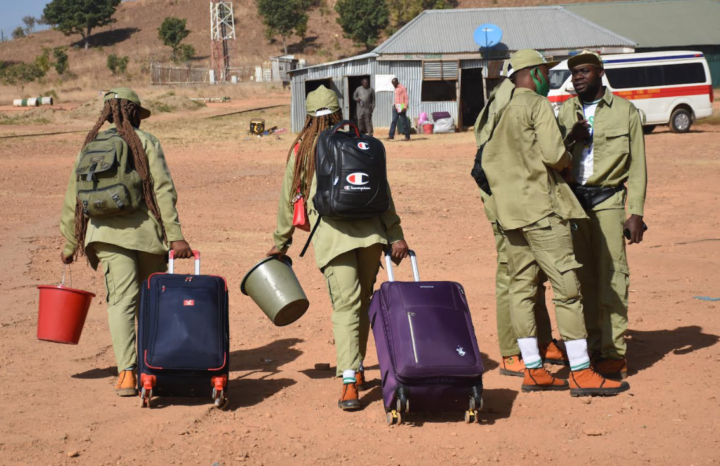
There is something deeply unsettling about the economics of the situation. A corps member currently receives ₦77,000 monthly, meaning twelve months of the federal allowance amounts to ₦924,000. The national minimum wage is ₦70,000. Yet the families of some of these young graduates were initially confronted with a demand of ₦50 million per person.
The comparison is not meant to suggest that ransom should be measured against an allowance. Human life does not have a price tag, and a kidnapper’s demand is not a legitimate valuation of anyone’s life. But the figures show the extraordinary financial violence families can face when kidnapping becomes a negotiation.
For a young graduate who has just finished university, the service year is supposed to be a bridge into adulthood. It may be a first job-like experience, a chance to earn something, meet people, build connections and begin figuring out what comes next. Instead, some families spent Independence Day wondering whether their children would return home alive.

The rescue effort also shows how complicated the security problem has become. Police said drones helped locate the suspected hideout, but officers delayed advancing because intelligence indicated the camp had been fitted with improvised explosive devices. Additional tactical teams and operational assets were deployed, with the authorities saying efforts were continuing to rescue those still in captivity.
RECOMMENDED READ: If Kidnappers Leave Phone Records, Bank Trails and Social Media Videos, Why Are They Still So Hard to Catch in Nigeria?

The timing makes the emotional weight harder to ignore. Independence Day is usually a day of flags, speeches and celebration, but for these families the national celebration arrived with phone calls, uncertainty and ransom demands. Their children had not travelled for leisure; they were on a journey created by a national programme that asks graduates to leave familiar environments and serve elsewhere.
It is also worth separating two debates that can easily become one. The first is whether NYSC, designed for a very different Nigeria, still needs to remain compulsory. The second is whether Nigerians can move safely within their own country. The first can be debated through policy and reform; the second is a much broader question of public safety.
The question, then, is not simply whether NYSC should survive in its present form. It is whether Nigeria can maintain a national programme that asks young people to move across the country without making their safety an afterthought.
Perhaps NYSC needs reform. Perhaps deployment should become even more security-sensitive, with better route assessments, transport coordination and emergency response. Perhaps the country should examine whether compulsory service still achieves its original purpose in its present form.
But whichever direction that conversation takes, the underlying problem remains larger than NYSC. Nigeria cannot solve kidnapping merely by changing who is travelling. The people who are not corps members will still be on those roads.
The real test of national service may therefore be more basic than the colour of a corps member’s khaki. Can a young Nigerian travel from one state to another, start work, attend school, visit family or simply go home without having to calculate whether the road is safe?
Until that question has a credible answer, the debate over NYSC will remain only one part of a much larger Nigerian security problem.