The Pharmacy Has Become Our First Stop for Healthcare. Should It Be So?
Nigeria's pharmacies and chemist stores have made healthcare more accessible, but growing reliance on self-medication raises questions about diagnosis, medicine safety, and health education.
Growing up, the pharmacist was usually the second professional, or sometimes the third, that Mustapha met whenever his mother took him to the hospital because he was sick.
The process was predictable: a nurse would issue them a card, they'd have to wait for their turn, and eventually a doctor would go ahead to ask him what felt like a million questions he did not really care about, and sometimes requested tests before bringing out his pen to write what looked like complete rubbish on a piece of paper.
Mustapha could not understand how the pharmacist could read that handwriting, identify the medicines, and somehow know exactly what the doctor had written. Still, he never questioned it for long because the medicine usually came next.
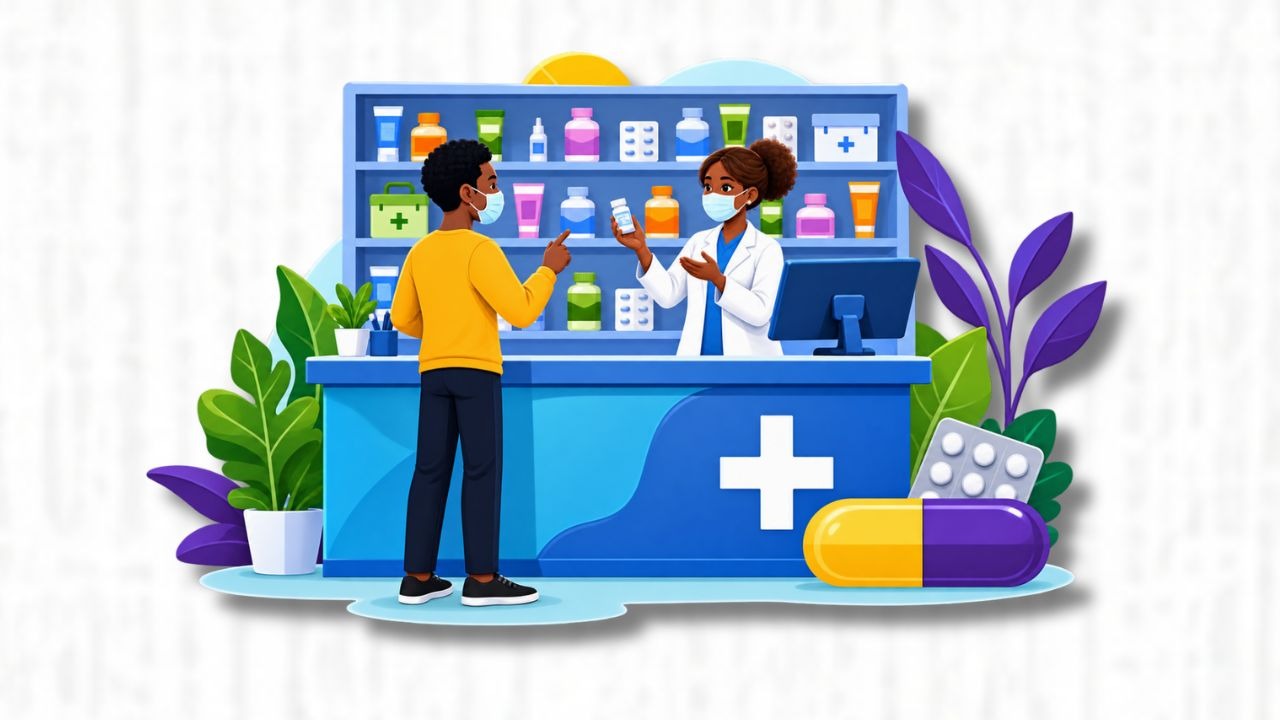
Many of us probably remember some version of that routine. But today, Mustapha does not necessarily need to enter a hospital before deciding what to take; a headache can send him straight to the medicine cupboard because “this was what he used last time,” while a walk to the chemist across the street can turn a complaint into a packet of tablets within minutes.
The pharmacist or medicine seller asks what is wrong, listens to the symptoms, recommends something, and Mustapha walks home feeling he has solved the problem without the queue, consultation fee, laboratory test, or several hours a hospital visit might require. That convenience did not appear from nowhere.
How Did We Get Here?

Image source: Shorthandstories
One major part of the story is the rise of the neighbourhood chemist store, which brought medicines much closer to ordinary Nigerians. These outlets filled a genuine gap: when someone has a headache, stomach discomfort, or another familiar complaint, a nearby shop is considerably easier to reach than a hospital that may involve transport costs, long queues, consultation fees, and lost working hours.
This is not an attack on chemists or community pharmacies, because many provide an important grassroots service; the bigger question is what happened when a system built for accessibility gradually became part of how people learned to approach healthcare itself.
In this context, “chemist” is a loose Nigerian slang for a small medicine outlet or neighbourhood version of a pharmacy, not someone who studied chemistry or works as a chemist.
There are other reasons too. Hospitals can be expensive, public facilities can involve long waiting times, and many Nigerians have become accustomed to treating minor symptoms themselves because they have done it before without an obvious problem.
Then there is the advice network: “Take this one, it worked for me,” a relative recommending an old prescription, a friend sharing what they used for the same complaint, or someone checking the internet before deciding that they already know what is wrong.
For Mustapha, the pattern he grew up with was the traditional chain of symptom → professional assessment → diagnosis → prescription → medicine, which has now slowly become symptom → assumption → medicine.
The first model has certainly not disappeared, especially inside hospitals, but the second has become so normal that many people no longer see the difference.
Should Pharmacy Replace the Doctor?

This is where we need to be careful.
A pharmacy can be an important and accessible part of healthcare, and pharmacists are trained healthcare professionals who can provide advice on medicines and appropriate care. The problem begins when convenience turns every health complaint into a medication question, because a medicine can address a symptom while the underlying cause remains unidentified.
Take Mustapha's headache. He could take the same medicine that helped him the last time, but a headache does not automatically have the same cause every time it happens, and persistent, severe, unusual, or worsening symptoms may require proper medical assessment.
The same principle applies to antibiotics: taking an antibiotic because it helped someone previously does not mean it is appropriate for a different illness, and unnecessary antibiotic use contributes to antimicrobial resistance.
This is why the question is not whether pharmacies or “chemists” should exist or whether people should stop using them. It is whether we have allowed the most convenient point of access to quietly become the default point of diagnosis.
What We Need Is More Sensitisation, Not More Fear


Mustapha needs to know something simple: a medicine that worked for Emeka does not automatically mean it will work for Femi, and neither should it automatically be prescribed to Ibrahim.
People can experience similar symptoms for completely different reasons, and the right treatment can depend on the individual's condition, medical history, other medicines, and other factors that cannot always be established from a few questions at a counter.
The answer is therefore not to frighten people away from pharmacies, but to improve health education so people understand when a pharmacist can help, when self-care may be reasonable, and when a doctor or other qualified healthcare professional needs to assess the problem.
Pharmacies should remain accessible, but the public also needs to understand that dispensing medicine and establishing a diagnosis are not the same thing.
Maybe Mustapha's childhood confusion about the doctor's mysterious handwriting was actually pointing to something important: there was a process behind the medicine he received.
Today, we have made healthcare more convenient in many ways, but convenience should not make us forget that knowing what medicine to take begins with knowing what is actually wrong.
Because sometimes the cheapest trip to the chemist can save you a hospital queue, and sometimes, the hospital queue is exactly the trip you needed to make.