The Fight Outside the Ring—Anthony Joshua’s Tragedy, The Loss of Lives and The Unfiltered Reality
Anthony Joshua survives a tragic road accident in Ogun State that claimed two close associates. This reflective social commentary examines loss, celebrity, systemic failure, and the human cost behind survival.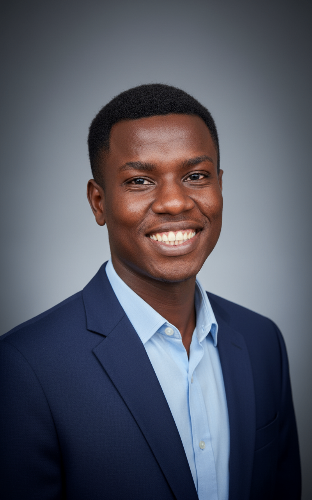

You might have probably heard it too, the recent accident involving Anthony Joshua and his team in Ogun State of Nigeria and I daresay this is a fight outside the ring and not the usual fight against an opponent that you know off but a fight for life.
The Internet and various social media platforms were thrown into a frenzy when the news of a fatal accident surfaced on Monday the 29th of December and there have been a lot of comments on this matter.
Honestly, if you have ever survived an accident or been to an accident scene, you would know for a fact that there are moments when life reminds you that titles, positions or degrees do not offer immunity and Anthony Joshua seemed to have experienced it.
A Nigerian-born and a two-time world heavyweight champion, Anthony Joshua is someone whose name echoes across arenas from London to Las Vegas, Joshua is not just a boxer but he is a personality who represents discipline, reinvention, and resilience.
He is a global boxing star, but also a son who returns home, a man whose roots remain firmly planted in Nigeria.
Just less than two weeks after recording a high-profile victory against Jake Paul on December 19, 2025, in Miami, Joshua’s world tilted in another direction and it looked like immediately he left the noise of the ring and the flashing cameras that comes with it—He is now another internet sensation again but this time as a result of an accident.
RECOMMENDED READ:Boxing star Anthony Joshua, Survives Fatal Accident that killed Two of His Close Associates
This story happened on a Nigerian road in Ogun State, where a tragic accident claimed the lives of two men close to him—men who were not just colleagues, but companions in the grind behind greatness.
This piece that you are about to read is not about sensational survival stories or internet conspiracies. It is about what survival exposes: grief that doesn’t trend, systems that fail loudly in silence, and truths that become uncomfortable once a celebrity is removed from the picture.
This is a story about loss, responsibility, and the fragile reality of infrastructure in a country where survival too often depends on luck rather than design.
The Accident That Brought This Conversation
What is publicly known is straightforward, and there is no need to beat about the bush or dance with words.
It is quite obvious that Anthony Joshua was in Nigeria visiting his father and family members in Sagamu, Ogun State.
Social Insight
Navigate the Rhythms of African Communities
Bold Conversations. Real Impact. True Narratives.
It is during this visit, that this road accident probably occurred—one that took the lives of Sina Ghami, a key member of his strength and conditioning team, and Latif “Latz” Ayodele, a trainer, confidant, and longtime friend.

The aftermath of the accident was as sobering as the accident itself because according to eyewitnesses there was no ambulance to help the casualties at the scene. There was no emergency response that came on time, no toll-free line proved helpful in a moment when minutes could define life and death.
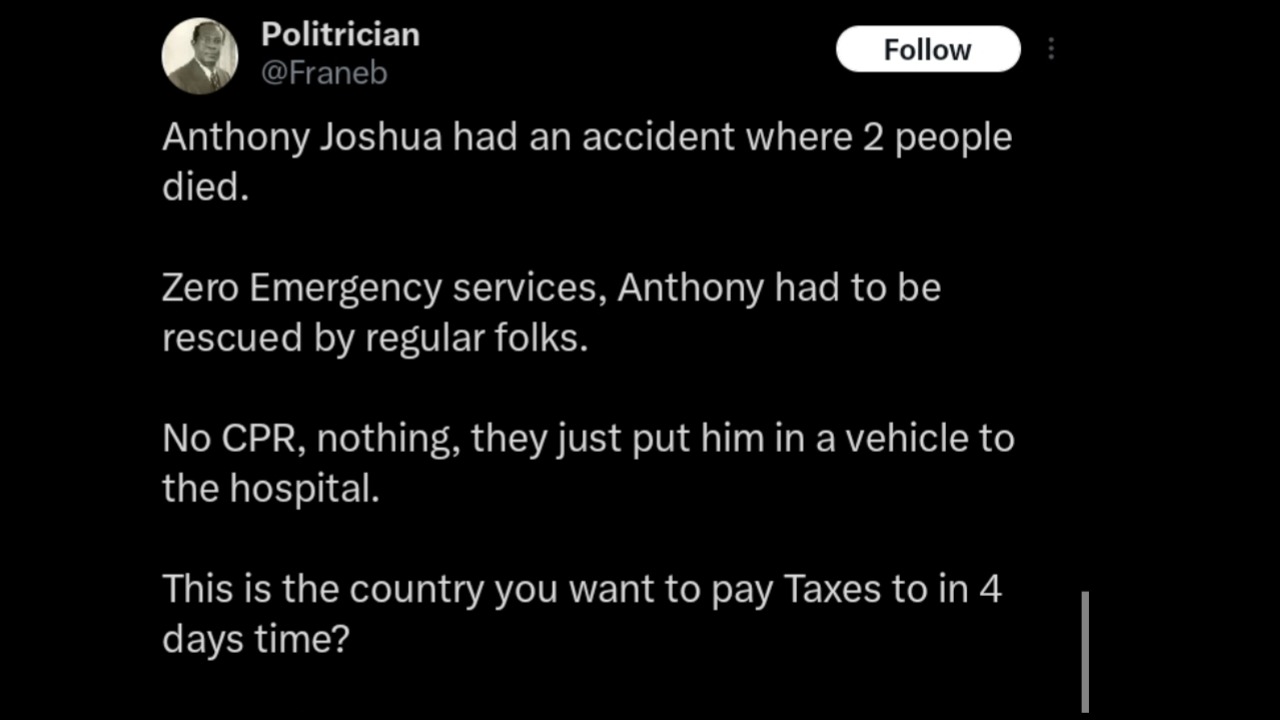
It is actually heartbreaking to say that assistance came instead from passersby—ordinary Nigerians who did what the system failed to do: they stopped, they helped, they carried bodies, and they tried.
And before curiosity and commentary could actually know what was actually going on, there was already a human cost. Two lives were lost, two families were altered forever.
Yet, as is often the case in Nigeria and trends online as it regards fame, conspiracies and even tragedy, the narrative has pivoted quickly.

Sympathy has given way to speculations from all angles, with whispers and opinions flying left, right and center. Questions like “How did he survive?” is actually and quietly floating louder than the real issue of the accident.
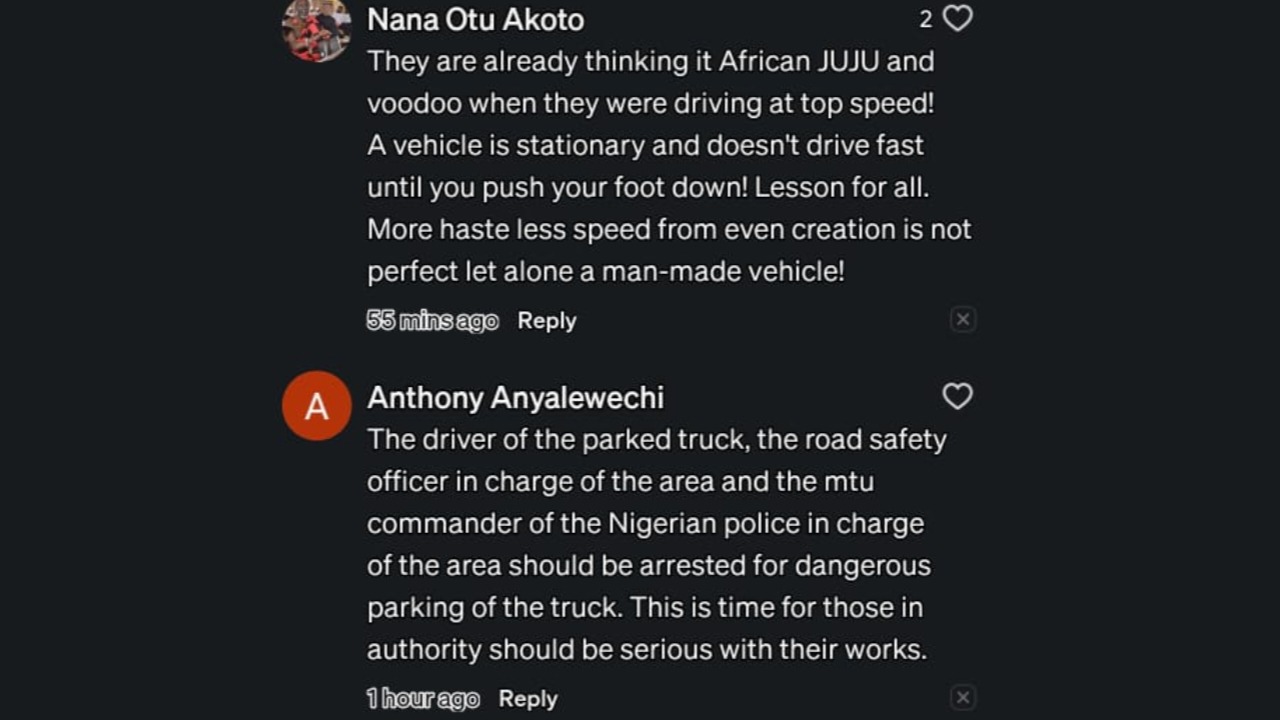
Rumors, conspiracy theories, and poorly disguised suspicion in the form of comments has crept into conversations regarding.
In this part of the world, celebrity issues including survival in this case, seems to invite interrogation rather than empathy.
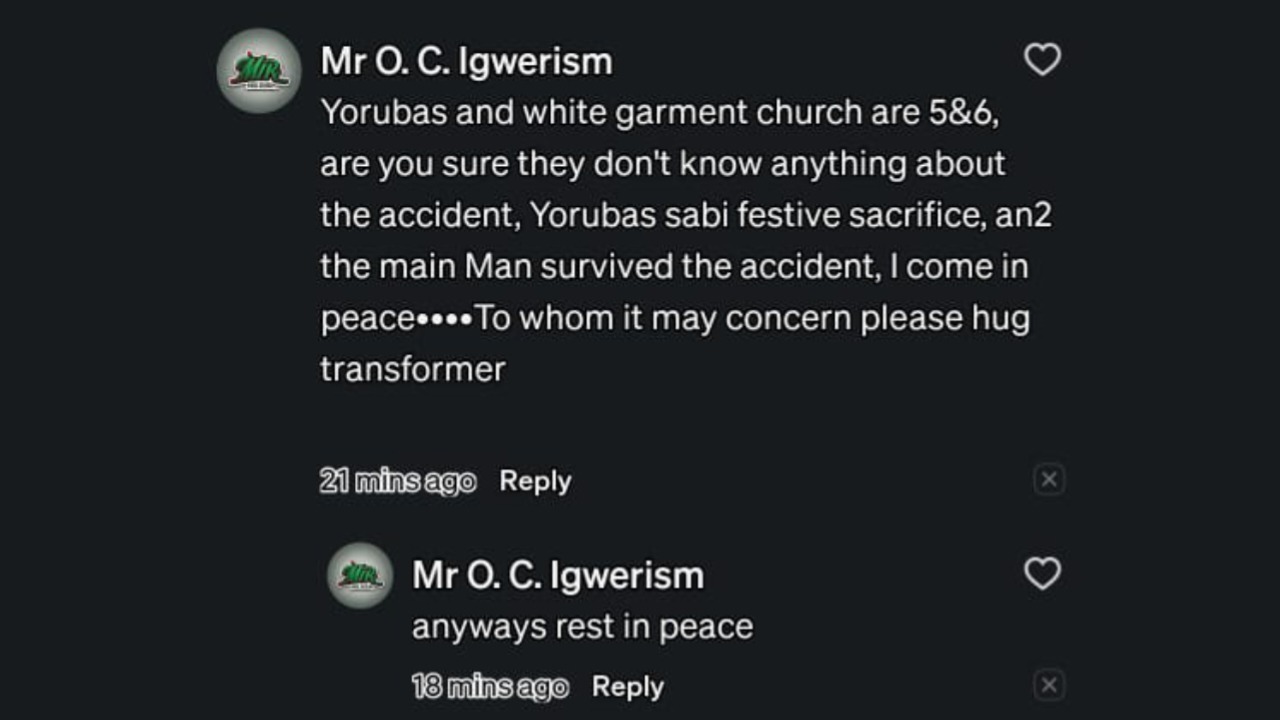
In this noise, facts become secondary, grief slowly fades into the background, and the loss in question risks becoming another content on the Internet.
In all of this happening we should be aware that survival, however, is not guilt. It is not a puzzle that demands dramatization or insensitive questions and remarks. It is simply what it is—one person lived, two did not, and that reality deserves respect.
The Silent Weight of Loss on a Champion’s Career
In sports or any field whatsoever we all know an award winning champion is not a product of the action of the figure alone, yes, that figure has work to do on his or herself but there are those who work behind the scene every time.
So in summary, behind every elite athlete like Anthony Joshua stands a small, trusted circle, one that consists of trainers, conditioning experts, PR team and support staff.
They are not just a group of people; they are anchors, carrying their routines with discipline, motivation, and sometimes, sanity for their sake and paycheck. Losing them is not a professional inconvenience, it is a psychological rupture, one that affects relationships built over time.
Social Insight
Navigate the Rhythms of African Communities
Bold Conversations. Real Impact. True Narratives.
For Anthony Joshua, this loss lands in a space few fans ever see. The gym would definitely become quieter and unfamiliar. The routines would definitely change and the voices that once corrected posture, pushed limits, and offered reassurance would not be heard anymore.
You might not be aware but I'm telling you that Anthony Joshua's grief would not announce itself during weigh-ins or on a live television as it were, but it would show up in pauses, in hesitations, in moments where focus demands more effort than before.
Joshua has a history of resilience. He has fallen, recalibrated, and returned stronger. Yet this is different, this is not a loss on the scorecard—this is a personal loss. The question is not whether it will affect him—because it will—but how. Does it slow him down? Does it force a pause? Or does it quietly redefine his purpose?
Athletes are often marketed as indestructible, but in truth, they are human first before they are actually champions or even global figures.
Because while the comments fly in the air we should all remember that muscles recover faster than hearts, and grief does not respect training schedules.
Did Nigeria Fail Them or Did Nigeria Simply Behave Like Nigeria?
This question is uncomfortable precisely because it feels familiar to the Nigerian citizens. The accident seems to be exposing systemic fractures that Nigerians experience on a daily basis: emergency response gaps, fragile road safety systems, and public infrastructure stretched thin or absent entirely.

And begs the question whether or not, if the response would have been different elsewhere? It is a fair question, not a provocative one. In many countries, an accident involving a public figure might trigger immediate emergency protocols, one that involves ambulances arriving swiftly, traffic being controlled and medical teams responding without delays.
But in this case, help came from the goodwill of Nigerians and not the Nigerian government.
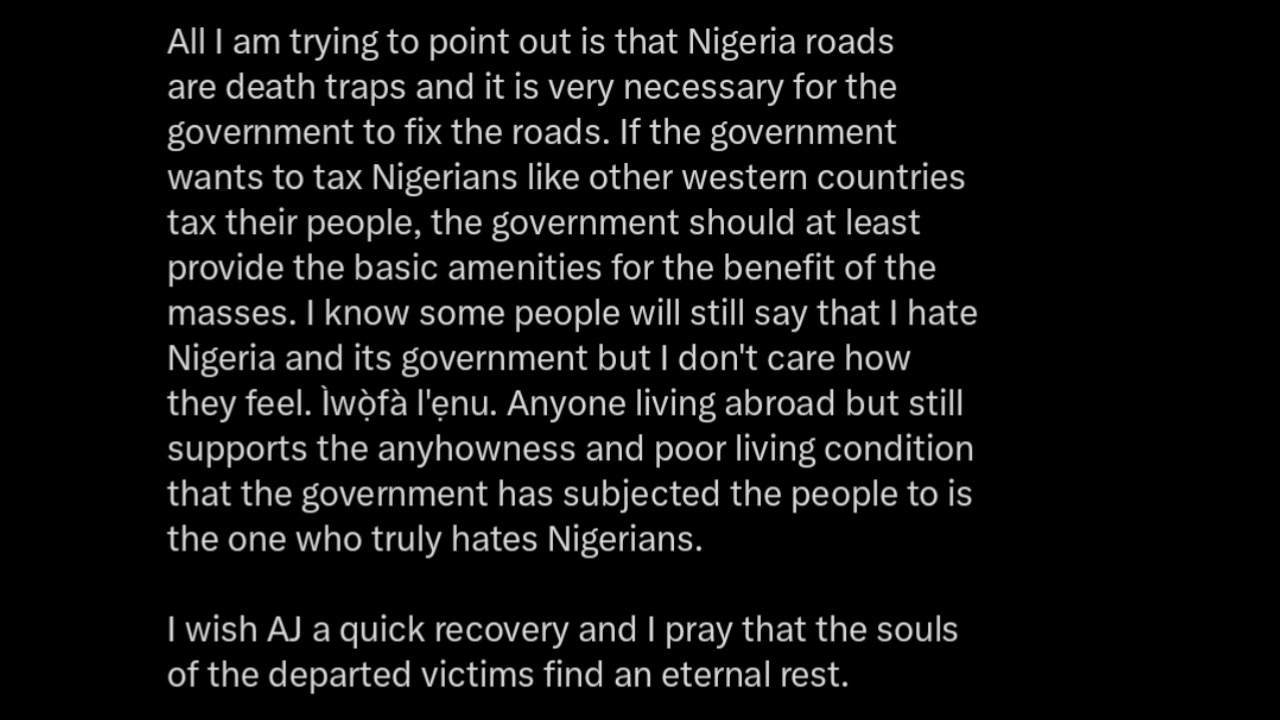
The global optics truly and frankly matters. When an internationally recognized athlete experiences the same vulnerabilities as ordinary citizens, it reveals a truth that can no longer be ignored: fame does not shield you from a broken system here.
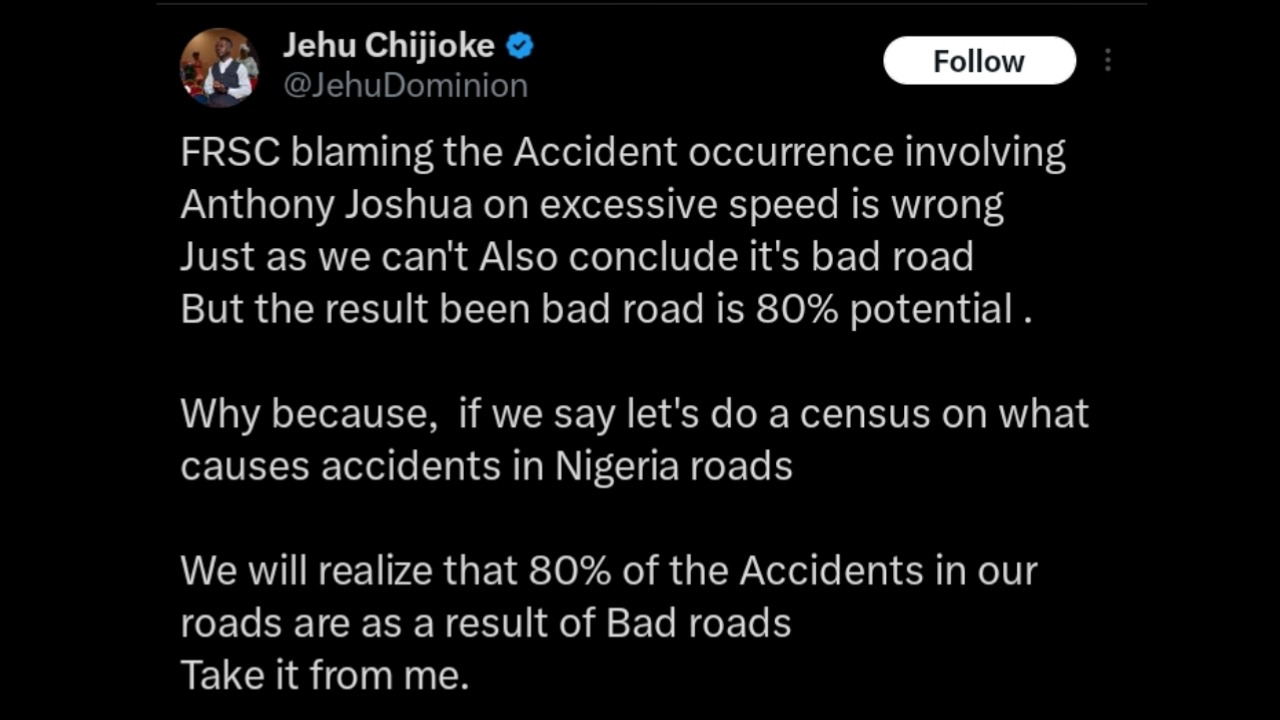
Ogun State’s response or silence becomes part of the story, not because of politics, but because accountability demands attention.
This is not about Anthony Joshua alone. It is about traders on highways, families on night journeys, commuters heading home daily after work and their daily activities.
They pass these same roads, They experience these same delays and are equally faced with these same reliance on chance. Avoiding political mudslinging does not mean avoiding reality. Systems exist to reduce loss, not explain it afterward.
And just maybe, it can be that the citizens have still lost faith in the government of the country becauseof consistent systemic failures and conditions.
Social Insight
Navigate the Rhythms of African Communities
Bold Conversations. Real Impact. True Narratives.
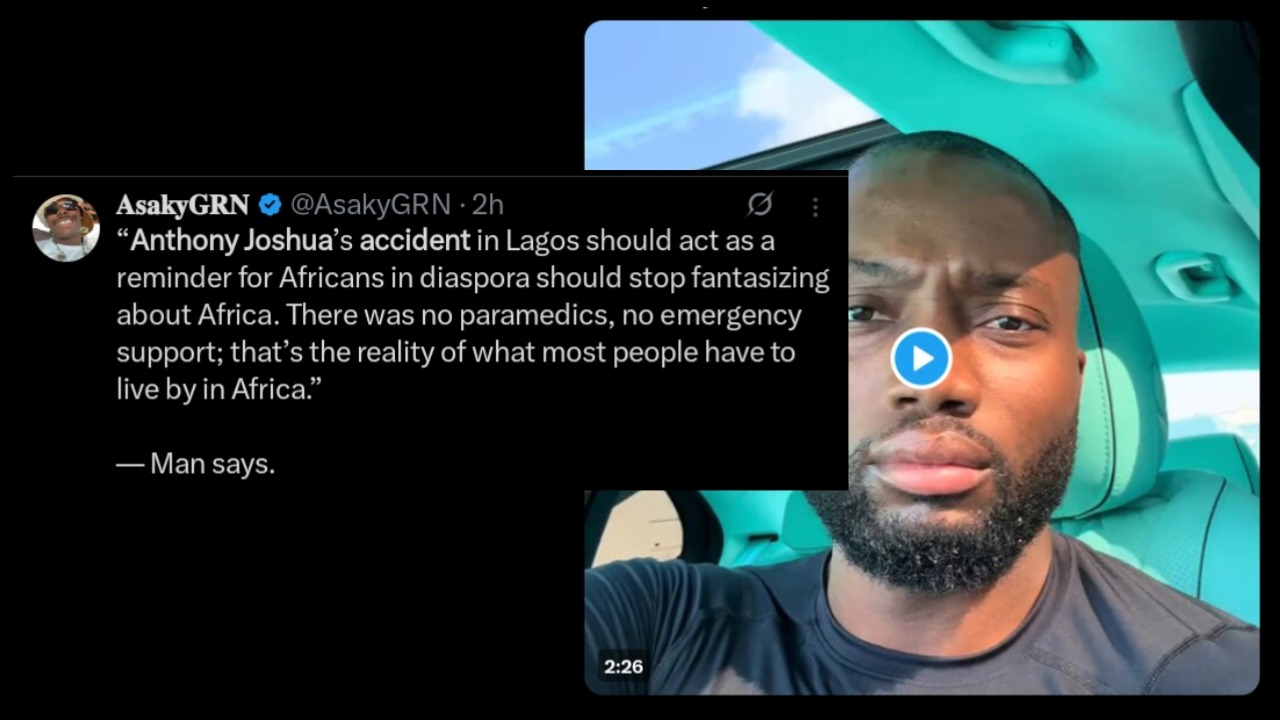
According to a video on X formerly known as Twitter, a user came to air his opinion about medical healthcare in Africa which might be as a result of emotion, but we must all be honest and ask ourselves when will systemic failures like this end? and when will the narrative change because people can only speak of what they see.
The Names We Forget: Mourning Beyond Celebrity
At some point, we must be brutally honest and know that the spotlight must move. Not away from Anthony Joshua’s pain, but toward the lives that ended.
Sina Ghami and Latif Ayodele, these are names that risk becoming footnotes in a celebrity headline.
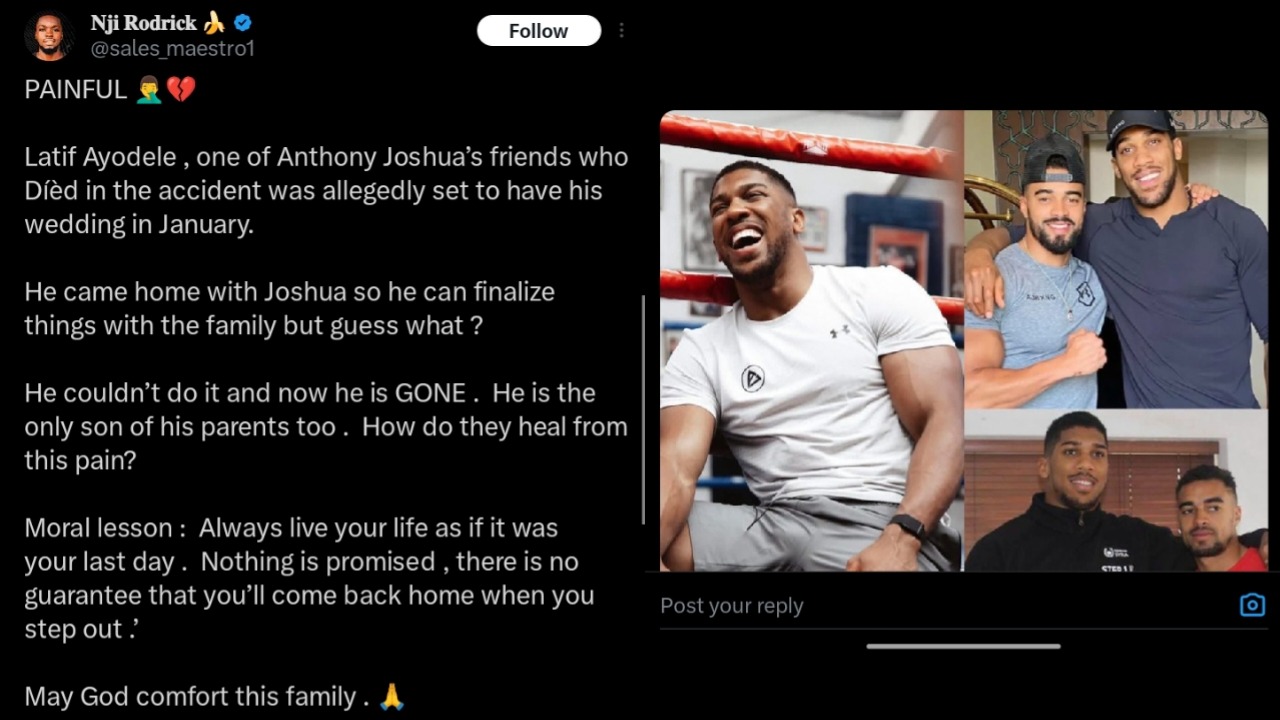
Who is checking on their families? Who is sitting with parents, spouses, or children trying to understand how absence becomes permanent overnight?
According to a user on X, he posted that Latif was allegedly set to have his wedding in January, what does this emotional cost mean for his fiancee and his immediate family. More terrifying is that he is said to be the only son of his parents, which would create a gap in the family and no one is talking about it.
ALSO READ:Sina Ghami and Latif Ayodele: The Two Lives Lost in Anthony Joshua’s Highway Crash
Sani Ghami is dead and no news headline is talking about it, maybe because he is not popular I presume and maybe I am just making assumptions and I stand to be corrected.

Because the truth is celebrity culture has a way of centering who is talked about and who trends faster while quietly sidelining loss. Condolences always flow toward the famous, while grief settles heavily on those without platforms.
Tragedy should not be ranked by relevance, popularity or opinions. Loss is loss, whether mourned by millions or by a small circle in silence, it carries the same weight and the same emptiness is felt. Collective empathy should include those who will never trend, whose pain will not attract hashtags, but whose lives mattered deeply even in silence or behind the scene.
Conclusion: What This Tragedy Demands of Us
This story is bigger than Anthony Joshua, Sani Ghami, Latif Ayodele or even boxing. It stretches beyond titles, beyond survival narratives, and beyond the momentary shock of tragedy. Sympathy for Anthony Joshua can coexist with remembrance for the dead. One should not cancel the other.
Survival should lead to reflection, not silence or outright apportioning of blames.
Nigeria must be honest with her systems and confront its emergency response failures and this should not be done defensively.
Social Insight
Navigate the Rhythms of African Communities
Bold Conversations. Real Impact. True Narratives.
Roads will remain dangerous until systems are designed to protect lives, not merely report losses and add them to statistics.
Until then and only then, tragedies like this remain repeatable because for a fact we don't know how many of this happens to those who are not popular and if we are sincere about survival—whether the person in question is famous or not—it will always come at a cost.