The Dangers Of Breaking Your Pills Are Worse Than You Think, And This Is Why You Shouldn’t
That line on your tablet doesn't always mean you can break it in half. Breaking the wrong medication could cause an overdose or other health problems. So, what does that line really mean, and what happens when you break the wrong tablet?

Breaking your tablet becasue you see a line on it could kill you. YES! IT CAN KILL YOU.
That tiny line running through your medicine might be more important than you think.
You have probably noticed it before. Some tablets have one straight line running across the middle. Others have a cross that looks like a plus sign, while some have several little grooves. And then there are those that are completely smooth.
If you have ever wondered why pharmaceutical companies put these lines on tablets, the answer is actually quite interesting.
Those little indentations are called score lines, and they are sometimes designed to help people divide their medication into smaller portions.
However, there is something you should know before you reach for your medicine and start breaking it into halves and quarters.
Breaking the wrong tablet can be dangerous. In some cases, it can cause an overdose, interfere with how a medicine works or expose you to harmful drug substances.
And no, having a line running through the middle does not automatically make a tablet safe to split.
So, what exactly are these markings telling us?
What Does One Straight Line Across Your Tablet Mean?
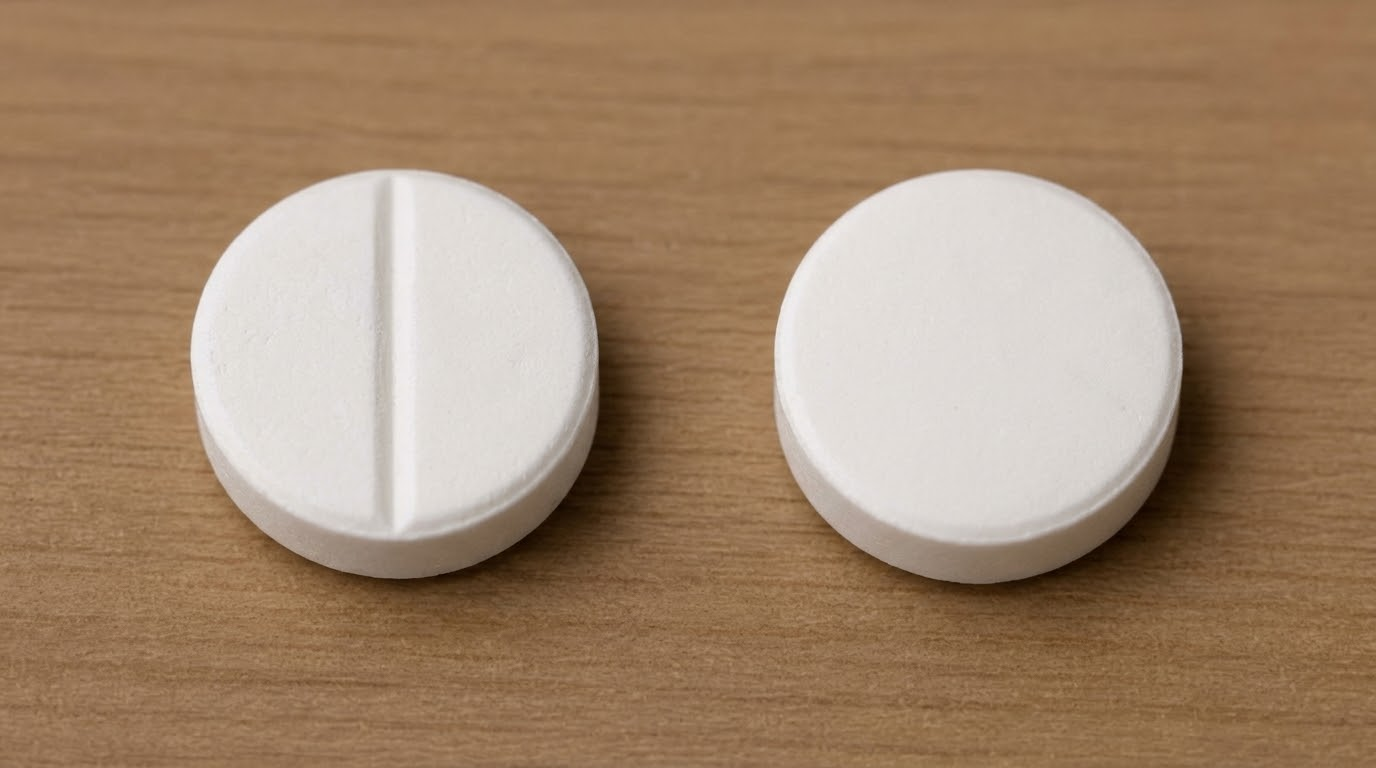
Let's start with the one most people have probably encountered: a tablet with a single straight line running through its middle.

That line is called a score line or bisecting score. When a manufacturer has designed and tested a tablet for splitting, the line provides a designated point where it can be divided into two portions.
For example, imagine you have a 500mg tablet. If it is approved for splitting into equal doses, breaking it along the score line should produce two portions containing approximately 250mg of the medicine each.
Why would anyone need to do that?
Well, medication doses are not always the same for everyone. A doctor may prescribe a smaller dose depending on a patient's age, condition, medical history or response to treatment.
Rather than requiring a completely different tablet strength, a properly scored tablet may allow the patient to take half of the prescribed dose.
Think of the line as a manufacturer's way of showing you where the tablet is designed to break.
But there is something important to understand: not every line on a tablet is intended to divide the medicine into two equal doses.
Some markings are simply there to make a tablet easier to break or swallow. They do not necessarily guarantee that each half contains the same amount of medicine.
And that difference is very much valid because the amount of medicine you take is determined by what is inside the tablet, not how neatly you manage to break it.
What Do Crosses, Multiple Lines and Other Markings Mean?
Now, let's move to the tablets with crosses.
You have probably seen one before. Instead of a single line running through the middle, there are two intersecting lines that divide the tablet into four sections.
These are known as cross-scored tablets.

When specifically designed and tested for quartering, these markings allow the tablet to be divided into four smaller portions.
For instance, a properly approved 400mg tablet with a cross-shaped score may be divided into four portions containing approximately 100mg each.
This can be useful when a patient needs a smaller dose of a particular medication.
However, don't assume that every tablet with a cross can be divided into four accurate doses. The manufacturer must establish that the tablet can be split that way.
What about tablets with several parallel lines?
These markings can also be designed to make dividing a tablet easier. Depending on the manufacturer's specifications, they may allow the medication to be divided into smaller portions.
But there is no universal rule that says one line means half, two lines mean quarters or three lines mean something else entirely.
You cannot simply count the grooves, divide the stated strength and assume you have calculated the correct dose.
Then there are the numbers, letters and symbols printed or pressed into tablets.
These are called imprints. They generally help identify the medication, its manufacturer or its particular formulation.
They are not necessarily instructions on how much medicine to take.
In other words, a number stamped into your tablet does not automatically tell you its strength.
Different markings serve different purposes, and knowing the difference can help prevent medication mistakes.

The Danger: What Happens When You Break the Wrong Tablet?
This is where things get serious.
People split tablets for different reasons. Some find them difficult to swallow. Others want to take a smaller dose, while some do it to save money by purchasing a higher-strength tablet and dividing it.
Whatever the reason, splitting medication without checking whether it is safe can have consequences.
Breaking the wrong tablet can have serious consequences. Some medications are designed to release their ingredients gradually, and splitting or crushing them can interfere with this process, causing too much medicine to enter the bloodstream at once.
This can lead to severe side effects or even poisoning.
There is also the risk of inaccurate dosing. A tablet may not divide evenly, meaning one portion could contain more medicine than the other.

Breaking certain tablets can also damage protective coatings designed to control where and how the medicine dissolves in the body.
Additionally, some medications contain hazardous substances that can be released as dust when broken, potentially exposing the person taking the medicine or anyone handling it.
Even the stability of certain medications can be affected when they are split and improperly stored, as exposure to moisture, heat and air may reduce their effectiveness.