SHOCKING CLAIMS: Iran's Supreme Leader Wounded as Officials Trade Insults with US Secretary Hegseth
Pete Hegseth claimed Iran's Supreme Leader Mojtaba Khamenei is wounded and hiding, following U.S. and Israeli airstrikes. This narrative was fiercely challenged by Iranian officials, who showcased leaders in public and sharply criticized U.S. leadership, framing the conflict as an "illegal war" linked to domestic political distractions.
Secretary of War, Pete Hegseth, delivered a blunt assessment at a Pentagon briefing, declaring that Iran's freshly installed Supreme Leader, Mojtaba Khamenei, is reeling from U.S. and Israeli airstrikes, stating "We know the new so-called not-so-supreme leader is wounded and likely disfigured."

Hegseth interpreted Khamenei's absence of voice and video in a written statement as clear signs of serious injury, and continued to claim that Iran's leadership was "desperate and hiding," having "gone underground, cowering," equating them to "rats."
He emphasized that relentless American and allied operations had crippled Iran's missile stocks, drone fleet, and production capabilities, vowing that the U.S. would maintain pressure until the threat was eliminated.
However, this narrative was sharply countered by critics and Iranian officials, who labeled the conflict an "illegal war" launched by the former U.S. president on behalf of Israel, describing the assassination of Ayatollah Ali Khamenei as a "stunning breach of international norms" and a "blatant act of terrorism."
Contrary to Hegseth's claims, Iran's Secretary of the Supreme National Security Council, Larijani, publicly refuted the assertion by posting videos on X showcasing the nation's leaders "boldly walking through the streets in broad daylight."
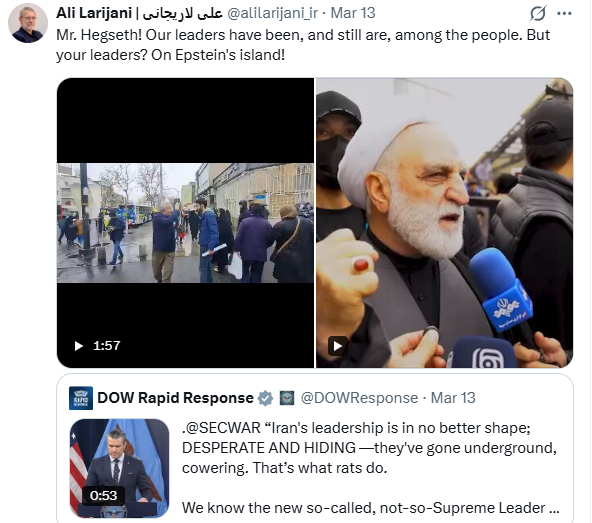
In a pointed retort, Larijani directly addressed Hegseth, writing, "Mr. Hegseth! Our leaders have been, and still are, among the people. But your leaders? On Epstein's island!"
This exchange highlighted a broader global perception that the war was framed by some as a "war of choice" initiated to distract from domestic scandals, with Iranians depicted as unifying behind their domestic leadership when faced with the external aggression of American and Israeli forces.