Royal Outcry: Emir of Katsina Blasts Tinubu Campaign Over Soaring Insecurity!
The Emir of Katsina, Alhaji Dr. Abdulmumini Kabir Usman, has challenged Nigerian political leaders, including Senator Abdulaziz Yari and Governor Dikko Umaru Radda, to prioritize insecurity and economic hardship over 2027 election ambitions. He criticized politicians for neglecting constituents post-election and urged a focus on community development, warning against superficial campaign strategies.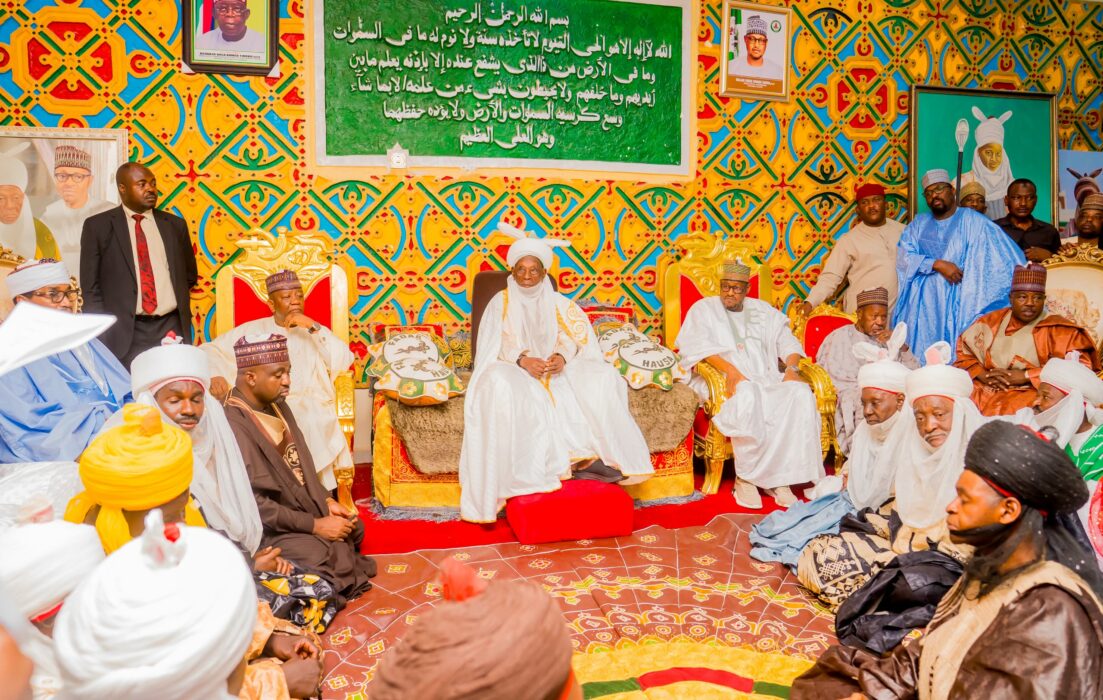
The Emir of Katsina, Alhaji Dr. Abdulmumini Kabir Usman, has issued a direct challenge to prominent political figures, including President Bola Tinubu’s campaign Director-General, Senator Abdulaziz Yari, and Governor Dikko Umaru Radda. Ahead of the 2027 general elections, the Emir urged these leaders and other political stakeholders to prioritize the pressing issues of insecurity and economic hardship over their political ambitions.
These significant remarks were made during a visit by a high-profile delegation, led by Senator Yari, a former governor of Zamfara State. The delegation also included Governor Radda, former Governor Aminu Bello Masari, and various other past governors and political figures. After their visit to the Emir of Katsina, the group proceeded to the Emir of Daura.
In a viral video circulating on social media, the Emir expressed profound disappointment with politicians who, he observed, consistently seek the support and prayers of traditional rulers during election campaigns but subsequently neglect the populace once they secure political office. He sharply criticized what he termed a growing culture of selfishness within Nigerian politics, asserting that leaders are increasingly preoccupied with personal interests rather than the welfare of their constituents. The Emir was quoted saying, “Every four years you come to my palace with cap in hand, asking for prayers, asking for support. After election, you disappear to Abuja, to Lagos. You don’t come back until next election.” He questioned whether politicians perceive traditional palaces as genuine forums for engaging with the people or merely as convenient stops for electoral solicitations.
The monarch’s comments also delved into the political rifts within the All Progressives Congress (APC) in Katsina State, highlighting how political actors are already jockeying for position ahead of the 2027 elections. He voiced concern that politicians are engrossed in campaign appointments and intra-state political contests while residents continue to grapple with severe security threats. The Emir challenged the rationality of pursuing political interests when communities in frontline areas remain acutely vulnerable to attacks by armed groups.
Furthermore, the Emir pointed out a stark contrast between the current political activities surrounding the 2027 elections and the immediate struggles of residents facing insecurity and economic hardship. He criticized the disconnect between government promises and the harsh economic realities confronting ordinary Nigerians, raising concerns about the escalating cost of living and the difficulties households face in affording basic necessities. He advocated for a political system driven by community development and public service, rather than the narrow interests of individual politicians, their families, and associates, warning that leaders who overlook the needs of citizens risk losing electoral support.
The Emir also drew attention to the severe consequences of insecurity in Katsina State. He reported that numerous schools have been forced to close due to banditry, and farmers in 12 local government areas are struggling to access their farmlands. He referenced reports of families paying exorbitant ransoms, sometimes millions of naira, to secure the release of kidnapped relatives. The monarch emphatically challenged political leaders to demonstrate tangible results in combating banditry instead of focusing solely on campaign activities. His remarks underscored the pervasive frustration surrounding the persistent insecurity in northwestern Nigeria, where attacks and kidnappings continue to imperil lives and livelihoods.
In a particularly significant part of the video, the Emir cautioned that distributing food and money during election campaigns would not guarantee electoral success. He questioned the closures of major Northern factories like the Peugeot Company in Kaduna and Arewa textile, and the ineffectiveness of multiple forums purportedly aimed at reviving the Northern economy. He urged stakeholders and politicians to “wake up” and have “a change of heart for the common good of the region.” This warning prompts questions about the efficacy of campaign strategies that rely heavily on material inducements rather than sustained engagement with constituents and tangible improvements in their living conditions.
The Emir’s intervention comes as political leaders across Nigeria begin preparations for the 2027 general elections, with the APC aiming to consolidate support for President Tinubu’s re-election bid. The delegation’s visits to the Emirs of Katsina and Daura highlight the enduring importance of traditional institutions within Nigeria’s political landscape. For Katsina, a state deeply affected by insecurity and its impact on communities and livelihoods, the message attributed to the Emir holds particular significance as political activities gain momentum ahead of 2027. The central question raised by the monarch’s reported statements is whether political leaders will genuinely prioritize the profound challenges confronting their constituents or allow the pursuit of electoral advantage to overshadow their fundamental responsibilities to the people.