Pritzker Unleashes Groundbreaking AI Regulation to Tackle Risks
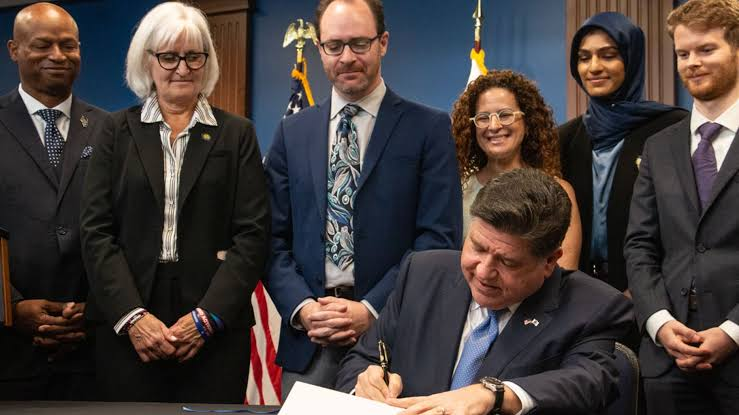
Illinois Governor JB Pritzker has signed the Artificial Intelligence Safety Measures Act, establishing a state-driven framework for AI regulation. This pioneering legislation enhances transparency and accountability for large AI models, featuring a unique requirement for mandatory annual third-party audits. Set to take effect in 2028, the law aims to mitigate catastrophic risks and influence national standards.Illinois Governor, JB Pritzker, has signed landmark artificial intelligence legislation, the Artificial Intelligence Safety Measures Act (Senate Bill 315), aiming to establish a state-driven national framework for AI regulation.
This move comes as a proactive measure in the absence of federal legislation, with Governor Pritzker criticizing Congress and the president for their unwillingness to act, attributing it to special interests.
Modeled after similar bills enacted in California and New York in late 2025, the Illinois law enhances transparency and accountability requirements for the largest AI models – specifically those generating over $500 million in annual revenue and trained with substantial computing power.
The key provisions include new reporting standards for potential large-scale harms, such as assisting users in creating chemical, biological, or nuclear weapons, or facilitating cyber-attacks.
The State Senator Mary Edly-Allen, D-Libertyville, emphasized the urgency for states to establish safeguards, stating, “We are not willing to wait for Congress to act.”

She highlighted the potential risks of unchecked AI, using the analogy of AI emptying a river if taught to fish without guardrails.
Although Illinois, California, and New York collectively represent only about 20% of the U.S. population, lawmakers estimate they account for roughly 40% of the U.S. AI market, effectively setting a de facto national standard.
The new law introduces rigorous guardrails, mandating that model developers publish an AI framework detailing their process for identifying and assessing “catastrophic risk.”
This risk is defined as incidents with the potential to cause death or serious injury to more than 50 people or over $1 million in property damage.
Developers are also required to report any such incidents to the state within 72 hours of identification, or within 24 hours if the risk of death or serious physical injury is imminent.
The Representative includes; Daniel Didech,D-Buffalo Grove, who are the bill’s House sponsor, who underscored that these harms are not theoretical, citing examples like an AI-inspired mass shooting and an AI system used to attack a municipal water utility.
He also referenced Anthropic’s Mythos model, deemed too powerful a cyberweapon for public release, noting Anthropic’s support for Illinois’s bill.
Didech drew parallels to other transformative technologies like automobiles and electricity, which required safeguards to ensure public trust and safety.
A unique aspect of Illinois’s legislation, setting it apart from California and New York, is the first-in-the-nation requirement for mandatory annual third-party audits.
While New York’s version only required a single independent audit once developers met the size criteria, Illinois's continuous auditing was a point of contention for some industry stakeholders, including TechNet, which expressed concerns about subjective determinations without established national standards.
Despite this, the bill garnered broad bipartisan support in both chambers of the Illinois General Assembly, passing almost unanimously in the House.
OpenAI and Anthropic, though initially advocating for a federal framework, ultimately supported the state-driven approach.
The OpenAI’s Global Affairs, Caitlin Niedermeyer, acknowledged that a coordinated state effort by Illinois, California, and New York could help establish a “de facto national direction of travel.”
Companies found in violation of the law will face significant civil penalties, with fines up to $1 million for a first offense and up to $3 million for subsequent violations, enforced by the attorney general’s office.

The law is set to take effect on January 1, 2028. Lawmakers and advocates, including Scott Wisor, policy director for Secure AI, anticipate continued work on AI regulation, identifying medical care and education as future frontiers needing further evaluation of AI’s public safety risks.
Wisor emphasized the importance of external evaluation of models’ risks, moving beyond mere compliance with internal safety frameworks.