Only 2 Out of 54 African Countries Have Menstrual Leave. What About the Other 52?
In 2026, only 2 out of 54 African countries grant women menstrual leave. This silence is not a gap in policy. It is a choice, and it needs to end.
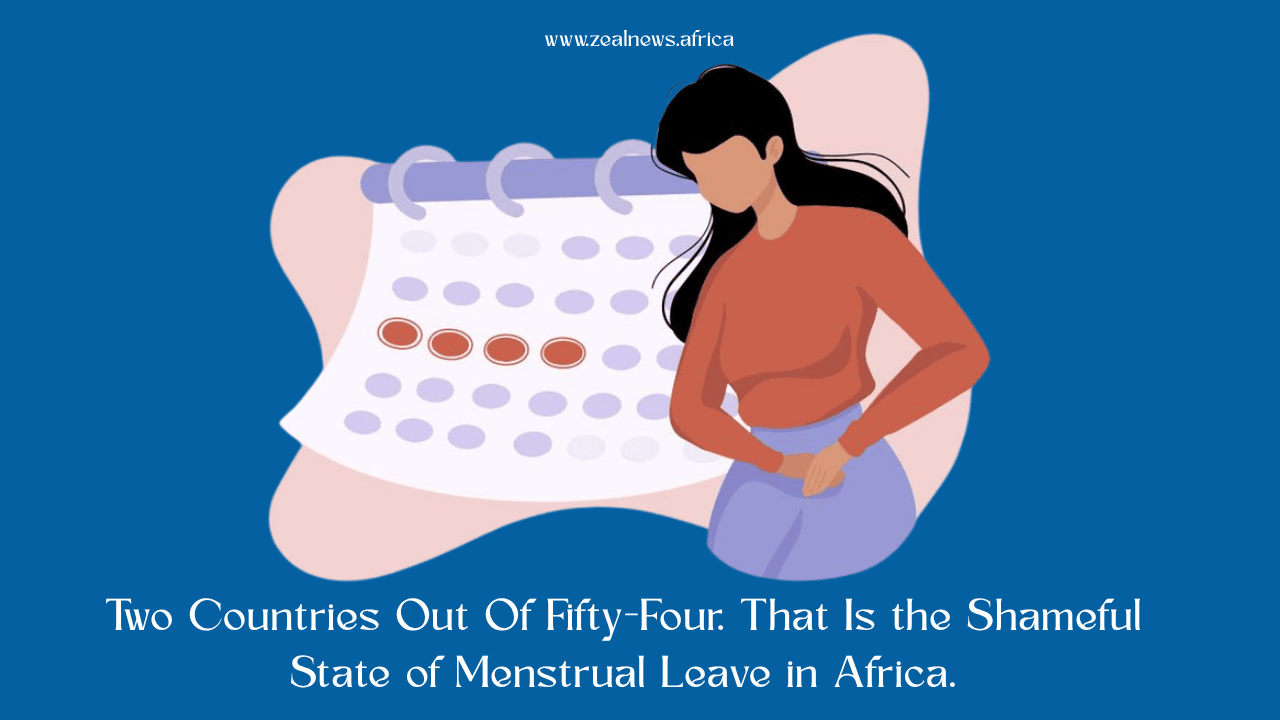
Half the continent's workforce bleeds every month. Barely any of it is allowed to rest.
The Pain Is Real. The Silence Is Louder.
Every month, millions of African women drag themselves to offices, markets, classrooms, and construction sites while their bodies protest in ways that words struggle to fully capture. Cramps that double you over. Fatigue so heavy it sits on your chest like a stone.
Headaches that make bright lights feel like punishment. And through all of it, the expectation remains the same: show up, perform, and say nothing.
Menstrual pain is not weakness. It is biology.A Nairobi-based gynecologist has noted that severe period pain affects roughly half of the women she treats, and for many of them, standard painkillers simply do not do enough. These are not women being dramatic. These are women being failed by workplaces that were never designed with them in mind.
And yet, across 54 African nations, only two have chosen to do something about it.
Zambia Said Yes in 2015. Eleven Years Later, Almost Nobody Followed.
Zambia deserves its flowers. In 2015, it became the first African country to enshrine menstrual leave in law, giving female employees one paid day off every month with no doctor's note required. No justification. No humiliation. Just the basic acknowledgment that a woman's body sometimes needs a day.
That was eleven years ago.
In the decade-plus since, 53 other African countries watched. Some debated. Most stayed quiet. An entire continent of governments looked at what Zambia did and decided it was not worth following.
It was not until December 2025 that a second entry appeared on the list, and even then it was not a country. It was a city. Nairobi County in Kenya introduced two paid days of menstrual leave per month for female government employees, with the county's governor describing women's health not as a cost but as an investment in productivity.
Early reports suggest women are returning from the leave more focused and more present.
Two. That is the full count. One country with a national law. One city with a pilot scheme. And 52 countries that have not yet found it in themselves to act.
The Excuses Are Tired, But The Women Are Tireder.
The arguments against menstrual leave are not new, and they are not convincing.
Social Insight
Navigate the Rhythms of African Communities
Bold Conversations. Real Impact. True Narratives.
Some employers worry the policy will make them less likely to hire women. This logic, if followed to its conclusion, means the solution to workplace discrimination is to ensure women suffer in silence so that no one is reminded they exist as full human beings.
That is not a policy position. That is a threat dressed up as concern.
Others say women will misuse it. This is the same suspicion applied to every worker benefit ever introduced in history, and it has never once been a good reason to deny an entire group of people basic consideration for their health.
And some simply say the continent has bigger problems. As if dignity is a luxury item to be addressed only after everything else is fixed.
As if the women holding up Africa's economies, families, and communities do not deserve a single day of rest when their bodies demand it.

These conversations happen while women quietly excuse themselves to bathrooms, stuff their mouths with painkillers, and count down the hours until they can go home.

Africa Cannot Afford to Keep Looking Away
Japan introduced menstrual leave in 1947. Spain became the latest country globally to adopt it in 2023. The world is having this conversation. Africa, largely, is not.
What makes this so painful is that it is not a resource problem. A policy costs a government nothing except the willingness to believe women when they say they are in pain. Zambia proved it could be done. Nairobi is proving it again. The template exists. The evidence is building.
What is missing is political will and the simple moral clarity that women's health is worth protecting in law, not just in speeches.
Fifty-four countries on this continent. Fifty-two of them have still not managed to say, in any formal or binding way, that a woman bleeding through her workday deserves so much as one hour of grace.
That is not a statistic. That is an indictment. And it should embarrass every government that has not yet acted.