Nigeria’s 30-Day Petrol Discount: Relief for Commuters or a Short-Term Fix?
Nigeria’s 30-day petrol discount could offer temporary relief, but questions remain over how much operators will save, whether commuters will pay lower fares, and what happens when the scheme ends amid concerns about its timing ahead of the 2027 elections.
The Federal Government has announced a 30-day petrol discount for public transport operators, but whether passengers will benefit through lower fares remains to be seen.
Announced by Finance Minister Taiwo Oyedele on October 8, 2026, the arrangement will see NNPC Retail give up its retail profit margin and sell petrol at cost, with public transport operators expected to receive priority.
The government says the arrangement is not a return to the petrol subsidy removed in May 2023. For commuters, however, the immediate concern is whether the discount will make their daily journeys cheaper and what happens when the 30 days are over.
How much cheaper will petrol be?
The government has not announced a fixed discount per litre.The Presidency used ₦1,300 per litre as an example of a possible landing cost, but this is not a confirmed pump price under the new arrangement.
The actual saving will depend on the retail margin NNPC gives up. Without a confirmed figure, it is difficult to tell how much the scheme could reduce operators’ fuel costs or whether passengers will see any difference in their fares.
The official start date of the 30-day period has also not been confirmed. The scheme should not be confused with a separateNNPC Fuel App promotion that offered a ₦66-per-litre discount from October 1 to 7.
What is the ₦1,350 petrol proposal?
Separately, the government has proposed a ₦1,350-per-litre ceiling on petrol landing or ex-gantry costs. This is not a proposed pump price; it concerns the cost of supplying petrol before it reaches the retail market.
Under the proposal, refiners and importers would initially absorb costs above the ceiling, with the possibility of recovering them later.Trade Union Congress President Festus Osifo has criticised the plan, arguing that it could amount to a subsidy in another form.
The two measures work differently: NNPC would give up its retail margin under the 30-day discount, while the proposed ceiling would limit the cost at which petrol is supplied.
Will commuters actually pay less?
A transport operator spending less on petrol does not automatically mean passengers will pay less. Fuel is one operating cost, and the government has not announced a specific fare reduction that operators must pass on to commuters.
That uncertainty is already reflected in the online reactions to the announcement.
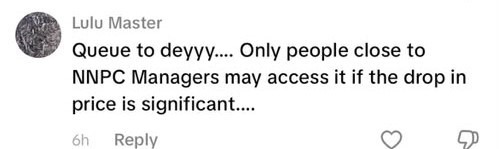
Lulu Master questioned who would actually benefit if the discount were substantial, suggesting that people with connections to NNPC managers might have better access.
Reuben Nwaenyi raised a different concern: could motorists end up queuing at NNPC stations and causing traffic as they try to buy cheaper fuel?
Other commenters questioned the timing of the announcement.
With elections approaching, some interpreted the short-term discount as a campaign strategy.

while Victor Chuks questioned what made the announcement good news if the discount would last only 30 days.


Another described it as a political bribe.


The comments raise questions about access to cheaper petrol, the effect on prices at other filling stations, and the timing of a discount that lasts only 30 days.
What happens when the discount ends?
One commenter, Awka Perfume Vendor, asked: “And what happens after 30 days?”

It is a fair question. The government says the discount is meant to cushion Nigerians against rising fuel costs, which it expects to be temporary.
But if prices remain high after the 30 days, what happens then? The announcement has not explained whether the discount could be extended or what would replace it.
Some commenters also see the timing as political, arguing that the government is offering temporary relief ahead of the 2027 elections.
That is an allegation, not an established reason for the policy. Still, the 30-day limit invites scrutiny, particularly if commuters are expected to feel the benefit.
The government has announced the discount, but the longer-term plan is not clear. Will the measure lead to any lasting reduction in transport costs, or will commuters be back where they started once it ends?