Nigeria Ranks 6th Globally for AI Adoption, Yet Its Businesses Are a Telling A Different Story
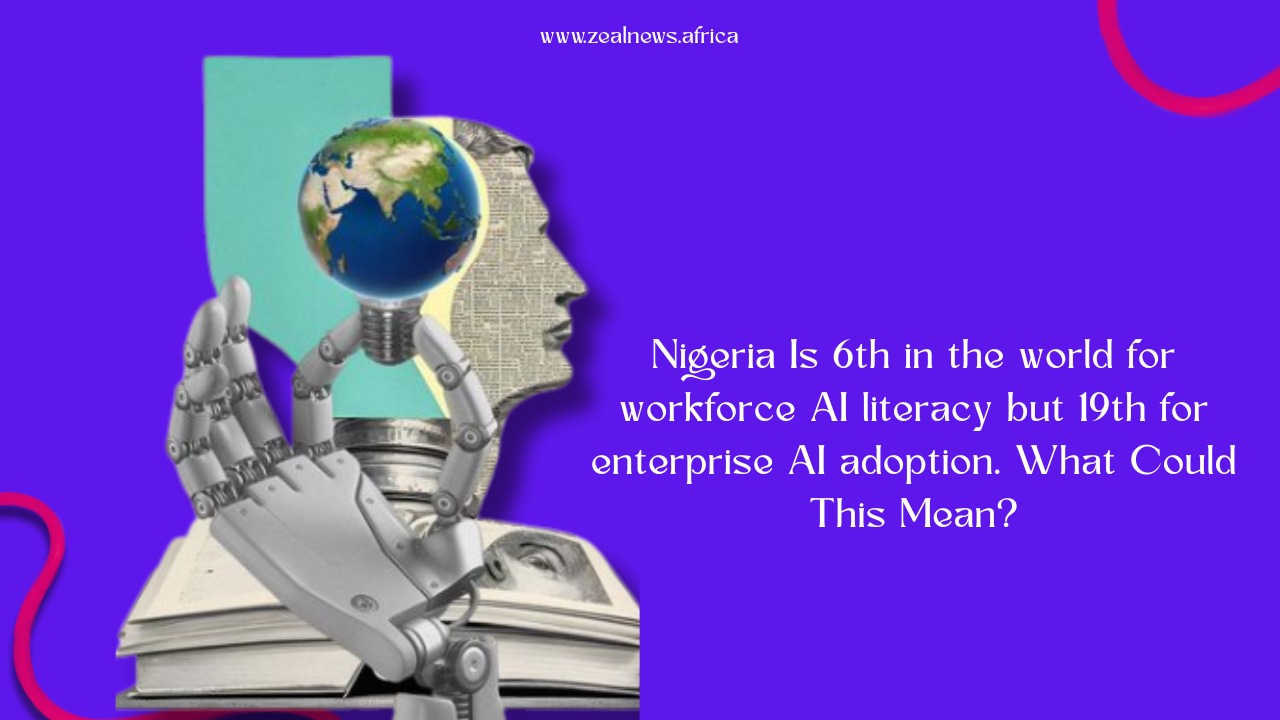
A new global report places Nigeria 6th in the world for workforce AI literacy but 19th for enterprise AI adoption. The 32-point gap between both scores is the largest in the index and reveals a structural challenge in Nigeria's digital economy.
Nigeria's workers are learning artificial intelligence faster than the country's companies are deploying it. That single fact sits at the centre of a new global report, and it says more about Nigeria's digital economy than any headline ranking could.
The 2026 Global Outsourcing AI Readiness Index, published by Ataraxis, evaluates 25 of the world's major outsourcing destinations across four dimensions: workforce AI literacy, enterprise AI adoption, population-level AI adoption, and AI education pipeline readiness.
Nigeria's overall score of 49.15 out of 100 places it 17th on the global list, a middling position that tells an incomplete story. The more instructive finding is what happens when you separate the four dimensions and look at each one on its own.
On workforce AI literacy, Nigeria ranks sixth in the world, scoring 66 out of 100. The five countries ahead of it are India, Brazil, the Philippines, Poland, and Malaysia. Every other country in Africa sits below Nigeria on this measure.
Several countries with far more developed digital economies also rank lower. By this indicator alone, Nigeria is producing workers who understand, adopt, and apply AI tools at a rate that competes with the most digitally advanced outsourcing markets on earth.
Then comes the enterprise score. Nigeria's enterprise AI adoption rating is 34 out of 100, placing it 19th globally. The gap between its workforce score and its enterprise score is 32 points, the largest disparity of any country in the entire index.
A nation where individual workers are racing ahead of institutional deployment is not a contradiction. In Nigeria, it is the current state of the digital economy.
But What Is This Gap All About?
To understand why this gap exists, it helps to understand how AI adoption typically happens in two different ways. The first is bottom-up: individual workers, usually on their own initiative, begin using AI tools to do their jobs faster and better.
A content writer starts using AI to speed up research. A developer uses AI coding assistants to write cleaner code. A customer support agent uses AI to handle repetitive queries. This kind of adoption does not require organisational approval. It requires curiosity and an internet connection.
The second kind of adoption is top-down: a business formally integrates AI into its operations. This might mean deploying AI systems across departments, restructuring workflows around automation, investing in AI infrastructure, training staff at scale, or building governance frameworks that determine how AI is used and monitored.
This kind of adoption requires leadership buy-in, capital, strategic clarity, and institutional readiness.
Nigeria is currently very good at the first kind and significantly behind on the second. Developers, writers, marketers, designers, analysts, and customer service professionals across the country are using AI tools to compete in global labour markets and improve their own output.
This is grassroots adoption, and the Ataraxis data confirms it is happening at a pace that puts Nigeria ahead of most of the world. What has not followed at the same speed is organisational deployment.

Many Nigerian businesses continue to operate without formal AI strategies, and the gap between what their workers are capable of and what their systems support is widening.
The Regional Picture
Within Africa, Nigeria ranks third for overall AI readiness, sitting behind South Africa and Egypt. South Africa leads the continent with a score of 66.5. Egypt scores 49.35, narrowly ahead of Nigeria's 49.15.
The comparison with Egypt is where the nuance becomes important. Nigeria beats Egypt on workforce AI literacy by a significant margin, scoring 66 against Egypt's 50.
That means Nigerian workers, taken as a group, demonstrate greater AI awareness and practical skill than their Egyptian counterparts. But Egypt outperforms Nigeria in three other categories: population-level AI adoption, enterprise AI adoption, and AI education pipeline readiness.
The result is that Egypt finishes marginally above Nigeria despite having a weaker workforce. Egypt's advantage is systemic, while Nigeria's advantage is human.
Enterprise Adoption Is Where the Work Begins
A 34 out of 100 enterprise score is not a comfortable number for a country that considers itself Africa's largest economy. Nigerian businesses are contending with a combination of barriers that make wide-scale AI deployment difficult.

Infrastructure limitations remain a genuine obstacle. Reliable electricity and high-speed internet access are not consistent across the business landscape, and many AI applications require both.
Investment constraints mean that the cost of building or licensing AI systems, training staff, and restructuring workflows is beyond the reach of most small and medium-sized businesses, which make up the vast majority of Nigeria's private sector.
Leadership-level AI literacy is also a factor. Employees using AI tools on their laptops is one thing. Executives understanding how to integrate AI into a company's core operations, risk framework, and competitive strategy is something else entirely.

Without leadership that understands what AI can and cannot do, the decision to invest in enterprise deployment often gets deferred. The result is companies where individual contributors are working with AI on a personal basis while the organisation itself has no formal position on the technology at all.
Cybersecurity and data governance add another layer of complexity. Deploying AI at an enterprise level requires handling data responsibly, securing systems against new categories of risk, and ensuring compliance with regulations that are still being developed in many markets.
For businesses already stretched thin by the demands of operating in a high-inflation, high-interest-rate environment, these additional requirements can make AI adoption feel distant from immediate priorities.
The Education Pipeline Problem
Nigeria ranks 19th globally in AI education readiness, the category that measures how well formal educational institutions are producing AI-ready graduates. The score reveals a tension that could become a long-term challenge if left unaddressed.
Much of Nigeria's current AI literacy has been self-generated. Workers have used online platforms, YouTube tutorials, bootcamps, and peer learning to acquire skills that universities have not yet embedded into standard curricula at scale.
This approach has worked remarkably well in the short term. It is why Nigeria ranks sixth in the world for workforce literacy despite ranking 19th in education readiness. People figured out how to learn without waiting for institutions to catch up.
The Opportunity Underneath the Gap
Nigeria leads Pakistan by 8.55 points in overall AI readiness and Bangladesh by 16.35 points. It also holds a narrow lead over Kenya, a country that has invested significantly in positioning itself as East Africa's technology hub. These are not small markets.
They are countries that compete directly with Nigeria for outsourcing work and global digital talent contracts. Maintaining and extending those leads depends on addressing the enterprise and education gaps before competitors close the distance.
The broader argument the Ataraxis report makes is that AI readiness is now a competitive factor in the global outsourcing industry. Companies looking to send work offshore are no longer evaluating destinations purely on labour costs and language proficiency.
They want to know whether the workers in a given country can use AI effectively and whether the businesses there have the infrastructure to support AI-augmented service delivery. Nigeria scores well on the first test and poorly on the second.
The country's strongest asset is not its oil reserves or its population size. It is the adaptability of its people. A sixth-place global ranking for workforce AI literacy is evidence that Nigerian professionals are already positioning themselves for an AI-driven future without waiting for structural conditions to be perfect.
The task now for businesses, policymakers, and educational institutions is to build systems that are worthy of the workforce they already have.