Kenya's Tax Authority Is Closing M-Pesa Tax Loophole. Here Is What Small Traders Were Doing and What Comes Next.
Kenya's KRA has confirmed that switching M-Pesa paybills and till numbers to hide income no longer works. Here is what traders were doing, how eTIMS closed the gap, and why mobile money's biggest benefit may now be its biggest tax exposure.
Regulatory shifts tied to government policy are rarely announced loudly. They happen quietly, through system integrations, data partnerships, and infrastructure most people don’t notice, until one day, when the effects become clear.
That is exactly what Kenya's tax authority did on April 24, 2026. The Kenya Revenue Authority (KRA) confirmed that businesses rotating M-Pesa paybills and till numbers to hide income from the taxman are now firmly within its detection systems.
The tactic of switching between different payment channels to fragment transaction records and obscure total turnover no longer works. The authority announced it publicly, which is itself a statement of confidence in the infrastructure behind the announcement.
This matters not just as a tax enforcement story, but as a story about what digital financial infrastructure eventually makes possible and what it eventually makes unavoidable.
What Traders Were Doing and Why It Stopped Working
The tactic here is not so complicated. Micro, small, and medium-sized enterprise (MSME) traders, particularly those operating in high-volume informal markets such as Nairobi's Eastleigh business hub, would register multiple M-Pesa paybills or till numbers, often under different identities, and rotate among them.
The logic as to why this is a recurrence is actually straightforward: if no single account accumulates enough transaction volume to trigger scrutiny, the actual size of the business stays invisible to the KRA.
What many of these traders did not account for was a simple structural reality of mobile money: every transaction creates two records. One on the sender's side. One on the receiver's.
Even if a trader never declares their total income, the volume of transactions still appears in the records of whoever paid them, and it's still on the financial trail that can be tracked.
The KRA could trace from either end. Switching till numbers did not erase the record; it just created a fragmented trail that the system was now equipped to reassemble.
By 2024, mobile money accounts used by merchants had been converted into Electronic Tax Registers (ETRs), integrating M-Pesa directly into Kenya's tax infrastructure. Lipa na M-Pesa.
Safaricom's merchant payment service processes an estimated KSh 4.1 trillion in annual merchant payment volume across more than 650,000 active till numbers and paybills, according to the Safaricom FY25 report. That is not a data pool the KRA was going to leave unconnected to its filing systems indefinitely.
What eTIMS Actually Does and Why It Changed the Game
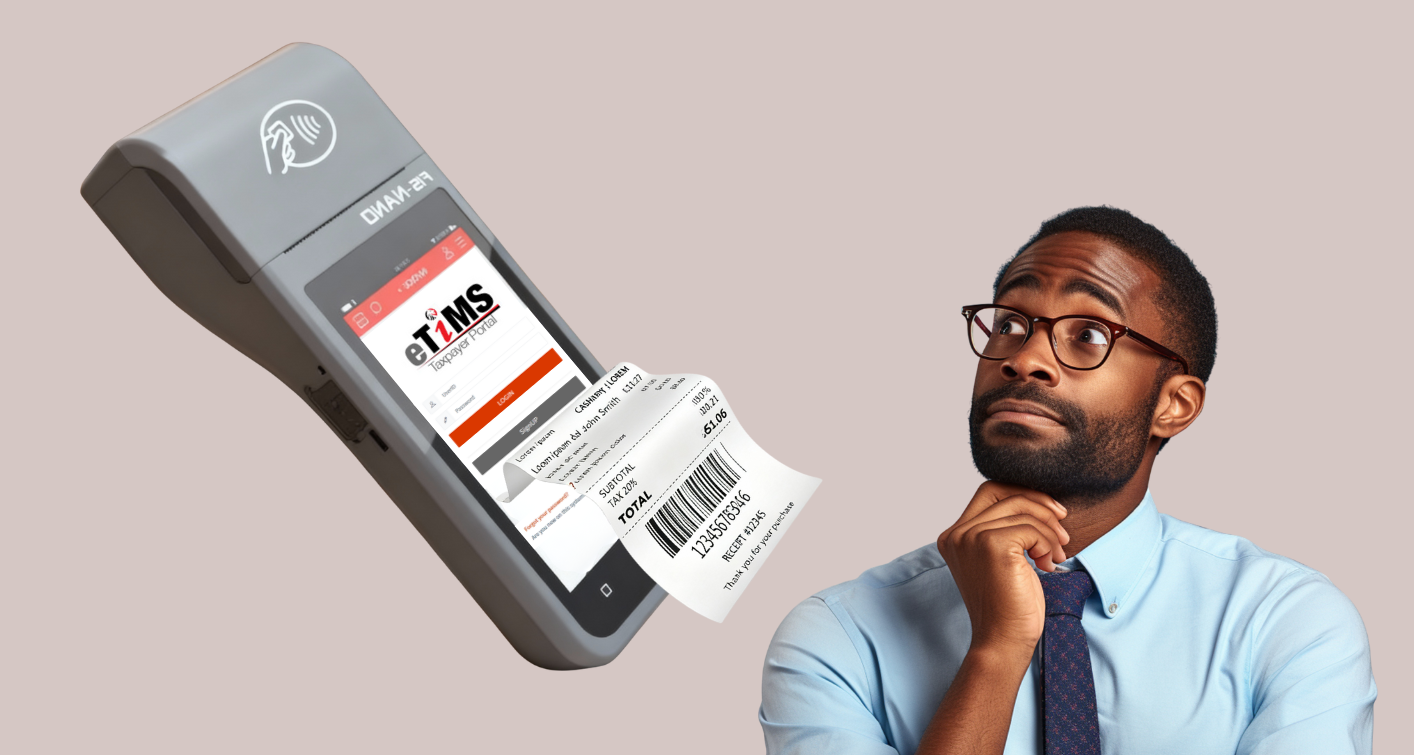
At the centre of the crackdown is the Electronic Tax Invoice Management System (eTIMS), introduced in 2023. The system links sales, invoices, and payments into a single verification loop, a real-time tax engine that does not wait for annual returns to identify mismatches.
If a business is generating transaction volume through M-Pesa but filing zero or low returns, eTIMS flags the gap almost immediately.
The compliance structure works in two directions. Traders with annual turnover above KSh 5 million are required to issue eTIMS invoices directly. For those below that threshold, who are not required to register on eTIMS, the burden shifts to the buyer, who must generate a buyer-initiated invoice through the KRA's eCitizen platform to support expense claims.
This two-way traffic between buyers and sellers means transactions are captured on at least one side, with details of both parties recorded. There is no clean exit.
The consequences of non-compliance are also strict. Businesses that cannot provide eTIMS-compliant invoices find themselves unable to claim legitimate expenses. If a business spent KSh 700,000 on stock but only KSh 300,000 of that is documented through eTIMS, the remaining KSh 400,000 is treated as taxable profit, not expenditure. Undocumented expenses become income in the system's logic.
That is a pressure point that hits informal supply chains particularly hard, especially in markets like Eastleigh, where cash transactions remain common, and many suppliers operate without a KRA Personal Identification Number (PIN).
The Irony at the Heart of This and What It Means Going Forward

Kenya's revenue gap is estimated at KSh 930 billion. The government is under sustained pressure to close it without returning to the kind of broad tax measures, including the Finance Bill 2024 proposals, that triggered public protests serious enough to force legislative reversals.
Taxing the informal economy more effectively is the path of least political resistance. And M-Pesa, which gave millions of Kenyans access to the financial system, has now made them eligible to it in ways they did not anticipate.

That is the irony that sits underneath this whole story. The mobile money infrastructure that democratised payments, that allowed a market trader in Kisumu or a produce supplier in Nakuru to receive money without a bank account, is now the same infrastructure generating the data trail that the KRA uses to track them. Digital inclusion created digital visibility. And digital visibility, eventually, creates tax liability.
The authority has begun sending targeted warnings to traders whose transaction data shows undeclared activity, with an April 30, 2026, deadline to settle outstanding tax dues before penalties and interest apply.
It has also run awareness campaigns in Eastleigh specifically, acknowledging that limited awareness, not just deliberate evasion, is part of the compliance gap.