Iran Plunges into Chaos: Supreme Leader Khamenei Reportedly Killed in US-Israeli Strikes
Massive US and Israeli air strikes have rocked Iran, resulting in widespread casualties and the confirmed death of Supreme Leader Ayatollah Ali Khamenei. Iran retaliated with missile and drone attacks across the Middle East, striking Israel and US bases, as global alarm rises over the escalating conflict.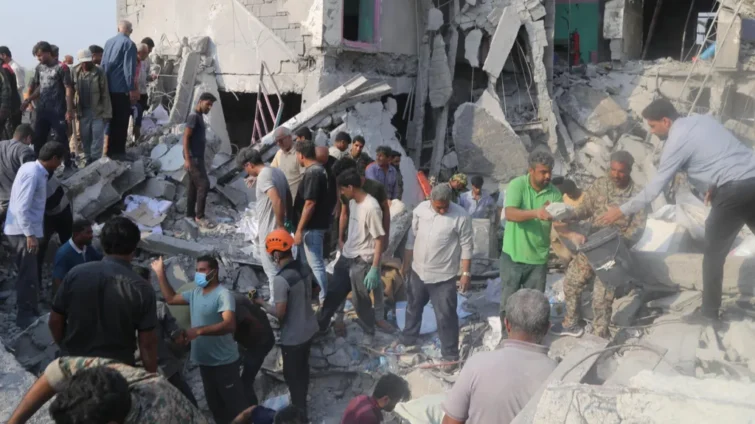
A massive wave of US and Israeli air strikes against Iran has dramatically escalated tensions in the Middle East, leading to widespread destruction, civilian casualties, and the confirmed death of Iran's Supreme Leader, Ayatollah Ali Khamenei. The joint operation, aimed at dismantling Iran's security apparatus and potentially toppling the Islamic Republic, began early on Saturday, March 1, 2026, targeting numerous cities and military installations across the country.
Initial reports on Saturday were conflicting regarding the fate of the 86-year-old Supreme Leader. US President Donald Trump and Israeli Prime Minister Benjamin Netanyahu both claimed there were growing signs, and later confirmations, that Khamenei had been killed in the strikes. Trump specifically stated on Truth Social that Khamenei, along with other leaders, was unable to avoid highly sophisticated tracking systems. Netanyahu, in a televised address, declared that Khamenei's compound in Tehran had been destroyed and that the 'tyrant himself is no more.'
Despite initial denials from Iran's Tasnim and Mehr news agencies, which reported Khamenei as 'steadfast and firm in commanding the field,' Iranian state television confirmed his death early on Sunday, broadcasting archive images with a black banner. A 40-day mourning period and seven public holidays were announced in Iran. Iranian media also reported the deaths of Khamenei's daughter, son-in-law, and granddaughter alongside other senior officials like Ali Shamkhani, secretary of Iran's Defence Council, and Revolutionary Guard Corps (IRGC) commander Maj Gen Mohammad Pakpour.
The strikes caused extensive casualties and damage across Iran. A local prosecutor in southern Iran reported that at least 108 people died in an explosion at a girls' school in Minab, Hormozgan province, which was reportedly hit by three missile attacks. The Iranian Red Crescent stated that a total of 201 people had been killed and 747 injured across 24 of Iran's 31 provinces by Saturday evening. Videos verified by the BBC showed smoke rising from buildings, crowds gathering, and people screaming in panic in various cities, including Tehran, Karaj, Isfahan, Qom, and Kermanshah. Satellite imagery showed significant damage to Khamenei's compound, including blackened buildings and debris.
US and Israeli officials outlined their objectives, with Israel's Defence Minister Israel Katz calling it a 'pre-emptive strike to remove threats.' President Trump clarified the US involvement was 'to defend the American people by eliminating imminent threats from the Iranian regime,' vowing to 'destroy their missiles and raze their missile industry to the ground,' and 'annihilate their navy.' He also stated the objective was to ensure Iran does not obtain a nuclear weapon and urged the Iranian people to 'take back their Country,' promising immunity to armed forces who lay down their weapons. Netanyahu echoed these sentiments, calling it an operation 'to remove the existential threat posed by the terrorist regime in Iran' and inviting Iranians to 'overthrow the regime and to secure your future.'
The US military's Central Command reported that US and Israeli forces targeted IRGC command-and-control facilities, air defence capabilities, missile and drone launch sites, and military airfields. The Israel Defense Forces (IDF) stated that approximately 200 fighter jets took part in an 'extensive attack,' dropping hundreds of munitions on about 500 targets. The scale of this operation was described as 'completely different' from previous conflicts, including the 12-day war fought between Israel and Iran last June.
Iran swiftly retaliated with a wave of missile and drone attacks. The IRGC announced they had targeted multiple sites in Israel and five major US military facilities in the region: Al Udeid airbase in Qatar, Al Dhafra airbase in the United Arab Emirates, the US Fifth Fleet headquarters in Bahrain, Ali Al Salem airbase in Kuwait, and Muwaffaq Salti airbase in Jordan. A US combat support vessel reportedly came under 'severe blows,' and a US FP-132 radar system in Qatar was 'completely destroyed.' In Israel, a woman was killed in the Tel Aviv area, and at least 21 others were injured by shrapnel or blast shockwaves. Explosions were also reported across the Gulf region, with two people killed in Abu Dhabi, UAE, and four injured in Dubai. Kuwait reported three soldiers injured and minor damage to its international airport, while Bahrain experienced drone attacks and damage to residential buildings. The IRGC also moved to close the Strait of Hormuz, a critical global shipping lane.
The international community reacted with alarm. The United Nations Security Council held an emergency meeting, where Iran's envoy accused the US and Israel of committing a 'war crime,' and UN chief Antonio Guterres warned of an uncontrollable 'chain of events.' Oman, a traditional mediator, expressed dismay, while the European Union deemed developments 'perilous.' Gulf states, represented by Bahrain, condemned Iran's 'cowardly' attacks. Russia criticized the US-Israeli strikes as a 'dangerous adventure' risking 'regional catastrophe,' and Lebanon's Hezbollah called for regional unity against Israel and the US. Airspaces were closed across Iran, Iraq, Kuwait, Syria, the UAE, and Israel, leading to numerous flight cancellations and diversions by major airlines. Travel advisories were issued for multiple Middle Eastern countries, urging vigilance and shelter if advised.