Global Climate Fury Erupts at COP30: Activists Demand Action Amidst Cooperation Calls
Thousands of climate protesters have gathered at the COP30 climate talks in Belém, Brazil, demanding an end to fossil fuels and calling for indigenous rights, as negotiators struggle to make progress on global climate change targets. The summit is marked by controversies including a record number of fossil fuel lobbyists and the striking absence of the US, while South-South cooperation, particularly with China's involvement, emerges as a key pathway forward for developing nations.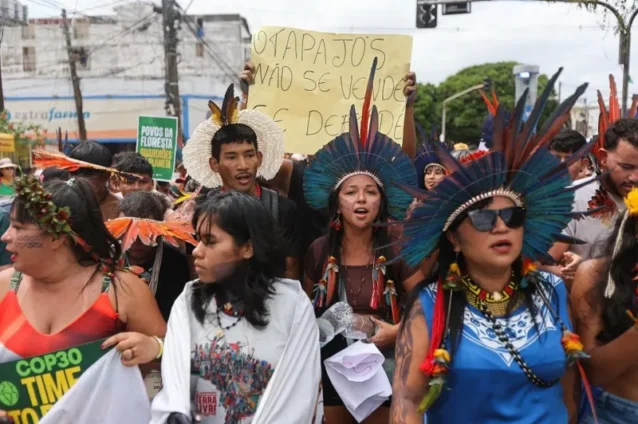
Thousands of climate protesters have converged on Belém, Brazil, bringing their urgent message to the gates of the COP30 climate talks. Demonstrators, chanting and singing "free the Amazon" to the beat of pounding sound systems, carried three giant coffins labeled Oil, Coal, and Gas, flanked by grim reapers. Indigenous groups prominently displayed signs declaring "the answer is us," as an inflatable elephant and an anaconda wound through the sun-drenched crowd. This marks the first time since 2021 that protesters have been permitted to demonstrate outside the UN climate talks, as the previous three conferences were held in countries with restrictions on public protest.
Activists voiced their frustrations and demands for immediate action. Tuga Cíntia from the Hydra Dance theatre group declared, "We are holding a funeral for fossil fuels." She added, "I'm here because enough is enough with COP meetings and theory. It's time for us to actually act." Brianna Fruean, a climate activist from Samoa, a low-lying island highly vulnerable to climate change, emphasized, "Fossil fuels are still being burned. We know all too well what it's like to live on the frontline of climate change." Ilan from the NGO 350 reiterated the call for justice, stating, "We are here after so many COPS, marching for justice, for the end of fossil fuels." The march saw participation from indigenous communities, Brazilian youth groups, and activists from around the globe, with some seeking shelter in a petrol station forecourt as the midday sun intensified.
Many protesters also carried signs reading "demarcation now," advocating for legal ownership of territories for indigenous groups. Hundreds of these communities reside in the Amazon, and experts recognize them as crucial protectors of biodiversity and forests. The meeting was optimistically dubbed the "indigenous people's COP," yet many groups feel their concerns regarding deforestation, land protection, and resource extraction in their homelands are not being adequately addressed. Some indigenous representatives set up stalls outside the fenced-off COP30 venue to engage with passing delegates. Security was notably tight at the COP30 venue, with police guarding the entrance with riot shields. Earlier in the week, some protesters managed to breach security lines at the summit, resulting in minor injuries to two security staff and limited damage to the venue.
At the ongoing 30th UN Climate Change Conference, which opened on a Monday, leaders and experts stressed the importance of stronger South-South cooperation to advance global climate governance. Simon Stiell, executive secretary of the UN Framework Convention on Climate Change (UNFCCC), drew a parallel between the Amazon River, nourished by a thousand tributaries, and the COP process, which must be supported by diverse streams of international cooperation. UN Secretary-General Antonio Guterres called for this COP to "ignite a decade of acceleration and delivery," urging parties to "choose to make Belém the turning point." Guterres further proposed a clear roadmap to mobilize 1.3 trillion US dollars annually for developing countries by 2035.
Brazilian President Luiz Inacio Lula da Silva, hosting the talks in Belém to focus global attention on the Amazon, expressed his hope that the conference would move beyond empty rhetoric to deliver on climate commitments. He proposed establishing a governance mechanism within the UN framework to ensure effective implementation, including exploring sanctions for countries failing to meet their pledges. However, a significant controversy emerged shortly before the talks, when Lula's government granted permission to the Brazilian state oil company to explore for oil at the mouth of the Amazon, a decision at odds with the conference's environmental focus.
The absence of high-level US officials at COP30 drew considerable criticism. Colombian President Gustavo Petro highlighted the United States' historical role as the largest cumulative emitter, asserting its major responsibility for the climate crisis and lamenting its decision not to play an expected role at this critical juncture. Samuel Spellmann, a political economist at the Federal University of Pará, described the US stance as not merely an avoidance of responsibility but an attempt to obstruct global climate progress. This insufficient action by developed countries, according to Fernando Romero Wimer, a professor of international relations, has prompted the Global South to accelerate its efforts toward diversified, self-driven energy transition and climate finance solutions.
South-South cooperation is a key theme of COP30. Brazil, as host, has invited multiple countries to collaborate on protecting the Amazon rainforest. Lula also highlighted how collaborative efforts in renewable energy development in poor regions of Latin America and Africa could create jobs and economic benefits while addressing climate change. He specifically praised China as a model for advancing green transition through technological innovation. As of September 30, less than one-third of Paris Agreement parties had submitted or announced updated Nationally Determined Contributions (NDCs) with 2035 targets. In contrast, Beijing has submitted its 2035 NDCs to the UNFCCC Secretariat, expanding targets to cover all greenhouse gases across the entire economy, a historic first. China's contributions to global climate action, particularly through South-South cooperation, are expected to receive significant attention. By the end of October 2025, China had signed 55 memoranda of understanding on South-South cooperation to address climate change with 43 developing countries. China is also hosting several "China Pavilion" side events during COP30, covering carbon market development, pathways to carbon peaking and neutrality, and low-carbon technology innovation. Leila da Costa Ferreira, an environmental sociology scholar, emphasized the importance of solidarity among developing countries, noting China's role as a key driver of global green transition through innovation.
Amid these discussions, an analysis of attendee lists by the coalition Kick Big Polluters Out (KBPO) revealed a record number of delegates from fossil fuel companies at the meeting, suggesting 1,600 lobbyists in Belém, a 12% rise from the previous COP. While business leaders commonly attend to strike deals, the slow progress in negotiations, compounded by the US's striking absence, remains a concern. Senior climate leaders wrote a letter calling on the summit to ensure climate change facts are upheld. Ten countries launched the Declaration on Information Integrity on Climate Change at COP30, an initiative by the Global Initiative for Information Integrity on Climate Change, aiming to create international commitments to address climate disinformation and promote evidence-based information. On the core issues of tackling climate change's root causes and helping countries adapt, Brazil has pledged that the talks will deliver action to implement years of deals and pledges, as negotiations continue into the next week.