FIFA Is Handing Out $871M, But The Countries That Produce the Most Talent Are Getting the Least
The World Cup prize pool has grown 32 times since 1982. But the structural conditions determining which nations collect the largest share have barely shifted. A financial and geopolitical breakdown.
In 1982, Italy lifted the World Cup trophy and took home $2.2 million. In July 2026, whoever lifts it in New Jersey will pocket $50 million.
That is a 32-fold increase in 44 years, a curve so steep that the chart looks less like a growth story and more like a confession. The question almost nobody is asking isn't why the prize pool grew.
The question is who designed the conditions under which it grows, who benefits most systematically from those conditions, and why the nations that supply the most raw talent to the world's most commercially successful sport keep finishing at the bottom of its balance sheet. Football calls itself the world's game.
The economics of the World Cup suggest it is a world game run on a very particular world's terms.
A Tournament Built on Labour It Does Not Fully Compensate
The FIFA World Cup 2026 will distribute a total of $871 million across 48 participating nations, the largest prize pool in the history of team sports. The champion takes $50 million. Every team eliminated at the group stage is guaranteed at least $12.5 million.
These are numbers designed to communicate generosity, and in absolute terms, they are not small. But the architecture of the payout system obscures a structural transfer of value that runs in the opposite direction.
Consider the talent pipeline first. Research published by research gate examining multi-national football eligibility quantified what economists call the 'leg drain,' the movement of player value through national team representation.
France alone gains over three billion euros in player value through players of African and Caribbean descent representing the French national team.
The countries those players or their parents left, overwhelmingly former colonies of major European footballing nations, bear the largest losses in player value relative to their economic output. The study found that colonial ties are among the strongest predictors of leg drain intensity, even after controlling for population and income.
What this means in practice is that African and Caribbean federations invest in the early development of footballers who are then absorbed into European club systems and eventually into European national team squads.
The prize money those European teams earn at World Cups is partly built on infrastructure, coaching, and scouting that happened elsewhere and was never compensated at fair value.
The compensation mechanism that exists for this transfer is FIFA's training compensation and solidarity payment framework. Under it, clubs that develop youth players receive payments when those players transfer internationally.
On paper this sounds fair. In practice, a club classified in the top UEFA tier can earn up to 90,000 euros per year for training a youth player. An African club in the lowest tier receives as little as 10,000 euros for developing a player of equivalent quality through comparable investment.
The geographic location of the club determines the valuation of the labour, not the quality of the development itself. The prize money pool grows every four years. The underlying valuation gap grows alongside it.
Performance as a Structural Outcome, Not a Natural One
The performance-based structure of World Cup prize money is presented as meritocratic: advance further, earn more. What this framing obscures is that the ability to advance is itself partly a function of resource access accumulated long before the tournament begins.
The gap between what the richest and poorest federations can spend on preparation is not a gap that $12.5 million in guaranteed prize money closes, particularly when those funds arrive after the tournament, not before it, and must be split across players, coaching staff, and federation operations.
FIFA does cover preparation costs for teams, but at $2.5 million per team, a federation that spends more than that on pre-tournament camps absorbs the difference from its own budget.
The structural outcomes are visible in the data. Of the twenty-two World Cup finals ever played before 2026, European and South American nations have contested every single one.
Africa, which supplies a disproportionate share of the talent playing in Europe's top leagues, has never produced a World Cup finalist. Morocco's fourth-place finish at Qatar 2022 was historic precisely because it was an outlier of that magnitude.

For context, Morocco's $25 million prize for reaching the semi-finals was the largest the African Football Confederation had ever seen from a single nation in a single tournament. Argentina's $42 million for winning that same tournament was more than Morocco, Croatia, and the third and fourth-place finishes combined.
The prize pool rewards advancement. The structural conditions that govern which nations advance are not neutral.
This is compounded by what happens to the money once it arrives. FIFA does not pay players directly. Prize money flows to national federations, which then determine how much reaches players through pre-negotiated bonus structures.
A common arrangement sees players collectively receiving between 20 and 30 percent of a federation's total earnings. For a group-stage exit worth $12.5 million, that means a squad of roughly 26 players might share between $2.5 million and $3.75 million.
For federations in wealthier nations with strong commercial operations and supplementary bonus pools, the total player earnings can be substantially higher. The federation's financial capacity before the tournament determines how much it can supplement the FIFA payout.
That capacity is itself a function of historical commercial development, media rights value, and sponsorship appeal, all of which correlate strongly with geography and economic development.
The Revenue Model and Who It Was Built Around
FIFA generated approximately $8.9 billion in projected revenue for the 2026 World Cup cycle. Television rights alone account for $3.92 billion of that total. The critical detail about broadcast revenue is where it originates. Europe, North America, and Asia are the dominant broadcast markets. The viewing populations in those regions set the commercial floor for the entire tournament.
Africa, despite its estimated 1.4 billion people and its deep, genuine relationship with football, contributes a far smaller share of global broadcast revenue, partly because of lower per-capita income and partly because of how media rights are valued and packaged. The tournament is priced around the spending capacity of richer markets and sold globally as a universal spectacle. The universal spectacle framing is then used to justify prize money growth as shared benefit, when the commercial conditions driving that growth are not universally distributed.
The Club Benefits Programme illustrates this dynamic from another angle. FIFA distributes $355 million to clubs for releasing players to national teams during the 2026 tournament. Manchester City alone received $4.6 million from the equivalent programme at Qatar 2022, compensation for releasing 16 players.
The clubs receiving the largest Club Benefits Programme payments are, by definition, the clubs with the most players at the tournament, which are overwhelmingly the wealthiest clubs in European leagues.
The financial logic is circular: the clubs that already generate the most revenue receive additional compensation from the tournament's commercial success because they hold the employment contracts of the tournament's most prominent players. Those players were often developed in academies in Africa, South America, or Asia before being acquired by European clubs at market prices that reflect the tiered valuation system described above.
What the 32-Fold Increase Actually Measures
The chart showing World Cup prize money from $20 million in 1982 to $652 million in the original 2026 estimate, now revised upward to $871 million, is almost universally read as a story of football's commercial success. It is also a record of the specific economic configuration that made that success possible.
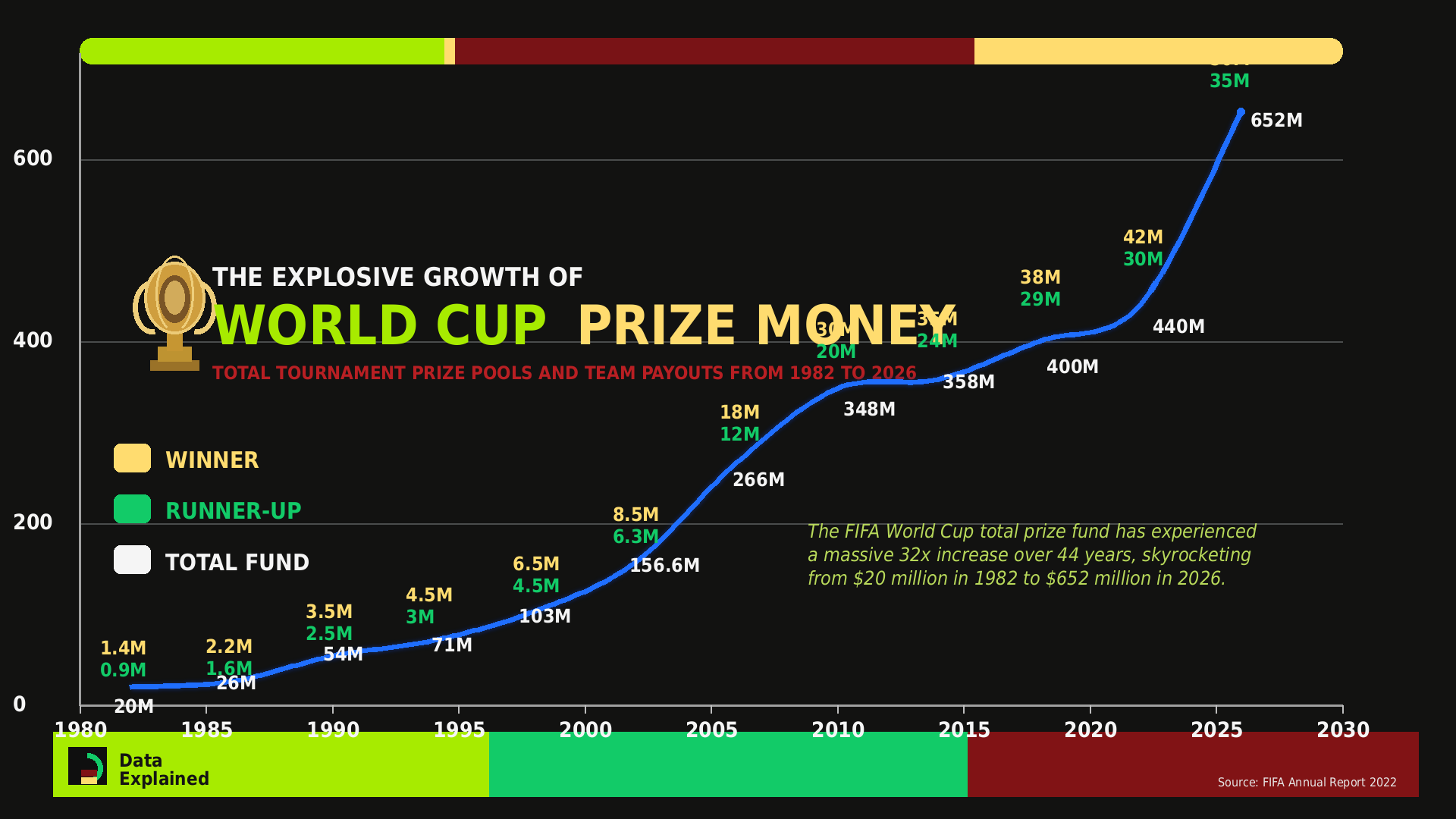
The broadcasting revolution that drove prize money growth from the 1990s onward was anchored in European and North American media markets. The sponsorship deals that fund the pool, Adidas, Coca-Cola, Visa, Hyundai, are negotiated by multinationals whose primary consumer bases sit in high-income economies.
The tournament's expansion from 32 to 48 teams, justified partly on grounds of inclusion, generates more matches, more broadcast inventory, and more commercial revenue, a portion of which returns to smaller federations as guaranteed participation fees.
The inclusion generates revenue. The revenue is distributed through a structure that rewards the teams most likely to advance deepest, which are not the teams inclusion was designed to benefit.
None of this is accidental. It reflects the logic of a commercial enterprise that operates under the branding of a global civic institution. FIFA's non-profit status and its stated commitment to football development exist alongside a financial architecture in which the wealthiest nations extract the most from a sport whose talent, passion, and viewership are genuinely global.
The prize money grows every four years. The structural conditions that determine who collects the largest share of it change far more slowly, if at all. The world's game has a price. Most of the world pays it. Fewer collect it.
___