Eco-Revolution: Riverhead Town Unveils Groundbreaking Textile Recycling Program
Riverhead Town has launched a new textile recycling initiative at its yard waste facility, aiming to divert millions of pounds of clothing and other textiles from landfills. Partnering with Advanced Climate Resources, the program gives unwanted items a second life, transforming them into new materials while complementing Riverhead's broader waste reduction and Climate Smart Communities efforts.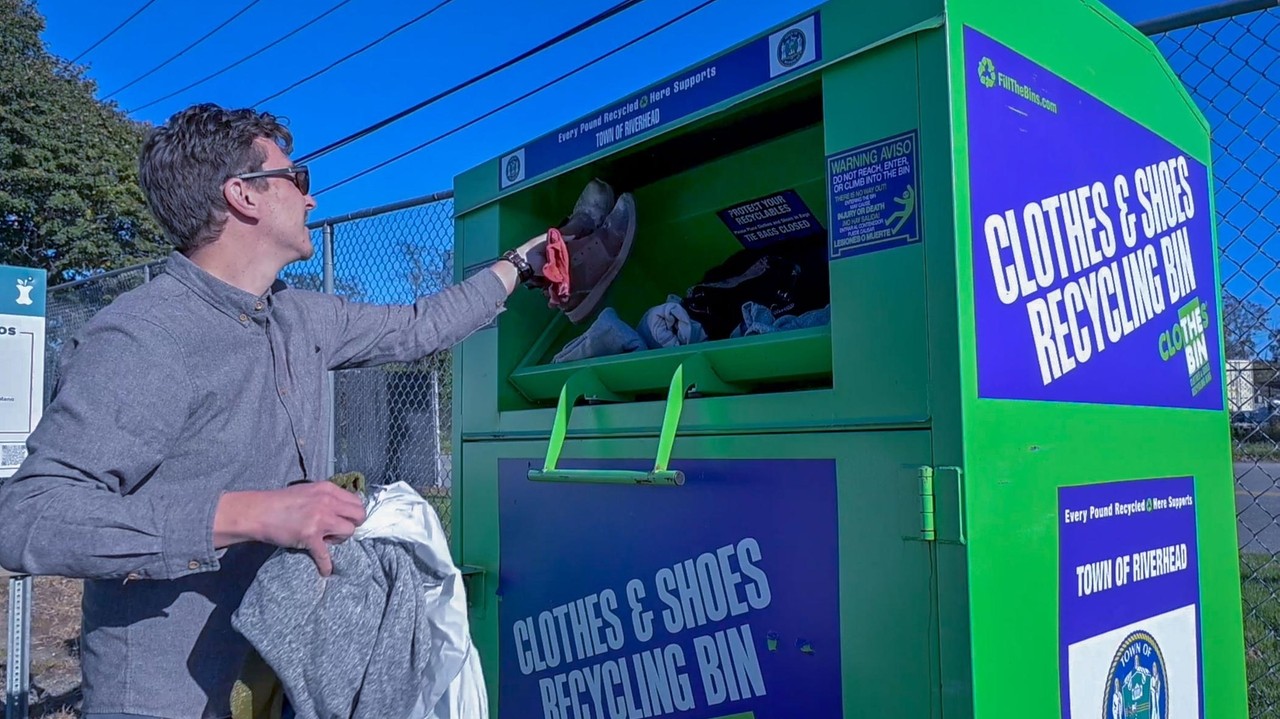
Riverhead Town has launched a new recycling initiative aimed at significantly reducing textile waste sent to landfills. As individuals sort through unwanted clothing, shoes, and accessories, this program offers a vital alternative to discarding items, providing them a second life and easing the burden on solid waste management systems. The town recently installed a dedicated clothing collection bin at its yard waste facility on Youngs Avenue, making it accessible for all residents.
Joe Rutt, a junior civil engineer for Riverhead Town, highlighted the critical need for such a program, stating that textiles are the number one item discarded that can be recycled, and their significant weight poses a considerable challenge for waste disposal. The initiative specifically targets worn-out, stained, and tattered items that are typically deemed unsuitable for donation to conventional thrift stores or charities. However, it's crucial that residents avoid depositing wet or moldy items, as these can contaminate the entire batch and undermine the recycling effort. The bin accepts a wide range of textile products, including clothing, shoes, belts, bags, and linens.
The collection bin is operated in partnership with Advanced Climate Resources of Huntington, a franchisee of the Florida-based company Clothes Bin. Ken Bruder, CEO of Advanced Climate Resources, explained the efficiency of the system, noting that sensors within each bin monitor fullness, ensuring timely and frequent pickups to maintain tidiness. Once collected, the textiles are transported to an operations center in Huntington. From there, they are sold to various buyers across the country, fetching between 30 to 50 cents per pound. This system ensures that items are put back into the circular economy through diverse applications.
The reuse possibilities for these collected textiles are extensive. While items in excellent condition might find a new home in thrift stores, a significant portion of the discarded pieces undergo transformation into new textiles, insulation materials, industrial rags, or even spongy playground surfaces. Bruder emphasized his goal to "make it as easy to dispose of a garment as it is to purchase a garment and put it on a path towards circularity," combating the environmental toll of fast fashion. The state Department of Environmental Conservation estimates that New Yorkers alone dispose of 1.4 billion pounds of textiles annually, with a staggering 85% ending up in landfills.
Advanced Climate Resources has seen substantial growth in its mission to divert textiles from landfills. Since 2023, the company has expanded its operations to include over 50 collection bins across Long Island, establishing partnerships with towns like Babylon and Huntington, Patchogue Village, and several nonprofit organizations. Cumulatively, these efforts have resulted in the collection of more than 400 tons of clothing. In return for hosting these bins, participating towns and organizations receive 10 cents for each pound of clothing collected. While Riverhead Town anticipates modest revenue, Rutt expressed hope that any funds generated could be used to support local community groups. He described the initiative as a "win-win" for the town, especially as it seeks innovative ways to reduce solid waste amidst rising costs and the impending closure of the Brookhaven landfill.
The textile recycling program is part of Riverhead Town’s broader commitment to waste reduction and its participation in the state’s Climate Smart Communities program. This initiative challenges municipalities to lower greenhouse gas emissions and address local climate change impacts. Councilwoman Denise Merrifield, who serves as liaison to Riverhead’s Climate Smart community task force, highlighted other concurrent efforts. These include a food scraps recycling and compost program, the provision of rain barrels, and a unique project involving the collection and curing of oyster and clam shells for return to the Peconic Estuary to support marine habitat restoration.
Further demonstrating its dedication to reducing waste, Riverhead Town is also planning its inaugural post-Halloween "pumpkin smash" event. Scheduled for Saturday, November 7, from 11 a.m. to 3 p.m. at the town yard waste facility, this event will allow residents to transform their pumpkins into nutrient-rich compost, preventing them from decaying in landfills and instead integrating them into the town’s food scrap program. Merrifield underscored the collective impact of these diverse efforts, stating, "All these little things really do add up to a lot." Mark Haubner, a Riverhead resident and member of the climate task force, strongly supports these initiatives, recognizing textile waste as "overwhelmingly large." Haubner also advocates for and participates in repair cafe events, which empower neighbors to mend worn clothing, broken appliances, and other items, thereby extending their lifespan. He articulated the overarching philosophy: "The whole idea is to keep everything that we use, everything that we manufacture as high up the use chain as we can for as long as possible."
Residents are encouraged to utilize the textile collection bin at the Riverhead Town yard waste facility, located at 532 Youngs Avenue, which operates Thursday through Monday from 7 a.m. to 3:30 p.m. This facility is also the site for the upcoming pumpkin smash event. By participating in these programs, the community can collectively work towards a more sustainable future, significantly reducing the volume of waste destined for landfills and fostering a circular economy.