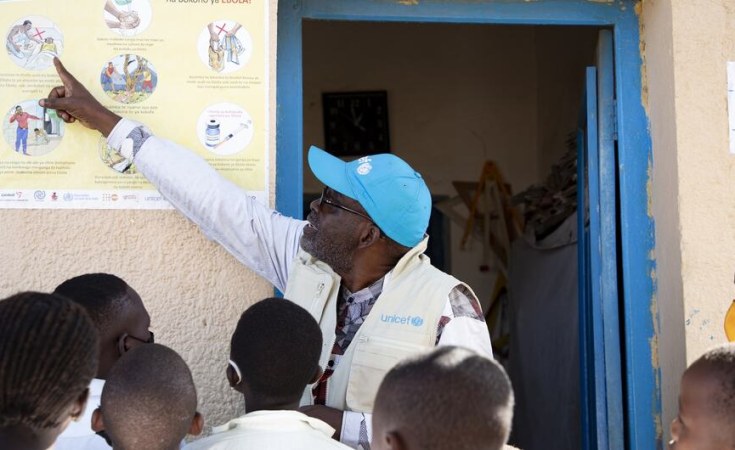
Ebola Crisis Grips East/Central Africa, US Aid Sparks Fierce Debate

The Democratic Republic of Congo (DRC) is grappling with a severe Ebola outbreak, particularly centered in the violence-hit Ituri province, which the World Health Organization (WHO) has declared an international emergency. This latest flare-up, detected on May 14, 2026, has seen more than 900 suspected cases and over 220 suspected deaths reported. The current outbreak is attributed to the less common Bundibugyo strain of the virus, for which there are currently no approved vaccines or treatments, and which carries a fatality rate of up to 50 percent.
The human toll of the outbreak is starkly evident, as illustrated by the arrival of a young, exhausted, and symptomatic woman at Rwampara Hospital. Wedged between her sister and a motorcycle driver, she presented with a temperature of 39.7C and clear symptoms of Ebola, including bleeding from the nose, a common sign of the haemorrhagic fever. Her sister recounted their initial confusion, mistaking the illness for malaria and attempting traditional remedies due to the long-standing absence of state services and healthcare knowledge in Ituri province, where armed groups and massacres are common. Healthcare workers, like Dieudonne Sezabo, were forced to immediately disinfect the driver and vehicle with chlorine due to the lack of protective gear on the motorcycle operator, highlighting the perilous conditions faced by those on the front lines.
The health response in Ituri has been slow, hampered by a lack of resources and community distrust. With no ambulances, patients often rely on motorbikes for transport, increasing exposure risks. Furthermore, initial attempts to establish isolation centers have been met with violent resistance; for instance, two isolation tents set up by the NGO Alima were set on fire by an angry crowd demanding the body of a friend who had died of Ebola. Dr. Isaac Mukengi, Rwampara Hospital's medical director, expressed concern that several patients had returned to the community after the isolation center fire, complicating containment efforts. Experts emphasize that successful containment hinges on trust in health authorities, a commodity scarce in conflict-ridden and fragmented regions like Ituri, though staff strive to facilitate supervised family visits to build rapport.
In response to the escalating crisis, neighboring Uganda has implemented stringent measures to prevent cross-border transmission. The Ugandan government, led by its National Task Force on Ebola Response, temporarily closed its border with the DRC for four weeks, effective May 27, 2026. Exceptions are only granted for authorized Ebola response teams, humanitarian workers, food and cargo transporters, and essential security personnel, all subject to strict health monitoring. All entrants must undergo mandatory health screening, documentation, locator form registration, and continuous monitoring, with returnees from DRC mandated to self-isolate for 21 days. Despite heightened alert and earlier measures like suspending public transport, Uganda's Ministry of Health confirmed no new Ebola cases had been recorded in the country since May 25, 2026, though 7 cases and 1 death were linked to the outbreak.
Kenya has also been thrust into the international spotlight regarding the Ebola outbreak. Reports from The New York Times and The Wall Street Journal have indicated that the United States plans to deploy US public health officers to Kenya to staff a quarantine facility, approved by the Kenyan government, for American citizens exposed to or at high risk of testing positive for Ebola in the region. Initially, the plan was to monitor Americans in Kenya and move symptomatic individuals to Europe for treatment, but the administration now reportedly intends to provide treatment within Kenya as well.
This revelation has ignited a political firestorm and public uproar in Kenya, with allegations that the government is compromising national health and safety to gain favor with the United States. In response, Kenya's Health Cabinet Secretary Aden Duale confirmed ongoing discussions with the US government and other global partners regarding strengthening preparedness and response mechanisms for Ebola and other public health threats. Duale reassured the public that any cooperation would be strictly guided by Kenya’s national laws, public health regulations, biosafety, and biosecurity standards, emphasizing the paramount responsibility to safeguard the health and welfare of Kenyans. He highlighted Kenya's critical role in regional and global health security, citing its professionals' support in past outbreaks and its robust systems for surveillance and emergency response. So far, over 55,000 travelers have been screened at points of entry, and 10 suspected cases have tested negative.
The continuous movement of populations, trade, and refugee flows across porous borders in East Africa poses a significant challenge to containing infectious disease outbreaks like Ebola. While Kenya asserts its readiness and capability, and Uganda enforces strict border controls, health experts consistently warn that these cross-border dynamics heighten the risk of disease spread. Effective prevention relies heavily on strict adherence to guidelines, rapid detection, and reporting, alongside fostering trust between communities and health authorities to ensure vital measures such as safe burials, isolation, and contact tracing are followed.
You may also like...
Mbappe's Reign Continues: Real Madrid Star Secures Back-to-Back POTS Award

Kylian Mbappe has secured Real Madrid's Mahou Five Star Player of the Season award for the second consecutive time, high...
Wemby on the Spot: NBA Slams Star with Warning for Media Breach

The NBA has issued a warning to Victor Wembanyama for violating media access rules after he did not speak to reporters f...
News Emmys Shaken by Student's CBS Criticism Amidst Top Network Wins

The 47th News & Documentary Emmy Awards celebrated excellence in journalism, with ABC News leading wins and student Sant...
ARIA Hall of Fame Forges 'Historic First' Broadcast Deal: A New Era for Music Recognition

The Australian Recording Industry Association (ARIA) celebrates its 40th anniversary Hall of Fame with a special broadca...
Kid Cudi Battles Darkness: Rapper Becomes Founding Partner for Mental Health Advocacy

Kid Cudi is joining 'We Are Enough' as a founding partner, leveraging his own mental health journey to combat stigma and...
Unpacking 'Clout Chasing': The Internet Term Taking Over Celebrity Buzz!

Discover the phenomenon of "clout chasing," a modern internet term describing the pursuit of online attention and fame. ...
Tanzania's Trillion-Dollar Bet: New Railways Set to Revolutionize Regional Travel

Tanzania is making significant strides in its ambitious railway transformation program, allocating TSh 2.872 trillion fo...
Republic of Congo Sparks Regional Travel Boom with 2027 Visa-Free Policy

The Republic of Congo will implement visa-free entry for all African passport holders starting January 1, 2027, a landma...