BITTER RIFT: Ruto's Graft War Under Fire as Gachagua Accuses President of Entrenching Corruption Amid Political Showdown
Kenya's political scene is fraught with tension as President William Ruto faces accusations of corruption, surveillance, and political coercion from his former deputy, Rigathi Gachagua. These allegations, alongside Ruto's evolving alliance with Raila Odinga, highlight a complex struggle for power and influence, raising questions about the nation's political future.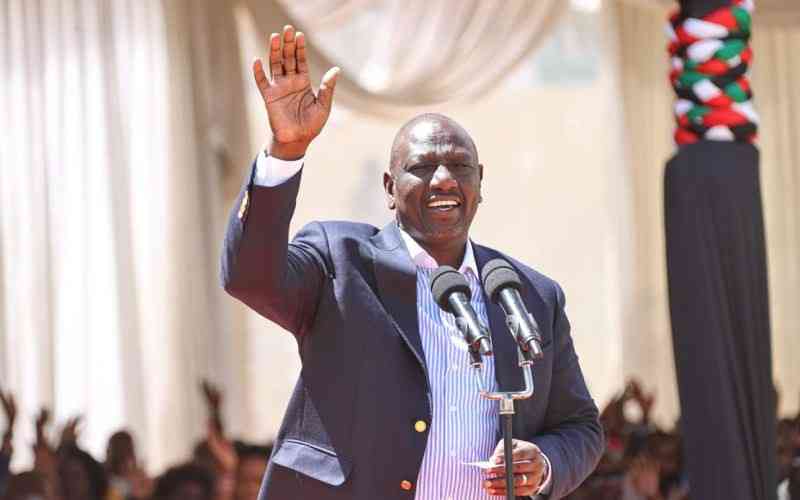
President William Ruto's recent strong rhetoric against corruption in the legislature has sparked significant debate, raising questions about his true motivations—whether it signifies a genuine reform drive or conceals a deeper political agenda targeting specific individuals. This comes amid a complex political landscape marked by shifting alliances and growing internal rifts within the ruling coalition.
A recent 'conclave' held in Karen, attended by Members of Parliament from both Raila Odinga’s ODM and William Ruto’s UDA parties, reportedly aimed to diminish the media presence of Deputy President Rigathi Gachagua. However, this meeting unexpectedly became a national spectacle where MPs appeared to turn against both Raila and Ruto. Despite defeating Raila in the 2022 elections, Ruto and Odinga later developed a close relationship, seemingly at the expense of Gachagua, who was initially the deputy president. Gachagua had reportedly disregarded warnings about a potential alliance between Ruto and Raila, as he tried to establish himself as a leader in the 'mountain' region. While Gachagua’s political standing within UDA seemed to diminish, Raila’s influence within Ruto’s government appeared to grow.
Adding to the political turmoil, Kenya experienced a "low moment" following Rigathi Gachagua’s return from a month-long visit to the US. Chaos erupted along Mombasa Road as his motorcade was teargassed and goons assaulted people. This incident highlighted an alarming trend of political intolerance and thuggery becoming ingrained in the country’s political culture. Various theories emerged to explain the chaos: some suggested Gachagua orchestrated it to discredit the government, others blamed the government, citing police inaction and a desire to retaliate against Gachagua, who had become a persistent irritant. A third possibility pointed to government loyalists and opportunists seeking to gain favor with President Ruto by exploiting the perceived animosity between him and Gachagua. Regardless of the truth, Gachagua reportedly gained political mileage, appearing as a victim.
Former Chief Justice David Maraga has publicly criticized President Ruto’s actions, describing his allegations of corruption among legislators as "cheap theatrics" and "blame games." Maraga accused the Head of State of overstepping his constitutional mandate by establishing unconstitutional bodies that duplicate existing state agencies, leading to a wasteful expenditure of taxpayer funds.
Further intensifying the political drama, former Deputy President Rigathi Gachagua has leveled serious accusations against President Ruto. Gachagua claimed that Ruto has introduced a "high level of corruption" into the National Assembly, arguing that the President lacks the moral authority to speak against graft, alleging that Ruto is "leading from the front." He dismissed the recently formed multi-agency team to combat corruption as merely a "diversionary tactic," asserting that Ruto is involved in "every scandal" in the country and is attempting to deflect attention from himself by blaming MPs. Gachagua also alleged that legislators who accepted bribes are now compelled to blindly endorse Kenya Kwanza government policies. He specifically claimed that Ruto maintains detailed "files" on all senators and MPs, containing evidence of their involvement in alleged bribery during his impeachment process and in the passage of the Finance Bill. According to Gachagua, this ensures their continued loyalty "up to the ballot." He attributed his own fallout with the President to his refusal to be a "Mr. Yes Sir," further alleging that Ruto routinely bribes lawmakers to secure support. Gachagua specifically claimed that MPs received KSh200,000 each to pass the Finance Bill, while for his impeachment, MPs were paid KSh500,000 and senators KSh10 million each.
Gachagua expanded on his accusations, stating that President Ruto secretly monitors MPs and Senators, possessing "dossiers" on them, including recordings of alleged bribery. He claimed Ruto anticipated potential defections and that the multi-agency team against corruption is, in reality, being used to compile political dossiers on adversaries and control UDA members contemplating switching allegiances. Gachagua suggested this intelligence is used to coerce leaders into loyalty, threatening legal action or public embarrassment for defectors. He likened this strategy to former President Moi's tactics in 2002, asserting that Ruto has positioned himself to make or break political careers to prevent mass defections ahead of the 2027 general elections.
The situation has prompted reflections on how political leaders handle dissent. The way former South African President Nelson Mandela managed Chief Mangosuthu Buthelezi, a divisive and polarizing critic, has been offered as a potential lesson for Kenya's political elite. Despite Buthelezi's role in violent clashes and his resistance to independence, Mandela, demonstrating immense wisdom and a spirit of reconciliation, brought Buthelezi into a government of national unity as Minister for Home Affairs. Mandela’s masterstroke was appointing Buthelezi as Acting South African President for two days in 1997, a move that reportedly assuaged Buthelezi's ego and diminished his role as an irritant. While the South African context differs, this approach suggests alternative ways to manage Gachagua. Proposed strategies include removing the negativity surrounding him, ignoring him, de-campaigning his perceived "tribal tag," and avoiding actions that keep him in the news. The sentiment is that engaging Gachagua in a public "wrestle" is counterproductive, especially given his past experience as a District Officer, implying his familiarity with "dirty tricks."
The unfolding political drama, with grave allegations of corruption, surveillance, and coercion, underscores a period of intense political maneuvering in Kenya, leaving the nation to ponder the true nature of its leadership's intentions and the path forward for national unity.