Beyond Holy Wars: The Realities of the Christian Crusades in Medieval Europe
An eye-opening commentary on the Christian Crusades beyond religious narratives, revealing the political ambitions, violence, cultural impact, and modern lessons on power, propaganda, and religious tolerance.
Introduction: The Holy Call and the Politics Behind It
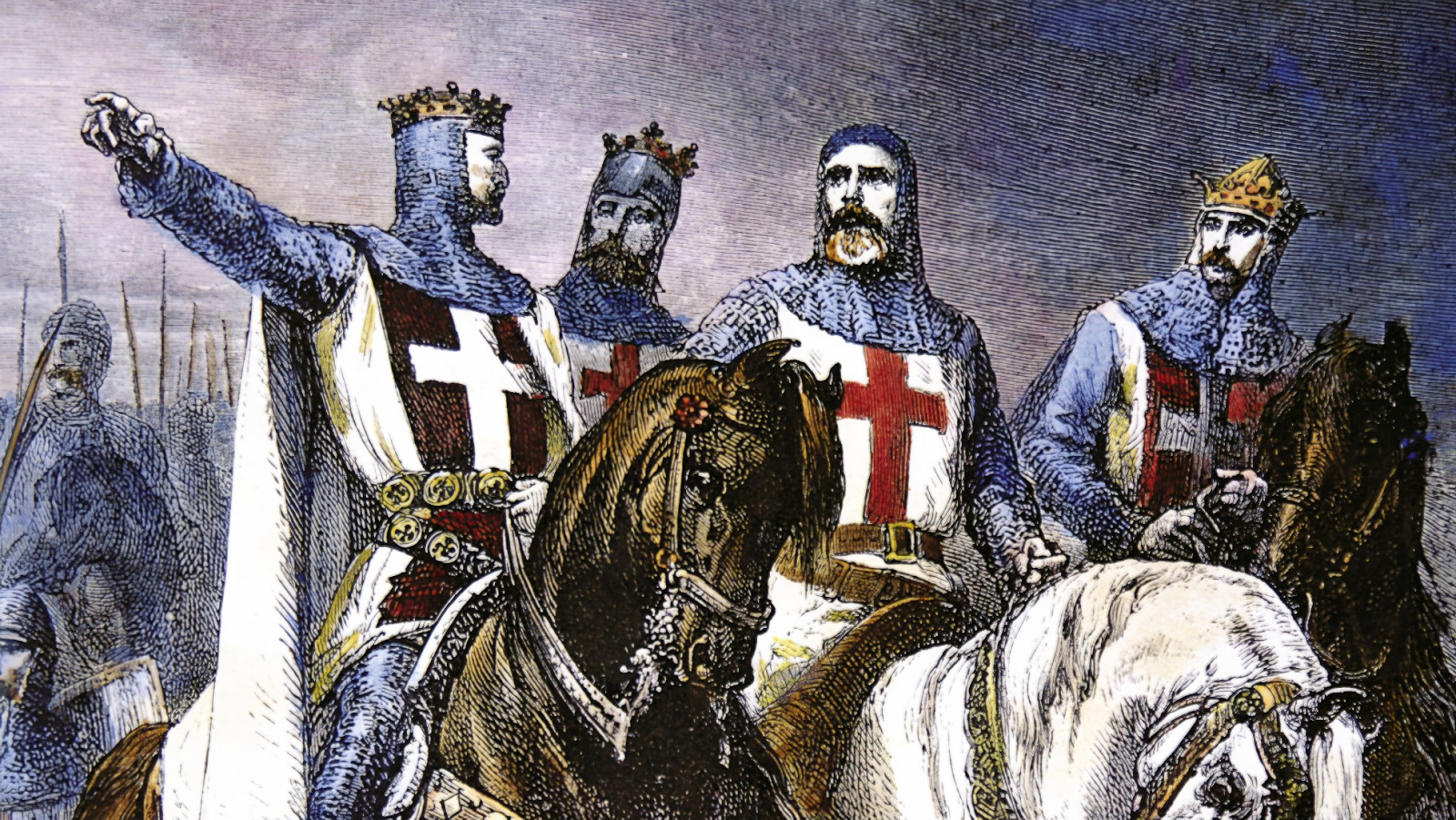
The story of the Christian Crusades is one many have heard in passing yet few truly understand. When people encounter the term today, they often imagine a modern Christian crusade, a contemporary religious gathering meant for worship, prayer, and revival. But what unfolded in medieval Europe was far from this peaceful assembly. The Christian Crusades were not choir-filled conventions or spiritual conferences; they were armed religious campaigns sanctioned by the Church and carried out by kings, knights, and ordinary people who believed or were made to believe they were fighting a holy war.
Before the First Crusade erupted in 1096, Europe was already a continent simmering with tension. Political power was fragmented as kings struggled to assert dominance over rebellious nobles, the Catholic Church held immense influence over people’s lives, and economic hardship left peasants desperate for opportunities that promised wealth or even salvation. It was within this reason that religious leaders, most notably Pope Urban II, found the perfect ground to plant an idea that would reshape continents: an armed pilgrimage to reclaim the Holy Land.
How Crusades Unfolded: Faith And Violence
The crusade, as it was defined then, meant a sanctioned expedition backed by the Church, promising both spiritual rewards and worldly gains. This was not merely a mission to defend faith; it became a political instrument wrapped in religious fervor. Medieval Europe teetered between faith-driven aspirations and the harsh realities of hunger, warfare, and social uncertainty. The Church, seeking to consolidate its standing, used the crusade to unify Christians under a single cause. Kings saw it as a chance to rid their territories of troublesome knights who stirred constant conflict. Nobles perceived it as an opening to acquire wealth and land. Ordinary people believed participation could guarantee forgiveness of sins and eternal salvation. Beneath the surface of religious devotion lay layers of ambition, manipulation, and political calculation. The Christian Crusades were therefore not solely about reclaiming sacred territory; they were also about expanding influence, redistributing power, and asserting dominance in a world already struggling with competing interests.
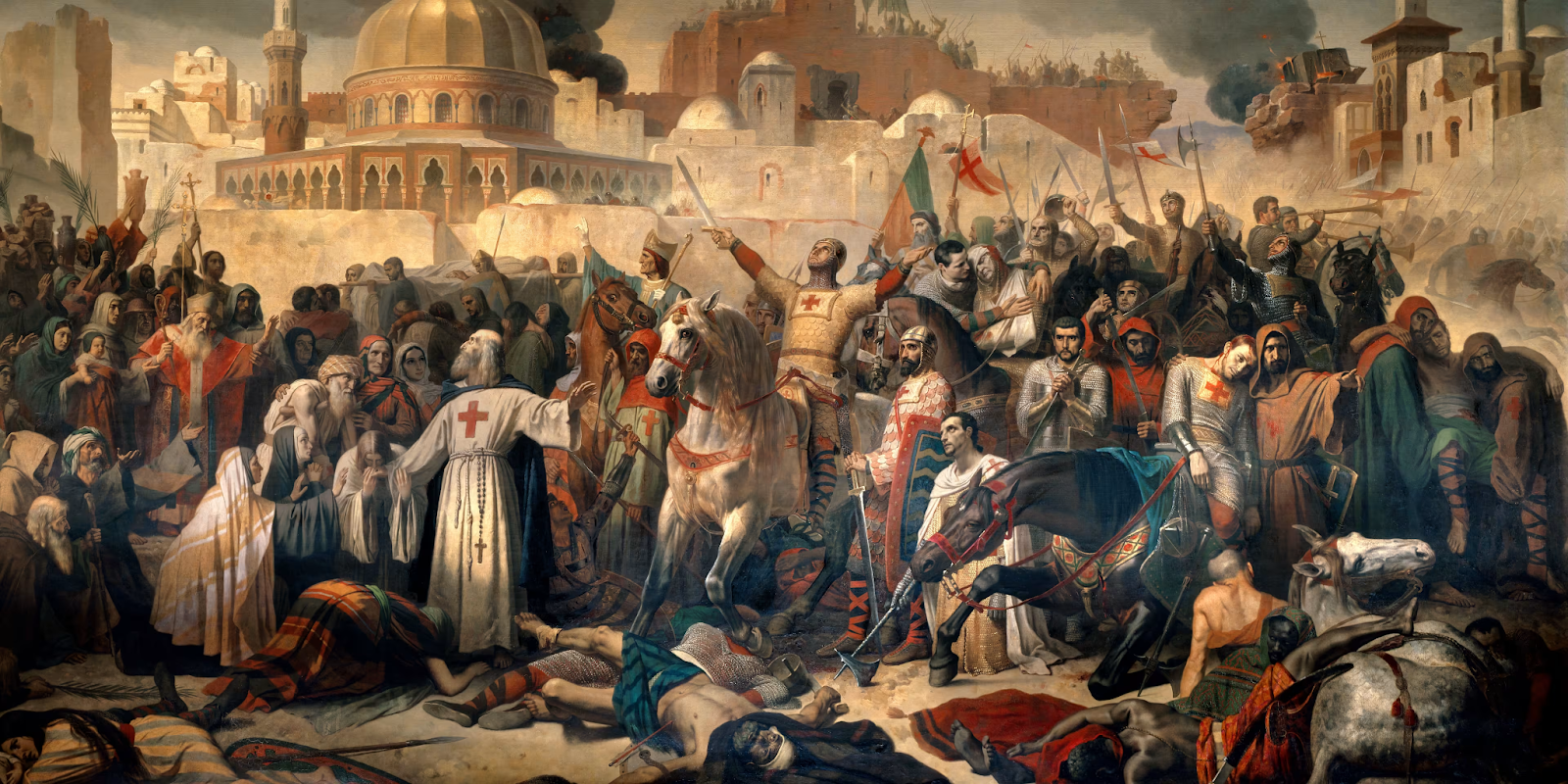
As the Crusades unfolded, the fusion of faith and violence became disturbingly clear. The call to arms that echoed across Europe compelled thousands to embark on a treacherous march toward Jerusalem. Many answered the call out of genuine religious conviction, but others were driven by fear, societal pressure, or the promise of glory and wealth. The journey itself was brutal, marked by starvation, disease, and internal conflict. When the crusaders finally reached the holy city, their arrival was far from the divine mission it had been portrayed as. The capture of Jerusalem in 1099 was characterized by intense bloodshed. Historical accounts describe the streets running red with the blood of both combatants and civilians. For many crusaders, the violence was rationalized as a purification of the city, a necessary act to complete what they considered God’s will.
Yet, within this chaos, surprising alliances and contradictions emerged. Not all interactions between Christians, Jews, and Muslims were marked by hostility. There were moments of negotiation, cooperation, and diplomacy. Some crusaders found refuge in lands ruled by Muslim leaders, and at various points, Muslim and Christian rulers entered agreements to secure peace, trade, or temporary stability. These moments complicate the typical narrative of the Crusades as an inevitable clash between religions. They were instead shaped by human motivations that transcended faith: strategic survival, political advantage, and economic interest. The crusaders also established states in the Middle East, such as the Kingdom of Jerusalem, which further blurred the lines between religious conquest and colonial ambition. Though the Church cast the wars as battles for God, the underlying forces, ambition, greed, fear, and rivalry, were undeniable.
Impact and Aftermath: What Really Changed
The impact and aftermath of the Crusades rippled across Europe and the Middle East long after the last campaign ended. This encounter between crusaders and Middle Eastern societies introduced Europeans to new ideas, technologies, and goods. Spices, mathematics, medical knowledge, and philosophical works flowed into Europe, contributing indirectly to the intellectual revival that would later flourish during the Renaissance. Also, the Crusades helped spark new trade routes and commercial networks between Europe and the East. Italian city-states like Venice and Genoa grew in wealth and influence through their role in supplying crusading armies and facilitating trade afterward.
We cannot deny the fact that the Crusades reshaped Christian and Muslim perceptions of each other, creating legacies of mistrust that still linger in some communities today. Jewish communities across Europe also suffered significantly during the Crusades, as crusaders attacked them en route to the Holy Land, viewing them as enemies of Christ even though they were far from the battlefield. These tragedies highlight a critical truth: the Crusades were not confined to distant lands; they disrupted local societies, intensified religious intolerance, and created patterns of violence justified through divine authority.
Looking at the military aspect, the Crusades introduced new strategies and technologies. Europeans adopted fortification techniques, siege methods, and certain weapon designs from the Middle East. These innovations influenced the structure of medieval armies and warfare. Politically, the Crusades shifted power balances in Europe. The Papacy grew more influential, asserting its authority across kingdoms. Monarchs who participated enhanced their prestige, while noble families rose or fell depending on their involvement and outcomes. Despite the stated religious goals, much of the change that followed was rooted in human ambition rather than spiritual triumph. Modern readers can draw important lessons from this era, especially the understanding that grand causes often hide complex motives.
History
Rewind the Stories that Made Africa, Africa
A Journey Through Time, Narrated with Insight.
Lessons for Today: Power, Propaganda, and Faith
The Crusades hold a mirror up to today’s world, where power, propaganda, and faith continue to intertwine in ways that can both uplift and destroy. One of the most enduring lessons is the danger of mixing religion with political agendas. When religious identity becomes a justification for violence or domination, society steps onto perilous ground. The medieval Church used persuasive rhetoric to convince people that warfare was a sacred duty. This manipulation of faith for political ends should caution contemporary societies about how easily narratives of righteousness can be weaponized. Leaders today may not issue crusades in the traditional sense, but they still shape narratives that appeal to emotion, identity, and fear to achieve political goals.
There is also a warning in the way the Crusades fostered superiority, intolerance, and the belief that one group must dominate another for divine approval. In modern times, it remains essential to ensure that no one is oppressed or discriminated against because of their religion. The right to belong to a religious group of choice without fear or harassment is a fundamental human right that stands in sharp contrast to the ideological forces that fueled crusader violence. Respect for diversity, peaceful coexistence, and open dialogue are values that must guide communities to avoid repeating the failures of the past. The Crusades show how quickly conviction can slip into fanaticism and how communities can be torn apart when ideology goes unchecked.
Another important lesson lies in recognizing how propaganda shaped medieval public opinion. Many participants lacked a full understanding of the politics behind the crusade; they believed what they were told, often without question. This parallels modern issues surrounding misinformation and media manipulation. People must remain critical thinkers, willing to question narratives and seek balanced perspectives. Blind trust in authority, whether religious or political, is dangerous when it silences reason and humanity.

Also it is important to note that the Christian Crusades were far more than a series of holy wars. They were a complex collision of faith, politics, ambition, and human frailty. While they reshaped continents and cultures, they also left behind painful legacies of violence, intolerance, and manipulation. Looking at them honestly, today’s societies can understand the necessity of separating personal faith from political ambition, the importance of respecting religious freedoms, and the responsibility to prevent oppression in all its forms. The Crusades may belong to the past, but their lessons remain profoundly relevant in a world still navigating the boundaries between belief and power.