Beats of the Diaspora: Afro-British Voices in the Rise of UK Hip Hop
How African Migrants Helped Shape One of the UK’s Most Influential Music Genres

Everyone knows a Malik
The streets of Birmingham shimmer wet beneath the orange haze of streetlights, but everything around Malik feels warped—like the city itself is shifting beneath his feet.
He tightens his black hoodie around his face, connects his earbuds, and puts his afro hip-hop playlist on full blast. In the sound mix is a chaotic shuffle of Dave, J-Hus, and Little Simz.
The night shift at the hospital still lingers in his bones. Hours spent wheeling gurneys through endless corridors, the hum of machines, the weight of lives in limbo. Now, the morning waits—flipping eggs, and slinging bacon at Champs Cafe.
Right now, his eyes and music carry him unsteadily through the waking city, his mind fogged and fracturing. Buildings bend at impossible angles, and shadows twist into figures that vanish when he looks straight at them. He stumbles into a lamppost, nearly crashes into a cyclist who he swears wasn’t there a moment ago. Words on signs jumble, letters falling out like loose teeth.
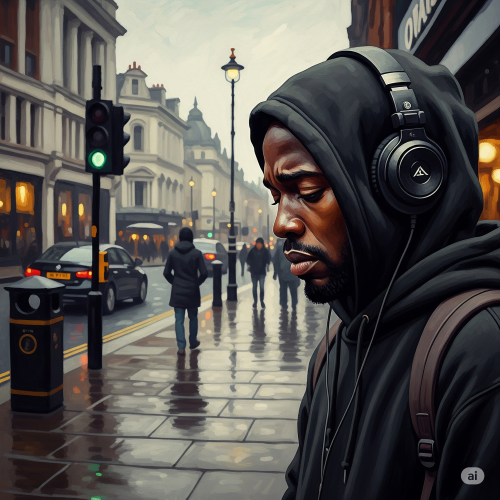
Dave’s calm verse cuts through the haze, albeit through earbuds: “I don't know myself. I don't know myself anymore.” The lyric is a sharp razor on a blistering wound. Gnawing fear wells up inside Malik—a darker shadow than exhaustion. His mother’s battle with Alzheimer's comes to mind, because these hallucinations, the creeping confusion—they feel like something deeper, something hereditary. Schizophrenia. The word coils around his chest like a noose. Is that what’s happening to me? Is my mind starting to betray me, too?
Ahead, the neon sign of Champs Cafe flickers weakly in the morning mist. The promise of the day job—a place where the grease and noise and routine might hold him steady—pulls him forward. His legs ache, his heart pounds, but then J Hus’ chorus settles over the turmoil: “Even when we never had a penny, yeah, we always had spirit. They can burn my flesh, but they can't touch my spirit.”
The Beginnings of British Hip Hop
Diaspora Connect
Stay Connected to Home
From Lagos to London, Accra to Atlanta - We Cover It All.
British hip hop has always pulsed with the energy of its margins - from the council flats of East London to the global festival stages, they have transformed UK rap from a raw imitation of American styles into a set of uniquely British genres, infused with African rhythm, Caribbean cadence, and homegrown urgency.
Within these sounds lies a deeper identity: the voice of the Afro-Diaspora. Since the 1960s, waves of migration from Africa and the Caribbean have helped forge not only Britain’s multicultural makeup but also its most dynamic musical movements. Through grime, drill, and afroswing, Afro-British artists have not only found their voice, but they've also helped redefine what British music sounds like.
The Roots of Sound (1960s–1990s)

In the 1960s, Britain saw an influx of immigrants from Africa, especially Nigeria and Ghana. They arrived on ships with dreams, degrees, and duffel bags. Their children, born into council flats and concrete estates, straddled two worlds: British by passport, African by culture.
By the 1980s, their voices began echoing through London, Birmingham, Nottingham, Bristol, and Manchester. Unlike the U.S., British inner cities were more class-segregated than racially divided, which meant that Black, Brown, and white working-class kids often shared the same buses, schools, and beats.
Afro diasporans in the U.K didn’t just imitate American rap — they made it theirs. Using thick Birmingham slang, African rhythms, and patois borrowed from Caribbean neighbours, they planted the seeds for what would become the UK's most original music movement.
All About Grime
East London became the crucible for grime, a genre defined by aggressive, fast-paced beats and MC-driven energy. Dizzee Rascal, a Nigerian-Ghanaian British artist from Bow, was a seminal figure in this explosion. His debut album Boy in Da Corner (2003) won the prestigious Mercury Prizeand became a foundational moment for UK hip hop, celebrated for its raw lyricism and innovative production. Dizzee’s influence earned him an MBE for services to music, reflecting grime’s cultural breakthrough.
Following Dizzee, Stormzy — of Ghanaian heritage — rose as grime’s global ambassador. His viral freestyle “Shut Up” reached the UK Top 10 after a fan-led campaign, and in 2019, he made history as the first British rapper to headline Glastonbury. Stormzy’s numerous accolades, including three BRIT Awards, three MOBOs, a BET Award, and an Ivor Novello, mark him as one of the genre’s greatest voices. Known for wearing a Banksy-designed stab-proof vest on stage, Stormzy used his platform to highlight social issues like knife crime, embodying grime’s tradition as the music of the underdog.

Image Above: Stormy. Credit: Jason Nocito of the BBC.
Diaspora Connect
Stay Connected to Home
From Lagos to London, Accra to Atlanta - We Cover It All.
Afroswing: Celebrating African Roots Through Rhythm (2010s)
While grime voiced urban struggle, Afroswing emerged as a sound of celebration, blending Afrobeats, dancehall, and UK rap into an infectious fusion. J Hus, a British artist with Gambian roots, pioneered this genre with his debut album Common Sense (2017), which artfully combined African melodies and UK street narratives. His BRIT Award for Male Solo Artist in 2021 cemented his status as a key innovator in this genre.
Kojo Funds, of Ghanaian heritage, is credited with coining the term “Afroswing,” emphasizing the genre’s African musical foundation rather than the Caribbean-heavy label “Afrobashment.” His hit “Dun Talkin’” showcased his smooth vocals and Afro-infused rhythms, helping shape the genre’s identity.
Not3s, a Nigerian-British artist, brought Afroswing to wider audiences with his viral single “Addison Lee,” referencing a popular London taxi company that publicly embraced the song’s success. Alongside others like MoStack and Tion Wayne, these artists celebrated African culture within a British urban context, redefining what British rap could sound like.
The Grit and Poetry of UK Drill (2012–Present)
UK drill emerged in South London’s Brixton after 2012, taking inspiration from Chicago drill but quickly evolving its own distinctive style — darker, minimalist, and raw. This genre is often dominated by Afro-Caribbean and African British youth who inject local slang, Afro-Caribbean rhythms, and street narratives into their music.
Headie One, of Ghanaian descent, stands out as one of the leading drill artists to cross into mainstream success. His 2020 album Edna, named after his late mother, topped the UK Albums Chart and earned multiple MOBO and BRIT nominations. Headie One’s emotive lyrics and melodic flows brought soul to drill’s hard-edged sound.
Unknown T, with Congolese heritage, added theatricality and charisma to the genre. His breakthrough single “Homerton B” went viral, highlighting his unique blend of gritty storytelling and stage presence. Both artists demonstrate the genre’s complex blend of harsh realities and artistic expression.

Image Above: Black Sheriff. Credit: Owula Kpako
Diaspora Connect
Stay Connected to Home
From Lagos to London, Accra to Atlanta - We Cover It All.
Ghanaian artist Black Sherif adds another layer to this cross-continental dialogue. Though based in Ghana, his fusion of drill beats with highlife melodies and emotionally raw storytelling resonates with the UK drill scene.
Songs like “Second Sermon” and “Kwaku the Traveller” have gained traction among UK audiences, blurring the line between African and British soundscapes. His collaborations with UK artists further show how drill has become a cultural bridge between African and British youth, rooted in shared struggles, diasporic identities, and defiant self-expression.
Skeng: The Hard Edge of Street Sound and Diasporic Fusion
Alongside grime, Afroswing, and drill, Skeng music has carved out a niche in the UK urban scene, characterized by its raw, aggressive energy and street-oriented themes. The term “skeng” in UK slang means “weapon,” and the music reflects a tough, unfiltered perspective on life in the inner city. The genre blends drill and dancehall influences, highlighting the ongoing interplay between African and Caribbean diasporic sounds in Britain.
Skeng music draws heavily from Jamaican dancehall, notably influenced by the Jamaican artist also named Skeng, whose style has inspired UK rappers and drill artists alike. This fusion is evident in the use of dancehall rhythms, patois slang, and a commanding vocal delivery. Afro-Caribbean and African British artists use skeng tracks to express street realities, resilience, and identity, making the genre a vibrant part of the UK’s diasporic musical ecosystem.
While skeng may not have a singular superstar associated with it as clearly as grime or Afroswing, many drill and grime artists incorporate “skeng” styles into their music. This crossover shows how Afro-Diasporan influences are fluid and constantly evolving, bridging genres and communities.
Cultural Impact and Global Recognition
As Malik steps toward Champs Cafe, still half-lost in the haze of exhaustion and fear, the beat in his ears anchors him. It’s more than just music—it’s memory, identity, resistance.
In that moment, the fractured cityscape, the encroaching shadows, even the fear of inherited illness—none of it can silence the rhythm that’s been forged from centuries of struggle and survival. This isn’t just hip hop. It’s a lineage. A movement born from migration and resilience, shaped by British streets and global diasporas, and carried by voices that refuse to disappear. It pulses through lives like Malik’s, offering clarity amid chaos, and anchoring a generation navigating multiple identities.