Andy Burnham Takes Reins as Labour Leader, Eyes PM Role
Andy Burnham has been confirmed as the new Labour Party leader, poised to become Prime Minister on Monday after an uncontested election. He pledges to deliver 'hope back' to the British people and lead an 'unashamedly Labour' government focused on ending neoliberalism, building council houses, and empowering local communities. His vision, honed during his time as Mayor of Greater Manchester, aims to tackle neglected issues and foster national unity across all regions.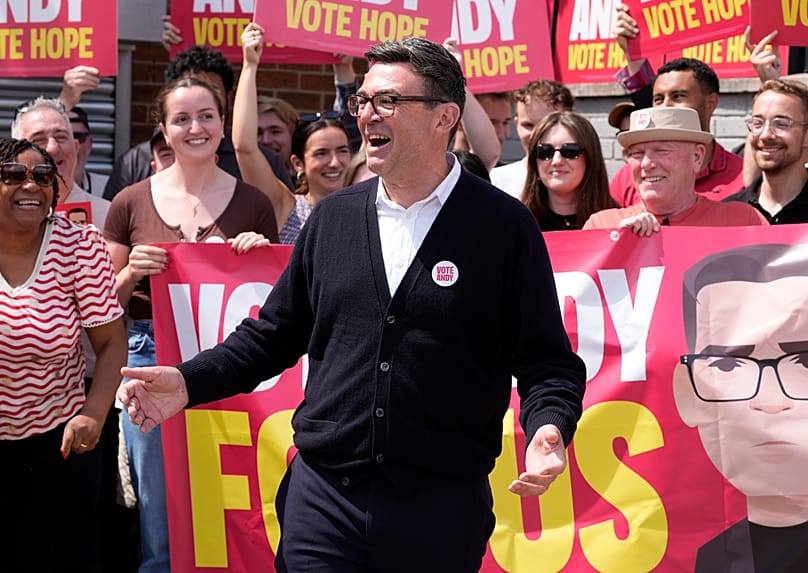
Andy Burnham has officially been confirmed as the new leader of the Labour Party, setting the stage for his appointment as the UK's seventh Prime Minister in a decade this coming Monday, July 20. The Makerfield MP's ascension to the top post comes after an uncontested leadership race, where he secured an overwhelming 379 nominations from Labour MPs out of a possible 403, and the backing of all 11 affiliated trade unions. This clear path to Downing Street was solidified last week when his final potential rival ruled out a challenge, although his uncontested run has sparked concern among some analysts and government insiders, with opposition leader Kemi Badenoch accusing Labour of 'running scared' of scrutiny.
Burnham's elevation follows Sir Keir Starmer's announcement last month that he would step down as Prime Minister, a decision made amidst mounting pressure after Labour's significantly poor performance in the May local elections. Starmer's resignation came on June 22, the same day Burnham was sworn into the Commons, with Starmer expressing pride in handing over the party 'in good shape' and belief that Labour could win the next election under Burnham.
Born on Merseyside and raised in Culcheth, Cheshire, Burnham's political inspiration stems from watching 'Boys From The Blackstuff,' a 1982 TV show depicting unemployed men in Thatcher's Britain. After studying English at the University of Cambridge, he worked in journalism before transitioning to politics as a researcher for former MP Tessa Jowell. He served as MP for Leigh from 2001 to 2017, holding significant ministerial roles, including Secretary of State for Health and Chief Secretary to the Treasury. Despite two unsuccessful bids for the Labour leadership in 2010 and 2015, losing to Ed Miliband and Jeremy Corbyn respectively, Burnham's political career continued to evolve.
In 2017, he became the Mayor of Greater Manchester, a role where he earned the moniker 'king of the North' and a reputation for staunchly defending the region, particularly during the Covid-19 pandemic lockdowns. His tenure oversaw considerable growth and development, where he honed his political philosophy, which he has dubbed 'Manchesterism.' His return to Westminster in June, after securing a substantial majority in the Makerfield by-election against challengers from Nigel Farage's Reform UK and Rupert Lowe's Restore Britain, further boosted his standing within the party, coming after Josh Simons stepped down as Makerfield MP to facilitate Burnham's return to parliament.
Burnham's official appointment was confirmed today at a special conference held at the headquarters of the Trade Union Congress (TUC) in London. The event was opened by Manchester Central MP Lucy Powell, and the leadership election result was formally announced by Home Secretary Shabana Mahmood, in her capacity as chairwoman of the party’s ruling National Executive Committee (NEC).
In his victory speech, Burnham pledged to restore 'hope back' to the people and promised 'the Labour they once knew.' He declared himself 'ready to lead' and committed to delivering a government with 'the courage to fix the big things that politics has neglected.' He vowed his government would be 'unashamedly Labour,' seeking to 'build a new politics' that is 'distinctively Labour,' moving away from 'wearing too many Tory clothes' or trying to 'out Green the Greens, or out Reform Reform.'
Central to his political direction, Burnham articulated a vision to end 'trickle-down economics' and 'neoliberalism,' arguing that Britain took 'series of wrong turns in the 1980s' by centralizing political power and privatizing economic power, leaving people exposed and communities deindustrialized. He plans to embark on 'the biggest council house building programme since the post-war period' and adopt a 'more interventionist approach to the economy' to spread growth to the regions. This includes establishing a 'Number 10 North' in Manchester. While he has previously advocated for the UK to rejoin the European Union, he softened his stance during the Makerfield campaign, stating, 'Brexit has been damaging. But I also believe the last thing we should do right now is rerun those arguments.'
Burnham underscored his commitment to national unity, stating he would be 'a leader for the north, the south, the east, and the west, plus Scotland, Wales and for Northern Ireland.' He emphasized the need to take power back from Westminster and Whitehall, giving it to local communities, and highlighted a pro-business approach. He aims to build an education system that offers parity between academic and technical education, providing every young person with a clear path to success.
In his address, Burnham extended gratitude to Sir Keir Starmer for his leadership in bringing Labour back to a position of strength, particularly acknowledging Starmer's role in the Hillsborough Law. He also paid tribute to three political mentors: Lord David Blunkett, Baroness Margaret Beckett, and Lord Neil Kinnock, crediting Kinnock with inspiring him to join the Labour Party in 1985. He acknowledged past shortcomings, but reinforced his commitment to staying close to the people, drawing strength from them, and his unwavering style and beliefs.
Burnham will officially assume the role of Prime Minister on Monday when Sir Keir tenders his resignation to the King, with his next address to Parliament scheduled for September following the summer recess. He steps into leadership at a challenging time for Labour, with the party having trailed Reform UK in opinion polls for nearly 18 months. Labour hopes his presence will spark a resurgence and reverse their fortunes. A by-election to select his replacement as Mayor of Greater Manchester is scheduled for Thursday, July 30.