Amazon’s $11 Billion Satellite Deal and What It Could Mean for Your iPhone
Amazon just spent $11B on Globalstar, a move that could change how your iPhone connects anywhere through satellites.
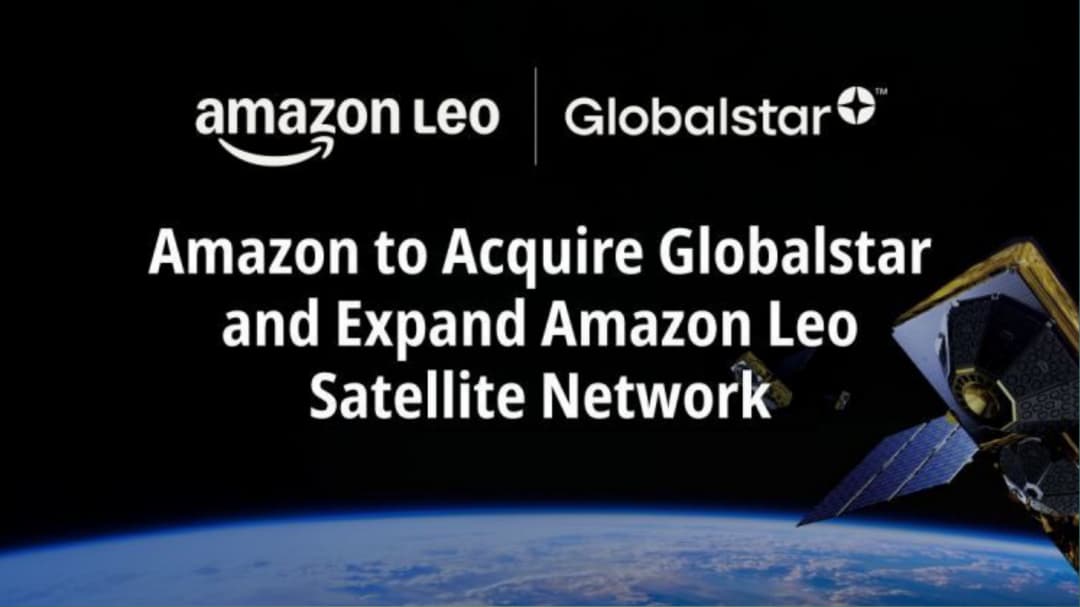
Amazon is paying over $11 billion to acquire satellite company Globalstar, a move that signals a quiet but major shift in how future mobile devices may stay connected, even when there is no network coverage.
The deal is not just about satellites. It is about control of the next layer of global communication: space-based connectivity.
Why Amazon wants Globalstar
Globalstar operates a small fleet of low-Earth-orbit satellites and holds licensed spectrum that allows signals to travel directly between satellites and devices on the ground.
That capability, known as direct-to-device communication, is the key asset.
Instead of relying on cell towers, phones connect straight to satellites. This is already used in limited form for emergency messaging on smartphones such as Apple’s iPhone lineup.
Amazon wants to scale this globally.
The company is developing its own satellite internet system, Project Kuiper, designed to deploy thousands of satellites into orbit to provide worldwide coverage.
But building from scratch is slow and heavily regulated. Globalstar gives Amazon something faster: existing satellites, approved spectrum rights, and regulatory clearance that would otherwise take years to secure.
In simple terms, Amazon is buying a head start.
The Apple link

Apple already uses Globalstar’s satellite network to power emergency SOS features on newer iPhones and Apple Watches.
This system allows users to send messages when they are completely outside cellular coverage.
Latest Tech News
Decode Africa's Digital Transformation
From Startups to Fintech Hubs - We Cover It All.
With Amazon now entering the picture, that infrastructure gains a powerful new backer.
Reports indicate Apple and Amazon have agreements to continue supporting satellite connectivity for current and future devices.
For users, that could mean:
More reliable emergency messaging
Expanded off-grid communication features
Broader satellite coverage over time
But it also creates an unusual dependency: Apple’s satellite layer now relies on infrastructure controlled by one of its biggest ecosystem competitors.
The bigger competition

Amazon is entering a space already dominated by SpaceX, whose Starlink network currently operates thousands of satellites in orbit.
Starlink has become the leading commercial satellite internet provider, offering broadband coverage in remote regions, ships, aircraft, and disaster zones.
Amazon’s approach is more ecosystem-driven. Instead of only providing internet service, it aims to integrate satellites with its cloud computing and logistics systems.
Globalstar helps accelerate that plan by giving Amazon access to ready-made infrastructure and pre-approved spectrum usage.
What changes for your phone
Nothing changes immediately.
Latest Tech News
Decode Africa's Digital Transformation
From Startups to Fintech Hubs - We Cover It All.
But the direction is clear: smartphones are moving toward hybrid connectivity systems that switch between: cellular networks, Wi-Fi and satellite links
This means future devices may stay connected even without mobile towers.
Practical use cases include:
Sending messages without network coverage
Emergency communication in remote regions
Location sharing in isolated areas
Satellite messaging is already being expanded across multiple manufacturers, including Google and Samsung devices in limited regions.
The hidden risk: space congestion
As more satellites are launched, Earth’s low orbit is becoming increasingly crowded.
This raises concerns about orbital safety and long-term sustainability.

One major risk is a cascading collision effect, where debris from satellite crashes triggers further impacts, potentially creating large fields of space debris.
This theoretical risk is known as orbital debris cascadeor Kessler Syndrome.
Scientists warn that without stronger coordination, increasing satellite launches could raise long-term risks for space operations.
What comes next
Latest Tech News
Decode Africa's Digital Transformation
From Startups to Fintech Hubs - We Cover It All.
The acquisition is expected to close around 2027, pending regulatory approval. Until then, Amazon and Globalstar continue operating independently.
But the direction is already set.
Amazon is expanding beyond retail and cloud computing into global communication infrastructure, both on Earth and in orbit.
And if the strategy succeeds, the future of mobile connectivity will not depend on stronger towers or better phones.
It will depend on how many satellites are overhead when you need them.