Africa's Dark Files: The Giulio Regeni Case That Shook Egypt and Italy
The Giulio Regeni case exposed allegations of torture, state impunity, and a decade-long legal battle between Egypt and Italy. Here's what happened.

A man's body does not simply appear beside a highway. Coincidence can explain many things but not this. Bodies do not place themselves.
On February 3, 2016, Giulio Regeni's corpse was found in a ditch along the Cairo–Alexandria desert road. He was half-naked, mutilated and found nine days after he vanished from a Cairo metro station.
What happened in those nine days would become one of the most consequential unsolved crimes of the decade. This is a case that indicted a state, froze a bilateral relationship, and is, ten years later, still waiting on a verdict.
This is not a cold or closed case. As of this month, it is a very hot one.

Who Was Giulio Regeni and Why Cairo Wanted Him Gone
Regeni was 28, a Cambridge PhD researcher at Girton College studying independent trade unions and the organizing power of Cairo's street vendors. He disappeared on January 25, 2016, deliberately. That day was the fifth anniversary of the Tahrir Square uprising, a date Egyptian security forces treat as a national threat-level red alert.
Regeni was born in Trieste and grew up in Fiumicello, in Italy's northeast. He had earned a scholarship to complete high school in New Mexico before pursuing his doctorate at Cambridge, where he researched Egypt's independent trade unions while also having worked for the consulting firm, Oxford Analytica.
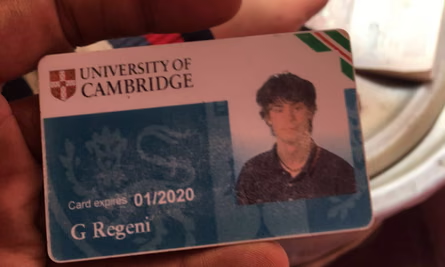
He was, in other words, exactly the kind of foreign researcher who draws the attention from a surveillance state and he had already drawn it. Cairo police had received a report on Regeni in early January 2016, and Egypt's National Security Agency had been monitoring him before he vanished.
The Body That Told Its Own Story
When Regeni's body surfaced, it had cigarette burns, broken teeth and fractured bones, an indication of prolonged torture. Investigators also documented that letters of the alphabet had been carved into his skin with sharp objects. This is a torture signaturewidely documented as characteristic of Egyptian police methods.
His mother would later describe recognizing only the tip of his nose.
A 300-page Italian autopsy report handed to Rome's public prosecutor's office contradicted early claims of electric shocks to his genitals, while a separate Egyptian forensic account concluded he had been interrogated and tortured over several days at intervals of ten to fourteen hours before he was killed; Egypt's own autopsy findings have never been made public.
Two states examined the same body and produced two different truths
Cairo's Cover Story Collapses
In March 2016, Egyptian police shot and killed four men in a raid, presenting them as a criminal gang specializing in kidnapping foreigners, claiming Regeni's passport and ID were recovered from one member's flat. It was a tidy narrative but it didn’t survive scrutiny.
Egyptian judges themselves later ruled that these men were not Regeni's killers.
Meanwhile, the evidence continued to point towards the state. Reporting emerged that the United States had acquired explosive proof that Egyptian security officials had abducted, tortured and killed Regeni, and that Egypt's leadership was fully aware of the circumstances of his death.
Italian investigators working inside Egypt described being obstructed at every turn.
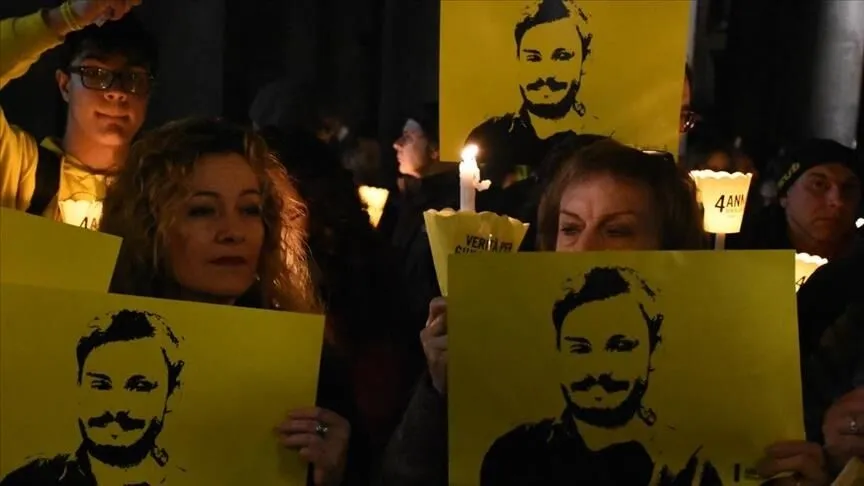
By November 2020, Italian magistrates had built a formal case. Investigators concluded Regeni had been tortured and murdered by Egyptian security officials after his doctoral research led them to suspect he was a spy and charged the men accordingly.
The accused are Major Magdi Sharifof Egypt's General Intelligence, Major General Tarek Sabir, police Colonel Hisham Helmy and Colonel Ather Kamal with Sharif additionally accused of running a network of informants who tracked Regeni before his arrest at a Cairo metro station.
A Trial Egypt Refused to Attend
Getting the trial to actually happen took years of legal combat. A first attempt in October 2021 collapsed within hours, when the court ruled the defendants had never been formally notified of their charges.
Prosecutors testified they had tried roughly thirty times, through diplomatic and government channels, to obtain the suspects' addresses from Egypt and never received an answer.

Italy's Constitutional Court finally broke the deadlock in September 2023, ruling the four Egyptians could be tried in absentia despite Egypt's refusal to deliver formal notice and the trial reopened in February 2024.
It marked the first time Egyptian security officials had been prosecuted abroad for the kind of abuses human rights groups say occur at scale inside Egypt. Egypt has never cooperated with Italian judicial authorities and the defendants have never appeared in court.
Even after resuming, the process kept stalling. In October 2025, defense lawyers raised a constitutionality challenge over the defendants' right to appoint expert witnesses, and Rome's Court of Assizes suspended the trial again, sending the question to the Constitutional Court.
Proceedings resumed in February 2026 once that court ruled with a verdict then projected for June or July.

Ten Years Later, Prosecutors Ask for Life
This is where the story stands right now. In late June 2026, Italian prosecutors formally requested a life sentence for Major Magdi Sharif and prison terms of seventeen years and six months each for Sabir, Helmy and Kamal.
For the first time, and with the family's consent, prosecutors showed the court autopsy images, arguing the injuries proved Regeni was tortured over days while fully conscious, without sedation, drugs or relief, describing it not as beatings but as a method of annihilation.
A few days ago, the Rome prosecutor's office delivered its closing argument, describing the killing as a methodical, cold-blooded and an organized act against a defenseless man.
Italy's government, appearing as a civil plaintiff, has also sought two million euros in damages from the four accused agents. A verdict is not expected before the court's August recess.
What This Case Says About Africa's Accountability Gap
Regeni's case is Egyptian, but its implications reach across a continent where enforced disappearance, custodial torture and state impunity are rarely tried in any courtroom, let alone a foreign one.
Egyptian officials and police have repeatedly and publicly denied any involvement and the suspects themselves have never responded to the accusations. Whatever verdict Rome delivers, it will be a test of whether justice can travel further than a state's borders when the state itself refuses to answer.