25 Years On: 9/11's Haunting Legacy and Hidden Truths Resurface
Twenty-five years after 9/11, Europe grapples with evolving terror threats, including a new online nihilistic extremism, while Americans continue to live with the profound personal and public health legacies of the 2001 attacks. Recent revelations of government misinformation regarding Ground Zero air toxicity highlight the ongoing fight for justice and remembrance for those permanently affected.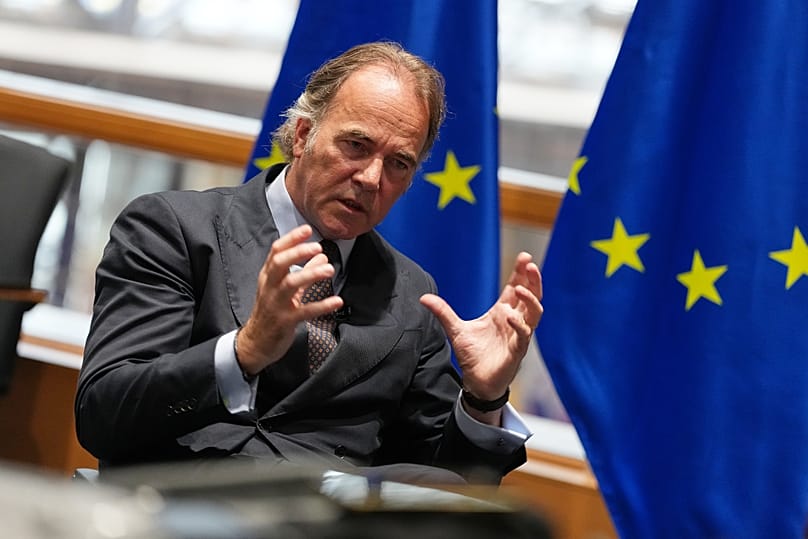
A quarter-century after the devastating Al-Qaeda terrorist attacks on the United States, Europe continues to face significant security threats from jihadist groups. However, a new and alarming form of extremism has emerged, primarily driven by young people online: nihilistic violent extremism. This phenomenon, characterized by "violence for the sake of violence," is causing concern among authorities across Europe, as highlighted by European Union Counter-Terrorism Coordinator Bartjan Wegter.
The exact scale of this new online menace, known as "The COM," remains unclear, but police in nine European countries identified approximately 4,340 web addresses linked to it during a recent disruption campaign. Wegter noted the absence of a direct ideological link, explaining that this violence is often a fascination, a means of asserting oneself, and gaining status within online communities. The number of such incidents has been on the rise for two to three years, leading to offline violence, including unprovoked stabbings. These attacks are particularly challenging to prevent because they often involve young individuals without criminal records, whose digital footprints are frequently hidden behind encrypted online platforms.
Last year alone, 45 terrorist attacks were reported in 10 EU countries, with jihadist groups responsible for 24 of them and over 70% of related arrests. Notably, around one-third of those taken into custody for terror links were under 18, mostly boys. While Europol does not track nihilistic violent extremism due to varying definitions, examples such as a 16-year-old in Finland who stabbed classmates and shared a "manifesto" online, and a 15-year-old in Italy who planned a murder for notoriety, underscore the severity of the threat. The online environment, described by Wegter as a "petri dish" for connecting different threats, is further complicated by the rise of artificial intelligence, which amplifies violent content, propaganda, and attack manuals through deepfakes, bots, and other AI-driven tools.
Meanwhile, the legacy of the September 11, 2001, attacks continues to profoundly shape the lives of Americans, particularly those in New York City and Long Island. A recent poll by Mount Sinai South Nassau hospital revealed that two-thirds of local residents believe their lives were permanently altered by 9/11, a sentiment even stronger among Long Islanders. A quarter of respondents also reported experiencing mental health issues or trauma related to the attacks. Dr. Josh Kugler, Mount Sinai South Nassau’s interim president, emphasized the "everlasting" and "palpable" psychological impacts that are difficult to quantify.
Personal accounts from survivors and those who lost loved ones vividly illustrate this enduring impact. Roderick Andersson, who escaped the South Tower shortly before its collapse, reflected on the profound loss of colleagues and the realization that many who didn't experience it directly "don’t get it." He learned invaluable lessons about prioritizing God, family, friends, and community. Rose DeMartino, a financial professional near the World Trade Center, found strength in community and resilience after witnessing the chaos, a resilience she later drew upon during her battle with cancer. James J. Malone, who navigated a chaotic commute on 9/11, remembered the 44 residents of his village who never came home, emphasizing that "nothing is the same, nothing is better, nothing is over."
Other poignant stories highlight the deep personal scars. Thomas Doyle, a retired New York City Sheriff sergeant, described inhaling the "terrible dark cloud of death and despair" at Ground Zero, feeling the lost souls in his heart and blood, and vowing to live his best life in their honor. Nancy K. Nee shared the pain of losing her firefighter brother, George C. Cain, and articulated a changed sense of national security. Adam Feinberg recounted his then 5-year-old son searching magazines for his little league coach, a firefighter who perished, encapsulating the sentiment, "Never forget!" Diane Zoeller, a teacher 60 miles away, could still smell the burning towers days later, underscoring that for Long Islanders, "it’s still personal." William E. Wickes, a currency broker who narrowly escaped the South Tower, found new purpose as a teacher, supported by a community that embraced him through his survivor's guilt, now participating in Tunnels to Towers races with his children, hoping to find national unity once again.
Communities like Garden City, which lost 23 residents, honor their fallen with scholarships, awards, and memorials. The names of Jonathan Neff Cappello, David Leistman, and Stephen K. Tompsett live on through various tributes, including a scholarship that supported students interested in science and technology. The deep grief experienced by families is compounded by questions of when it is acceptable to stop grieving, as noted by Rev. Maria Francesca French, with many survivors grappling with guilt. The sentiment that 25 years only magnifies the absence of loved ones resonates deeply.
A critical and painful aspect of 9/11's aftermath involves the health crisis faced by first responders and survivors. Babylon Town recently unveiled a new memorial specifically honoring residents who succumbed to diseases related to their work at Ground Zero, acknowledging that these individuals were "every much a part of that day." The monument, featuring 14 names with space for more, symbolizes the ongoing tragedy, as thousands more are expected to die from 9/11-related illnesses in the coming years, with over 130,000 enrolled in the World Trade Center Health Program.
Further compounding this tragedy are revelations about government accountability. Recently released, long-secret files from the New York City government, comprising over 170,000 pages, indicate that officials misled the public about the toxicity of Ground Zero air. Tests detected asbestos near the site almost a year after the collapse, despite assurances that the air was safe. Mayor Zohran Mamdani stated that "People got sick because the leaders they trusted lied and told them they were safe to breathe in the toxic air." This release, settling two lawsuits, follows years of advocacy by 9/11 survivors and first responders, who, as Jon Stewart criticized, had to fight, sick and dying, for these documents to see the light of day. This exposes a profound betrayal of trust and underscores the ongoing battle for justice for those whose lives were irreversibly altered by the attacks and their aftermath.