When the Earth Listens: Rice, Resilience, and the Quiet Revolution Of Land and Expectation
This highlights the significance of rice in Africa, beyond just being a grain. It's about promise, identity, and community. The article tells the story of Salmata Ouattara in Ivory Coast, whose rice yield more than doubled from 2 to 4.5 tonnes with the help of "Smart Valleys" - a humble innovation empowering farmers to control water and work with the land. This revolution in rice farming could lead to Africa's rice self-sufficiency by 2030, transforming the continent from a dependent to a producer.
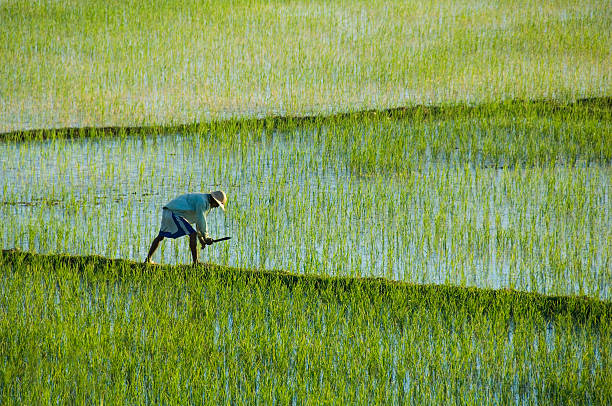
Rice in Africa is more than a grain. It is a promise. A fragment of identity folded into jollof, of ritual in celebrations, of comfort at the hearth. And for too long, this promise has been delayed by climate, isolation, and insufficient tools.
In the fields near Bouaké, Ivory Coast, Salmata Ouattara can speak of this delay with a tired but triumphant voice. Just a few seasons ago, Salmata’s patch yielded two tonnes of rice a year—enough, barely, to keep the family from hunger, but far from hope. Now, with the arrival of a simple innovation—Smart Valleys—her yield has more than doubled. She now harvests 4.5 tonnes, and with that, reclaims more than just rice. She reclaims agency, sustenance, and a sense that the earth, when gently respected, will bear fruit.

SOURCE: gettyimages
It is in that doubling—from two to four-and-a-half tonnes—that the real story lies. Smart Valleys are not magic. It is a design rooted in humility: controlling water, working with the land, and empowering farmers to build systems they understand and sustain.
Valleys that Keep Secrets—and Seeds
In much of sub-Saharan Africa, fertile inland valleys lie under-cultivated—not for lack of interest, but because water is a fickle ally. Too much in the rainy season drowns the field; too little in dry months chokes it. Earth readies itself to receive seeds, but no message—no irrigation, no trust—ever travels.

SOURCE: gettyimages
Smart Valleys changes that. It draws on age-old sawah designs from Asia, but rewrites the instructions with African knowledge. Communities in Benin, Togo, Sierra Leone, and Liberia have begun shaping bunds and shared canals, built at low cost, where water becomes a rhythm rather than a disaster.
When farmers themselves become architects of their irrigation, the field responds. In Benin, yield rose by around 0.9 tonnes per hectare; net income increased by about US $267 per hectare—a dramatic return on modest effort.
Here, innovation does not arrive in plastic crates. It grows from conversation—scientist with farmer, farmer with soil—tuned by taste, texture, toil.
One Mother’s Harvest, A Continent’s Hope
Salmata is not alone in her newfound abundance. Across Ivory Coast, other farmers have also transformed their yield, thanks to Smart Valleys and AfricaRice’s involvement. AfricaRice—with its 800-hectare research farm, its gene bank of 22,000 rice varieties, its investment partners like the Gates Foundation, Islamic Development Bank, and World Bank—now envisions this doubling not as outlier moments but as the seed of continental transformation.The Guardian
They are aiming for unlikely, but necessary, ambition: rice self-sufficiency for member states by 2030. If this happens, it would mark a turning point—not just feeding mouths, but redefining Africa as a producer, not a dependent.
Water, Yield, and the Climate’s Code
This rice revolution comes not a moment too soon. Enter climate change—with its droughts, floods, and unpredictable rains: threats turned routine. But Smart Valleys, by restoring control over water, also restores hope.
Elsewhere, AfricaRice and its partners are breeding stress-tolerant varieties—like ARICA and the flood-resilient FARO lines—that stand against drought, salinity, or submergence. Cultivation methods such as Alternate Wetting and Drying (AWD) also offer water savings of around 38% while keeping yields intact.
This is no longer about crops, but survival.
A Landscape in Motion
In Kenya, at the Mwea Irrigation Scheme, mechanization has begun reshaping planting itself. With new rice-transplanters, yields jumped from 25bags to 40 bags per acre. Labor, razor expensive, gives way to efficiency; costs collapse from nearly 9,000 shillings a day to just 700.
In Zanzibar, farmers using a drought-resilient variety (WDR-73) are watching crops survive floods and dry spells alike—with plans to expand from a pilot 300 growers to 6,000.
Pathways to Self-Sufficiency
With goals like rice self-sufficiency by 2030 on the horizon, partnerships between organizations like AfricaRice and local farmers are crucial. By combining traditional knowledge with innovations in water management, seed science, and mechanization, Africa could transform its rice landscape. This isn't just about yields—it's about empowering farmers and reshaping the future of food in Africa.

The impact of innovations like Smart Valleys and stress-tolerant rice varieties is spreading across Africa. Farmers are not just growing more rice; they're gaining resilience against climate shocks. As these methods take root in more communities, the ripple effects on food security, income, and dignity are becoming evident.
Nigeria’s Imota rice mill—a 22-hectare giant capable of turning 2.8 million 50-kg bags per year—stands ready to process more rice than ever before.
Across the continent, the soil is moving again—but with design, not desperation.
Between Plot and Plate, Stories Are Growing
Rice is more than a crop. It is memory, community, identity. Yet for decades, Africa’s dependency on imports—roughly 40% of what is consumed—has hollowed our fields. When India halted exports in 2023, panic hollowed markets. Leadership was thrown into negotiation—not harvest.

SOURCE: gettyimages
What Smart Valleys and its companions promise is not just more sacks of grain, but sovereignty. When Salmata plants and then reaps, she pushes against years of reliance on someone else’s yield. And in that reclaimed harvest lies dignity.
A Few Ripples Make a Tide
There will be no singular breakthrough that solves this crisis. But when communities own their fields, supply seeds with local meaning, run canals with gentle cunning, a profound shift takes hold. AfricaRice says it has doubled production in a decade. Smart Valleys, combined with smarter seed, climate-tough farming, and mechanization—that combination could quadruple yield again.
That is the scale of shift we need.
Cultivating Tomorrow
Rice remains among the continent’s fastest-growing staples, eaten more daily than maize or millet. But for too long, the field has been a place of frustration. Now, it is becoming a place of belonging.
If the gains of Ouattara, of mechanized Kenya, of irrigated plots in Mali or Ghana, spread through policy, investment, and respect—then this is a quiet revolution, one carried by water, by seed, by the patient hands of farmers.
In the end, the earth listens. What we feed into it—our design, our respect, our continuity—sprouts stories of enough. Enough yield. Enough hope. Enough agency.