What Happens When Writing Is Treated as a Task, Not a Craft?
A sharp social commentary on why companies are hiring fewer writers, whether AI can truly replace human storytelling, and what is lost when writing is reduced to automation.
There is a noticeable shift happening across various industries, and it is one that is affecting different jobs. With the AI era, it's no news how AI might take some jobs and experts in various fields are already feeling the heat and many writers are feeling but few companies are willing to say out loud.
Job listings for writers are becoming more competitive and thinning. Content teams are shrinking by the day and budgets that once went to storytelling are now redirected to tools, automation, and “efficiency.”
The question is no longer subtle: do companies still want writers or have they decided they no longer need them?
This is not just a career concern; it is a social one. Writing has always been how brands explain themselves, how movements are remembered, how ideas travel and how people connected.
Yet, in boardrooms and Slack channels, writing is increasingly treated as a task that can be outsourced to machines. That belief deserves closer examination because can writing really be outsourced by Ai?
Are Companies Pulling Back From Hiring Writers?
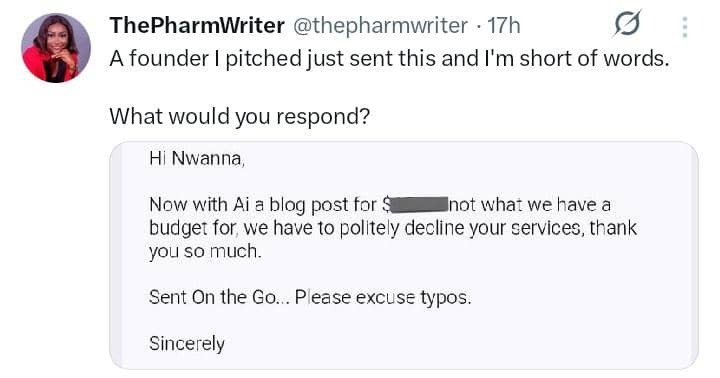
On the surface, the explanation sounds reasonable. Companies are under pressure to move faster and spend less. Artificial intelligence promises instant articles, captions, emails, and reports, often at a fraction of the cost of a human writer. To decision-makers chasing scale, the appeal is obvious.
But beneath the cost-saving narrative lies a deeper issue: many companies have reduced writing to output, not impact. Words are seen as filler for blogs, SEO checkboxes, or social media schedules. When writing is treated as volume rather than voice, replacing writers feels logical and the importance is not seen.
This mindset ignores a critical truth: writing is not just about producing text. It is about judgment, context, timing, and emotional intelligence. A brand voice is not a template, a social commentary is not a prompt and a statement is not a paragraph assembled by probability—they are feelings, ideas and emotions passed across through words.
Social Insight
Navigate the Rhythms of African Communities
Bold Conversations. Real Impact. True Narratives.
When companies stop hiring writers, what they are really saying is that they believe communication no longer needs depth, only speed and quantity. That belief may work in the short term, but it creates long-term damage: bland messaging, tone-deaf campaigns, and audiences that feel nothing.
Can AI Really Replace Writers?
This is the billion dollar question of the century, can AI Really Replace Writers?
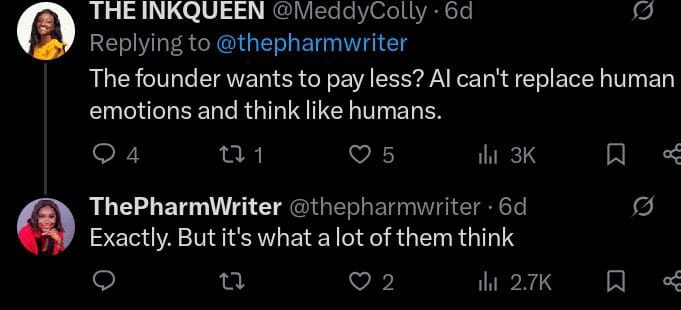
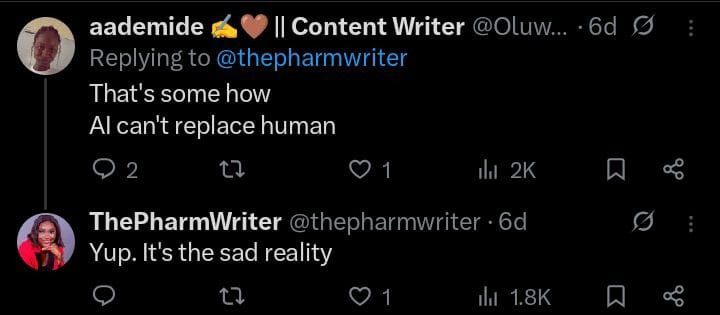
A recurring statement from a viral Twitter discussion captures the tension perfectly: “AI can’t replace human emotion or think like humans.” That sentence is not just laced with emotional panic, it is technical reality that we must all face and say the truth about.

AI does not understand loss, hope, fear, or ambition, it only recognizes patterns in how humans describe those things and follows those patterns—and those patterns might not work across different communities, environments and cultures and that distinction matters.
Writing that resonates is not assembled, like something that needs to be fixed or stacked together like a chair—it is felt and filtered through lived experience, relatable scenarios, cultural memory, and personal risk.
Can AI assist writers? Absolutely. It can summarize, suggest structures, generate drafts, and speed up research. But replacing writers entirely assumes that communication is mechanical. It assumes audiences do not notice when something feels hollow and it literally assumes trust can be automated.
Even brands that rely heavily on AI often still depend on human writers and editors to refine tone, catch cultural missteps, fully pass across the brand message and decide what should not be said. Machines do not understand consequences but writers do.
The irony is that many companies claiming AI has replaced writers are still editing AI-generated content extensively, dealing with backlash when it fails or even struggling with typo errors. Replacement, in practice, often looks more like dependency with denial.
What Happens When We Stop Valuing Writers?

If companies truly succeed in removing writers from the equation, the impact will extend beyond employment statistics. We will see fewer original ideas and more recycled language—more content, less meaning—louder messaging, weaker connection.
Writers are often the conscience of communication. They ask uncomfortable questions, they notice when messaging contradicts reality and they know and understand when silence is better than noise—removing them creates a vacuum where speed replaces thought.
Social Insight
Navigate the Rhythms of African Communities
Bold Conversations. Real Impact. True Narratives.
The question then becomes uncomfortable: Is this progress, or is it convenience disguised as innovation? And what will be the implication of this new order?
History suggests that societies that undervalue storytellers eventually lose clarity about who they are. Brands are no different because when every message sounds the same, differentiation disappears. When emotion is stripped out, loyalty fades and real connection is lost.
So no—writers are not obsolete. What is happening is a recalibration, companies are testing how far they can go without human insight and others—well they are trying to cut costs which might not be favourable in the long term. Most of them will learn quickly and others will learn after reputational damage.

The real future is not writers versus AI. It is writers who know how to think, feel, and use tools responsibly versus companies that mistake automation for understanding.
I'll just leave you with a question for you to ponder on: If no one is thinking deeply about the words we put into the world, what exactly are we building?