Unmasking You: The Hidden Power of Temperaments in Everyday Life
Ever wondered why some people thrive in chaos while others crumble under a hint of disorder? Or why one person’s calm feels like another’s frustration? Beneath every reaction lies temperament, the quiet rhythm shaping how we think, feel, and live. Understanding that rhythm might just change everything.

Mary woke up bright and early on a Saturday morning, determined to declutter her room. Weekends were for cleaning up, right?
She started, folding one shirt and then picking up a discarded book. However, along the way, she found herself trying on old outfits, scrolling through her phone, then obsessing over her jewelry for no reason at all. Two hours later, her room looked like a scene from a hurricane incident.
She looked around in shock, wondering how her room somehow ended up worse off than when she started. Still, she shook off her disappointment, grabbed her bag, and went to visit her friend, Anita, whose house was always spotless, and annoyingly so.
“How do you even stay this organized?” she asked incredulously. Anita just shrugged silently.
The simple answer is this: They aren't wired the same way.
How we react, how we feel, how we love, all of it traces back to temperament. This is an aspect of personality that includes emotional dispositions, intensity, and reactivity. It is more elemental, an unseen pattern that shapes our impulses and our hopes. Understanding this doesn’t excuse our faults and mistakes, but it gives clarity to the way we act and respond to every facet of life, and how we can work on ourselves to be better.
Temperament as Foundation
Brittanica refers to temperaments as an aspect of personality concerned with emotional dispositions and reactions and their speed and intensity; the term often is used to refer to the prevailing mood or mood pattern of a person.
Temperament involves biologically rooted tendencies in how we emotionally and behaviorally respond to situations, long before environment or choice steps in. It's the core wiring beneath personality traits. It is often visible even in infancy, and these traits grow in stability over time.
Some psychologists emphasize that temperament can also be partially inherited, interacting with our environment to form how we live.
The four temperaments basically refers to an ancient theory by a Greek physician Hippocrates and was expanded by Galen, suggesting that personality is determined by the balance of four bodily fluids, also known as humors, which are as follows: sanguine (cheerful due to excess blood), melancholic (depressive due to excess black bile), choleric (angry due to excess yellow bile), and phlegmatic (calm due to excess phlegm).
The ancient idea of these four temperaments remains significant, not because it’s perfect, but because it reveals patterns in our variety. They're lenses, helping us to see and read people properly, as each temperament has both strengths and blind spots. When we understand them, we begin to see why two people in the same room can feel worlds apart.
An Overview of the Four Basic Temperaments
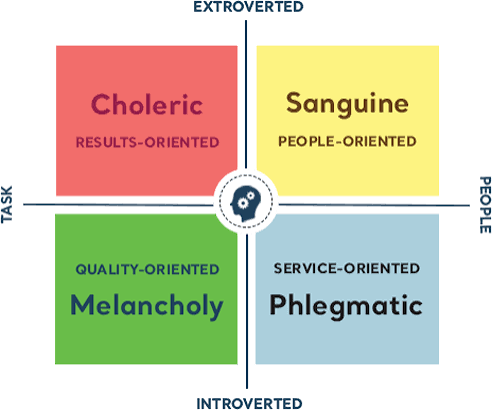
The Sanguine: This temperament can be described as cheerful, enthusiastic, optimistic, sociable, lively, charismatic, and spontaneous. From the old temperamental theory, it's linked to an excess of blood, associated with the element of air. Individuals with this personality trait are quick to get excited, often having flickering emotions, their reactions can also be shallow and superficial sometimes, though they are highly adaptable communicators.
The Choleric: This temperament can be described as ambitious, driven, decisive, self-confident, and goal-oriented. From the old temperamental theory, it's associated with yellow bile, the element of fire. Individuals with this personality trait are strong, and they possess lasting emotional reactions, they are strong-willed, assertive and sometimes aggressive, and they excel in new, goal-oriented environments.
The Melancholic: This temperament can be described as analytical, thoughtful, detail-oriented, sensitive, and introverted. From the old temperamental theory, it's linked to black bile, connected to the element of earth. Individuals with this personality react slowly but deeply, are very thoughtful, and often seek order and perfection.
The Phlegmatic: This temperament can be described as calm, diplomatic, patient, easygoing, and balanced. From the old temperamental theory, it's associated with phlegm, the element of water. Individuals with this personality have slow but shallow reactions, are good listeners, empathetic and adaptable, but can also be uncomfortable with conflict.
The Rhythm of Temperament
Temperament often features in our everyday life. It also influences how people respond to their daily environment and how long their reactions last.
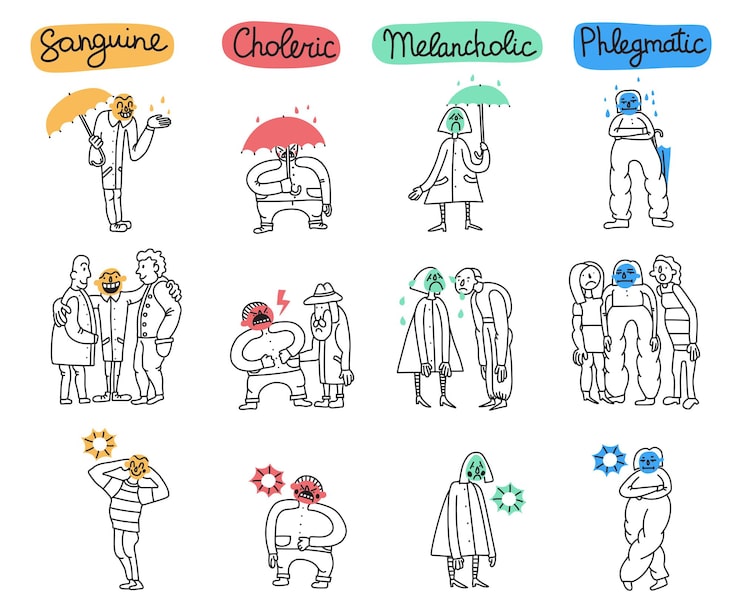
For example, in the morning, a sanguine may wake buzzing with possibility, feeling like he's been handed a fresh and beautiful start to life. A choleric on the other hand probably sees the morning’s tasks, and is just about ready to start his day so he can tackle them effectively.
In conflict scenarios, the melancholic individual will most likely shut down, retreating to properly process the situation, while the phlegmatic turns into the mediator, seeking peace and calm amongst both parties.
In times of rest, the sanguine needs connection even in rest, often finding rejuvenation in social gatherings, while the melancholic may crave solitude, finding social gatherings to be quite draining.
These patterns aren't to excuse behavior, but they explain it. And seeing one's nature and wiring helps to gain a road map to navigating everyday life as well as various relationships.
Temperaments in Work and Growth
Temperaments influence work and growth by shaping individual strengths, weaknesses, and how people interact in professional settings. Understanding one's main temperament and that of fellow colleagues can lead to better team dynamics, improved productivity, and personal growth through self-awareness and strategic development. Variations in temperament promote team equilibrium and harmony.
Temperaments are important for work and growth because they impact team dynamics, job satisfaction and individual growth. A good match between an employee's temperament and their job increases satisfaction, productivity, and performance.
Knowledge of one's temperament also aids in self-regulation by helping a person identify the areas in which to improve upon and pinpointing areas in which one already excels at.
Temperaments in Relationships
Understanding temperaments also transforms how we connect and relate with others, whether romantic, platonic or professionally. It helps to explain behavioral differences, improves communication, and guides conflict resolution.
Recognizing temperament patterns helps us interpret reactions instead of judging them. When we view people through this lens, we cultivate patience, empathy, and realistic expectations.
It is also a tool for self-awareness, you start to realize realizing not just how others function, but how to show up in love and friendships.
Ultimately, the advantage of figuring it out is that individuals can better understand differences in needs and expectations. This then leads to greater appreciation, reduced conflict, and smoother connection.

Living with Temperament, Not by It
At the end of the day, temperament isn’t a cage, it’s a compass. It reveals where strengths naturally lie and where more intention is needed.
To live with temperament is to embrace natural rhythm while still making room for change. The goal isn’t to erase one’s wiring and makeup but to refine it, allowing empathy to soften edges, discipline to steady impulses, and understanding to deepen connections.
When that balance is found, reactions give way to thoughtful responses, and temperament becomes not a limitation, but a quiet kind of strength.
And perhaps, in moments when chaos meets calm, what truly shows isn’t just personality; it’s growth in motion.